Germany is currently Ukraine’s most important partner and supporter. Both bilaterally and through its significant contribution to European Union funding, Germany’s direct and indirect budgetary, military, technical and humanitarian support has become decisive for Ukraine’s survival – especially since the United States cut its military aid by 99 per cent in 2025. At around €9 billion, Germany was the largest single provider of military aid to Ukraine in 2025, and its 2026 budget earmarks a record €11.5 billion for the country. Germany has also granted temporary protection to some 1.3 million Ukrainians since 2022.
However, this close German-Ukrainian relationship is a novel development and its future is uncertain. Until 2014, Berlin’s primary partner in Eastern Europe was Moscow. Until 2022, Berlin continued, in spite of the already ongoing Russian war, most of its energy cooperation with Moscow involving the two Nord Stream pipelines. Today, there are still many German voices arguing for a partial or even full restoration of friendly relations and economic ties to Putin’s Russia.
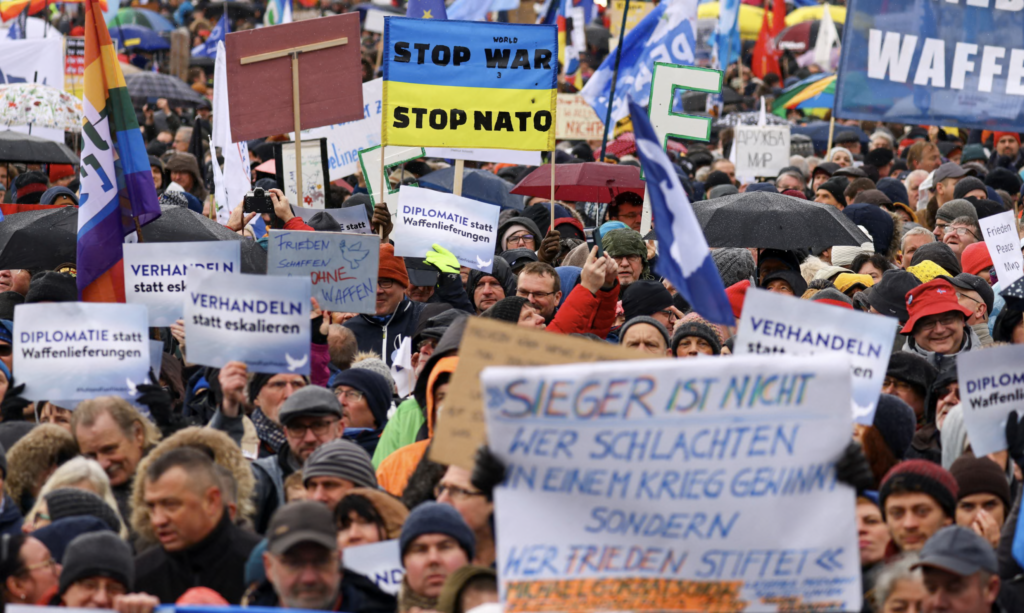
The 12-year political and intellectual debate about the so-called Ukraine war (Ukrainekrieg) and how to secure “peace in Europe” will enter the history books as a shameful episode in the history of reunified Germany. It is led today by the radical left-wing Sahra Wagenknecht Alliance (Bündnis Sahra Wagenknecht, BSW), which was renamed the Alliance for Social Justice and Economic Reason in October 2026, and the right-wing extremistAlternative for Germany (Alternative für Deutschland, AfD), along with a number of pseudo-pacifist public intellectuals. This vocal anti-war campaign has turned the idea of pacifism on its head.
Although Ukraine is an obvious victim of a military invasion that has escalated into a manifestly expansionist and partly genocidal war, the pro-Russian parties and their millions of followers argue that Ukraine does not deserve further German support. Under a veneer of pro-peace advocacy, hundreds of German politicians and public intellectuals are furthering the interests of an ultranationalist and neo-imperialist Russia, the leadership of which justifies its vicious assault and terrorist campaign against Ukraine by denying the very existence of a separate Ukrainian nation.
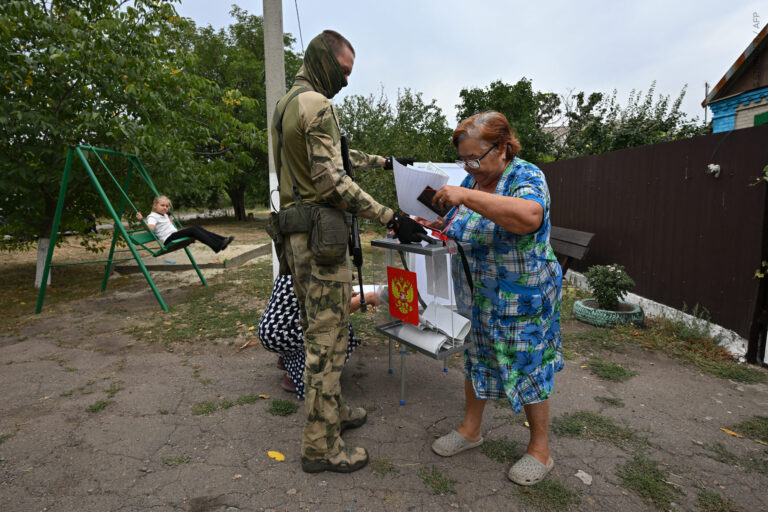
In spite of mounting evidence of Russian war crimes on an enormous scale, the recent rise of the AfD, now Germany’s most popular political party, has moved pseudo-pacifist ideas from the realm of public discussion into the field of political promotion. On 14 October 2026, the AfD and BSW factions of the newly elected state parliament of Saxony-Anhalt, which together hold 44 of the regional assembly’s 83 seats, called in a motiontitled “Peace Talks Instead of an Expansion of the War in Ukraine” for an end to Berlin’s military and non-humanitarian financial support for Ukraine, and to sanctions on Russia. This would, in their stated view, lead to a ceasefire and peaceful resolution of the conflict.
What these politicians and intellectuals present as a push for peace, however, would in practice at best result in a Russian victor’s peace (Siegfrieden) – if not something much worse. In the most benevolent case, it would mean Ukraine’s partial or full capitulation and the loss of further territory and/or sovereignty to Russia. In the worst-case scenario, a reduction of foreign aid for Ukraine’s self-defence would result in a successful Russian offensive deep into the Ukrainian heartland, and the expulsion, displacement, deportation, expropriation, incarceration, torture or annihilation of millions more Ukrainians.
To a limited extent, the first scenario is already unfolding as a result of other countries – most prominently the United States – withholding or withdrawing help from Ukraine. However, unlike a withdrawal by those other countries, Germany’s would push into the abyss a nation that less than 100 years ago was one of the biggest victims of Germany’s total war in Eastern Europe. In 1987, Holocaust survivor Ralph Giordano described early post-war West Germany’s reluctance to publicly discuss Nazi crimes and punish their perpetrators as Germany’s “second guilt”. The moral lapse of many modern-day Germans – including hundreds of influential politicians and intellectuals – may one day be remembered as a “third guilt”.
The Third Reich’s largest colony
Between 1941 and 1944, Ukraine was at the heart of Nazi Germany’s war of annihilation in Eastern Europe. As Timothy Snyder, then at Yale and now at the University of Toronto, told a conference in the German Bundestagin June 2017: “The purpose of the Second World War, from Hitler’s point of view, was the conquest of Ukraine”. Karel Berkhoff, of Amsterdam’s NIOD Institute for War, Holocaust and Genocide Studies, has called the Reichskommissariat Ukraine – the German occupation administration in much of today’s Ukraine – “the Third Reich’s largest colony”. Berkhoff’s seminal monograph, Harvest of Despair, on Nazi Germany’s rule in Ukraine, depicts a regime of terror that turned the country into something resembling a vast concentration camp. Its ruler, Reichskommissar Erich Koch, reportedly said: “If I meet a Ukrainian worthy of being seated at my table, I must have him shot”.
The various statistics on Germany’s Ukrainian victims are, depending on the counting method, divergent, yet uniformly staggering. According to the Encyclopedia of Ukraine, “more than 5,265,000 civilians and prisoners of war were killed” on Ukrainian territory, among them some 900,000 Ukrainian Jews. Altogether, Ukraine lost at least 8 million people in the Second World War, roughly one in five of its pre-war population of 41.7 million. In his above-mentioned Bundestag speech, Snyder asked why it is “not always remembered that 6.5 million inhabitants of Soviet Ukraine died as a result of German occupation”. More than 1.3 million Soviet prisoners of war died in camps on Ukrainian soil. Over 2 million Ukrainians were deported to the Reich as forced labourers. The occupiers also destroyed 714 towns and 28,000 villages, leaving about 10 million people homeless.
These and many other crimes by the Third Reich in Ukraine create lasting moral obligations. Germany’s popular post-war political slogan, “Never again!”, cannot just mean that never again must war be instigated by Germans. It must also mean that never again can there be indifference to the fate of a nation that Germany once tried to enslave and eradicate, and that is now the victim of another expansionist war of destruction.
Accordingly, on 9 October 2026, the Bundestag explicitly recognized Germany’s obligations by adopting a motion from the governing Christian Democrat and Social Democrat factions that confirmed Germany’s “special historical responsibility towards Ukraine”. A concurrent motion by the opposition Greens stated that “Germany bears a special historical responsibility for Ukraine and for peace in all of Europe”. While no parliamentary group voted against either motion, the Bundestag’s large AfD faction abstained on both.
“Peace” as a cipher for capitulation
It is not only the German extreme right but also Germany’s left-leaning self-declared “peace camp” that prefers to ignore or deny the dark episode in the history of German-Ukrainian relations and its implications for today. Instead, many Germans continue to feel an obligation to Russia, which was also a victim of the Nazi assault on the USSR during the Second World War. Snyder warned as early as 2017 that “Russian foreign policy regards the German sense of responsibility [for Germany’s crimes against Russians rather than Ukrainians] as a resource to be manipulated”. This is a mechanism that today’s pseudo-pacifists reinforce, knowingly or unknowingly.
Among other pseudo-pacifist appeals by prominent German public figures, in February 2023 the left-wing radical Sahra Wagenknecht and the feminist Alice Schwarzer published a “Manifesto for Peace”, which called on Germany’s Federal Chancellor “to halt the escalation of weapon deliveries”. At a subsequent rally in Berlin, Wagenknecht denounced the “endless war of attrition” supplied with “ever new weapons”, by which she clearly meant arms for Ukraine rather than Russia.
BSW’s Wagenknecht has since become more explicit in linking an end to German aid with an end to the war. Ahead of the Ukraine Recovery Conference in July 2025, she demanded that “no further German taxpayers’ money should flow for now” and that a peace conference should come first. On the campaign trail in Berlin in May 2026, she called it madness “that we squander billions upon billions to bribe Mr Zelensky and his clique”.
The AfD has multiple ties to Moscow and is therefore even more explicitly anti-Ukrainian. AfD co-chair Tino Chrupalla told the Bundestag in March 2023 that Germany should stay out, “because it is not our war”. In October 2026, the AfD’s other co-chair Alice Weidel told The Economist: “I believe it is wrong to continue funding a war that has already been lost”.
Parts of Germany’s artistic, literary and academic intelligentsia have paved the way. As early as April 2022, 28 writers, artists and scholars – among them the novelists Juli Zeh and Martin Walser, the filmmaker Alexander Kluge and the sociologist Harald Welzer – urged Germany’s then Chancellor Olaf Scholz not to deliver “directly or indirectly, further heavy weapons to Ukraine”. The political scientist Ulrike Guérot has described Ukraine’s self-defence as a Ukrainian proxy war for the United States. A former television correspondent, Gabriele Krone-Schmalz, who had earlier portrayed Russia’s 2014 annexation of Crimea as an act of self-defence, told the controversial newspaper Berliner Zeitung in September 2025: “Our democracy is not being defended in Ukraine”.
A treaty-breaker’s peace
The pseudo-pacifist rhetoric of these German anti-war activists ignores – deliberately or otherwise – what the Kremlin itself says, and so promotes a “peace plan” that would not end Russia’s war but instead reward expansionist aggression and could thereby extend it to other parts of Europe. Moscow has repeatedly and publicly demanded further surrenders of territory and sovereignty. It has also rejected or ignored Kyiv’s proposals for an unconditional ceasefire or for mutual moratoria on strikes against energy infrastructure and attacks in the Black Sea. Since 2022, Russian state media have regularly aired fantasies of annihilation. On 3 April 2022, RIA Novosti published Timofey Sergeytsev’s article, “What should Russia do with Ukraine?”, which called for the country’s “de-Ukrainization”.
Demands for a quick peace deal also betray political naivety in another sense. In the past 35 years, Moscow has broken almost all security agreements it has signed with Ukraine, Moldova and Georgia, some of them even ratified by Russia’s parliament. Chief among these are the 1991 Belovezha Accords dissolving the Soviet Union and confirming the Russo-Ukrainian inner-Soviet border as the new state border, the 1994 Russian-Moldovan troop withdrawal agreement, the 1994 Budapest Memorandum, the 1997 Russian-Ukrainian Friendship Treaty, the 1999 OSCE Istanbul Document, the 2003 Russian-Ukrainian border treaty, the 2008 Russian-Georgian ceasefire agreement, the 2014 Geneva Statement by the EU, the US, Russia and Ukraine, and the 2014 Minsk Protocol and 2015 Minsk Agreement.
In all of these agreements, Moscow promised to respect the inviolability of borders and/or to withdraw its unwanted regular or irregular troops from Moldova, Georgia and Ukraine. The Kremlin violated them all. Thirty years of impunity or light punishment for breaking the key provisions of these bilateral or multilateral agreements helped prepare the ground for Europe’s largest war since 1945.
Germany, of all countries, should know where the appeasement of and territorial concessions to an expansionist dictatorship lead. As Snyder put it in the Bundestag in 2017: “Germany cannot afford to get major issues of its history wrong”. The Germans’ own earlier war of aggression and genocide and their special historical obligations vis-à-vis the Ukrainian nation call for more German military and financial support for Ukraine’s self-defence, not less.