Executive summary
Ukraine is moving west faster than its infrastructure. Russia’s war has accelerated the country’s political, economic and demographic reorientation towards the European Union, but formal accession and political alignment are only part of this transformation. Integration must also take place of road and railway networks, border crossings, logistics, trade and regional cooperation, as well as the Ukrainian communities living in neighbouring EU member states.
This paper defines the transport, economic and human space that connects Ukraine through Zakarpattia with Slovakia and Hungary as the “Carpathian Corridor”. The idea is not to replace Poland as Ukraine’s principal land gateway. Its value lies in strategic redundancy. Political disputes could disrupt northern routes, while Russian attacks continue to threaten Odesa, the Danube ports and southern access. Its longer-term significance is even greater. The war is shifting Ukraine’s economic and demographic centre of gravity westwards, turning previously peripheral regions into centres of production, business relocation, logistics and labour demand.
Zakarpattia sits at the centre of this transformation. Mukachevo provides the principal gateway to Hungary, while Uzhhorod connects the region with eastern Slovakia. These branches are complementary but neither has received sufficient investment or political priority. Their development would serve interests on both sides of the border. Ukraine would gain more resilient access to European markets, while north-eastern Hungary and eastern Slovakia, which are among the least-developed parts of both countries, would gain transport links, investment and employment. Substantial railway and transshipment capacity already exists, but technical barriers, slow border procedures, weak coordination and difficult bilateral relations prevent this from functioning as an integrated corridor.
The Carpathian Integration Initiative could help Ukraine to develop the substantive neighbourhood policy that its westward transformation . Budapest and Bratislava are approaching the new format with caution, however, following repeated experiences of Kyiv neglecting agreed priorities and treating smaller neighbours as secondary. Consequently, both governments now prefer bilateral arrangements, established regional frameworks and EU instruments. Ukraine should respond with more institutional diplomacy, separate but connected project packages for the Hungarian and Slovak branches, an operational role for regional authorities and stronger links between infrastructure, customs reform, vocational education, recognition of qualifications and labour mobility.
The Carpathian Integration Initiative’s added value should be practical. It should coordinate existing mechanisms, resolve political obstacles and assemble a limited pipeline of bankable projects, including through Ukraine’s 2027 presidency of the Central European Initiative. If it succeeds, the Initiative can connect Ukraine’s emerging western economic centre with the EU’s underdeveloped eastern borderlands and become an infrastructure for European integration. If not, it risks becoming a persuasive regional idea whose publicity moved faster than its politics.
Institutional integration: mind the gap
Russia’s full-scale invasion accelerated a structural reorientation that had begun even before 2022. The war has shifted Ukraine’s economic, political and social centre of gravity decisively westwards. Trade has been redirected from Russia and other post-Soviet markets, millions of Ukrainians have moved to the European Union, and the country’s survival now depends on financial, military and logistical connections with Europe. EU accession is the political expression of this transformation but does not capture its full extent. A distinction must be made between institutional accession and structural integration into European transport networks, supply chains, labour markets, energy systems and regional institutions. The two processes reinforce one another but are not advancing at the same speed.
Ukraine completed the screening of its legislation in September 2025 and opened the first negotiating cluster in June 2026. The upgraded Deep and Comprehensive Free Trade Area entered into force in October 2025, providing a more stable framework for trade liberalisation and the alignment of Ukrainian product standards with those of the EU. Ukraine has also joined the Connecting Europe Facility and Common Transit Convention, while its principal transport routes have been incorporated into the Trans-European Transport Network. Practical integration is already taking place through railway standards, customs systems, border terminals and investment programmes, even as formal accession remains politically contested.
Ukraine’s western neighbours occupy a dual position in this process. As EU member states, their consent will be required at critical stages of accession. At the same time, they are Ukraine’s territorial gateways into the EU. Every land connection between Ukraine and the European economy passes through Poland, Slovakia, Hungary or Romania. These states consequently influence not only accession negotiations but also border development, railway investment, customs coordination, access to European transport networks and the movement of workers, businesses and goods.
Ukraine has historically concentrated its diplomatic attention on Washington, Brussels, Berlin and Paris, while relations with neighbouring states, apart from Poland, have received less sustained attention. However, developing physical connections with Europe requires continuous cooperation among ministries, customs and border services, railway companies, regional administrations and municipalities. The Carpathian Corridor underlines the resulting tension particularly clearly. Relations with Hungary and Slovakia have been difficult but Ukraine’s structural integration requires closer practical cooperation with both. Budapest and Bratislava, in turn, may contest elements of Ukrainian policy while retaining material interests in transit, energy connectivity, regional development and access to Ukraine’s reconstruction market.
Connectivity is already embedded in the accession process: Chapter 14 covers transport policy, market access, interoperability and safety; Chapter 21 covers trans-European transport and energy networks; Chapter 22 concerns regional policy and the capacity to use EU structural instruments; and Chapter 29 governs customs alignment and integration with the EU’s electronic customs environment. The European Commission’s 2025 assessment found that Ukraine had established the principal institutions responsible for EU integration but still needed stronger expertise, planning, inter-institutional coordination and participation by regional and local authorities.
These administrative weaknesses directly affect the corridor. Ukraine has adopted national transport and border infrastructure strategies, but the Commission found that administrative capacity and project preparation were insufficient. Responsibility is divided among the Ministry for Development, the State Agency for Restoration, Ukrzaliznytsia, customs and border authorities, regional administrations and local government. The problem does not rest with Ukraine alone. Hungary’s previous government subordinated potentially beneficial projects to its confrontation with Ukraine, while Slovakia’s fragmented administration and limited capacity to manage major EU-funded investments have also . Without permanent coordination, .
Customs demonstrates how institutions can reduce the effective capacity of otherwise adequate infrastructure. This is especially relevant in Zakarpattia, where legitimate cross-border commerce has long coexisted with smuggling networks and informal relations among businesses, customs officials, law enforcement bodies and political actors. Informal interests vested in regional policy-making have long been a limiting factors in implementing . Expanding border infrastructure without improving its governance could facilitate legitimate trade while creating additional opportunities for illicit flows and institutional capture.
Ukraine has been attempting to reform customs for at least two decades. A 2006 World Bank programme had already identified slow processing, smuggling and corruption as central problems. Repeated reorganisations have not produced a consistently professional and politically independent service. Estimates of the resulting losses are contested: one independent assessment put the cost of smuggling and grey imports at UAH 105–120 billion in 2024, while the State Customs Service reported that grey imports had fallen to 11.6 percent. The discrepancy reflects different methodologies and the absence of commonly trusted assessment criteria. Legislation adopted in 2024 introduced competitive selection for the customs leadership, staff recertification and stronger integrity provisions, but the appointment of a permanent head – an International Monetary Fund benchmark – was completed only in April 2026.
Nonetheless, there has been measurable progress since 2022. Ukraine has moved its legislation closer to the Union Customs Code, expanded its use of the Common Transit Convention and upgraded its computerised transit system. In the second quarter of 2025, customs processed almost 34,000 common transit declarations, compared with approximately 25,500 a year earlier, while the number of authorised economic operators doubled to 100 between August 2024 and August 2025. Mutual recognition with the EU has not yet been achieved, however, and staff shortages, fragmented IT systems and uneven enforcement continue to limit the benefits of digitalisation.
The EU side presents a different constraint. Hungary and Slovakia administer an external EU and Schengen border, where systematic checks and EU customs, security, veterinary and phytosanitary rules cannot simply be removed by bilateral agreement. Agricultural and food consignments requiring veterinary or phytosanitary inspection take an average of six hours and 38 minutes to process, excluding the queue outside the checkpoint. The objective must be faster and better-coordinated control rather than weaker control. Advance declarations, interoperable databases, coordinated inspections, trusted-operator lanes and common monitoring of total crossing times should be combined with staff rotation, electronic audit trails and joint anti-smuggling risk analysis.
The railway sector presents the same link between accession reform and practical integration. Ukraine still needs an independent regulator, a safety authority and an accident investigation body, as well as transparent access to infrastructure and clearer separation of infrastructure management from passenger and freight operations. The necessary legislation has been under discussion for more than a decade.
Reform is complicated by Ukrzaliznytsia’s role as both a critical wartime institution and a financially constrained state-owned company. It carried approximately 161 million tonnes of freight in 2025, which is 8 per cent less than in 2024 and close to half the 2021 volume, and reported a net loss of UAH 4.2 billion in 2024. Its estimated investment requirement to 2030 exceeds UAH 408 billion. Freight revenues have traditionally subsidised passenger services and infrastructure, but falling industrial production, Russian attacks and higher energy and repair costs have weakened this model.
Opening up the market without replacing this cross-subsidy could destabilise the railway, while postponing reform would deter private sector investment in locomotives, terminals, rolling stock and container services. Proposed freight tariff increases of up to 45 per cent in 2026 illustrate the tension between solvency and the competitiveness of Ukrainian industry. Ukraine needs transparent public service contracts, predictable infrastructure charges, separate accounting and non-discriminatory access before competition can deliver benefits. These conditions are especially important for the Carpathian Corridor, where physical capacity exists but is constrained by fragmented management and weak coordination among Ukrainian, Slovak and Hungarian operators.
Ukraine’s accession and neighbourhood policies are insufficiently connected. Kyiv has treated European integration primarily as a relationship with Brussels and leading European capitals, while border infrastructure has remained a technical or regional matter. Ukraine could adopt the EU acquis while remaining poorly connected to neighbouring member states. The Carpathian Corridor should become part of its accession strategy, translating enlargement into predictable borders, new commercial routes, better passenger connections and investment in peripheral regions on both sides of the EU frontier.
Underused corridor: capacity without connectivity
The Carpathian Corridor is often described as lacking transport infrastructure. This is only partly correct. Its road network is narrow and congested, but its railway connections and transshipment facilities are substantial. The real problems are limited interoperability and lack of commercial specialisation, as well as the institutional fragmentation of existing capacity.
The corridor follows a concentrated geography. The railway from Lviv crosses the Carpathians and continues through Mukachevo and Chop to Slovakia and Hungary, while the M-06 road follows a similar route before dividing near Uzhhorod. The Carpathians increase construction and maintenance costs and leave the corridor dependent on relatively few routes. However, the Beskyd Tunnel is no longer the principal bottleneck. In 2018, a new 1.8-kilometre double-track tunnel replaced the single-track section on the otherwise double-track electrified Lviv-Chop railway. Designed to transport up to 24 million tonnes of freight annually, it has removed local capacity constraints. The remaining vulnerability is the concentration of traffic along the Lviv-Chop road. Disruption to a bridge, power supply, signalling system or track would restrict access to both the Slovak and the Hungarian borders.
Ukraine has two railway crossings with Slovakia at Chop-Čierna nad Tisou and Pavlovo-Maťovce, and two principal crossings with Hungary, at Chop-Záhony and Batovo-Eperjeske. These are substantial facilities inherited from the Soviet-era integrated transport system. Čierna nad Tisou, Záhony and Eperjeske have extensive transshipment infrastructure, while the broad-gauge line through Maťovce extends into the Košice industrial area. Nonetheless, traffic through these crossings did not increase after 2022 as much as on the Polish and Romanian borders. Between January and July 2024, average monthly Ukrainian exports through Chop-Čierna nad Tisou and Pavlovo-Maťovce amounted to approximately 445,000 and 435,000 tonnes respectively. Estimated capacity utilisation was 50–70 per cent at the former and 70–80 per cent at the latter. Batovo-Eperjeske handled around 165,000 tonnes per month and Chop–Záhony only about 60,000 tonnes. Both Hungarian crossings operate below half their estimated practical capacity.
These figures nonetheless overstate the corridor’s versatility. In 2023, iron ore accounted for 85 per cent of Ukrainian freight exports through the two Slovak crossings. The terminals, rolling stock and operating practices are better suited to established bulk commodity flows than to containers, machinery, processed food or other higher value goods. The corridor has nominal spare capacity, but considerably less capacity adapted to Ukraine’s changing economy. The difference between Ukraine’s 1,520-millimetre railway gauge and the European standard 1,435-millimetre gauge is the most visible technical obstacle. Freight would have to be transhipped, have its bogies changed or continue over broad-gauge lines extending into Slovakia and Hungary. Each option will increase costs and require specialised equipment, storage and coordinated scheduling. The World Bank has identified related constraints, such as shortages of shunting locomotives, container equipment, specialised EU-compatible wagons and transshipment capacity for cargo other than ore. Paper documentation, inspections conducted on connecting tracks and incompatible operating procedures further reduce practical throughput.
The still-unrealised direct Kyiv-Košice passenger service illustrates how institutional coordination can be as important as physical infrastructure. Ukraine and Slovakia agreed in 2024 to develop a connection using the existing broad-gauge freight line through Maťovce to Haniska near Košice. The project would require passenger platforms, border control facilities, security arrangements and coordination among various Slovak institutions, but there has been no progress. An indirect Kyiv-Bratislava service involving a transfer at Chop has been introduced instead. This contrasts with Ukraine’s completion, in wartime, of the 22-kilometre standard-gauge line between Chop and Uzhhorod. Opened in September 2025, the line made Uzhhorod the first Ukrainian regional capital directly connected to the EU standard-gauge network. Electrification between Uzhhorod and Chop was completed in September 2026; the extension from Chop to the Hungarian border is scheduled for completion by the end of the year. The project cost UAH 1.3 billion, half financed by an EU Connecting Europe Facility grant. It allows direct passenger connections without a gauge change and has considerable practical and symbolic value. However, it is just a short border section. Freight from deeper inside Ukraine must still be transferred between gauges.
Faced with a choice between converting Ukraine’s entire railway network to European gauge or preserving the existing system, a European Commission-European Investment Bank (EIB) study instead proposed the phased development of a European-gauge backbone alongside the existing broad-gauge network. A subsequent Commission assessment estimated the cost of gauge conversion and interoperability investments in Ukraine and Moldova at around €15 billion, including approximately €3.5 billion for priority cross-border corridors. This would be in addition to the tens of billions of euros required to rehabilitate Ukraine’s existing railway infrastructure and rolling stock.
Investment is beginning to address some of these constraints. In September 2026, the EIB approved a Hungarian project to modernise freight and transshipment infrastructure at Záhony-Chop and Eperjeske-Batovo. Its estimated cost is €152 million, including €74 million in proposed EIB financing. The project is intended to upgrade tracks, install transshipment equipment, strengthen border security and accelerate railway procedures. Success, however, will depend on attracting new freight rather than restoring historical flows. Bulk commodities will continue to favour maritime routes where the Black Sea is available. The Hungarian terminals must compete for containers, machinery, automotive components, processed agricultural goods, construction materials and reconstruction-related imports.
Road transport faces the opposite problem. Rather than extensive facilities operating below capacity, heavy freight is concentrated at a small number of crossings. Uzhhorod-Vyšné Nemecké is the only Slovak crossing open to regular heavy trucks. Malyi Bereznyi-Ubľa began admitting vehicles of up to five tonnes in January 2026, but cannot provide an alternative heavy freight route. Passenger vehicles, buses and commercial trucks are concentrated at Uzhhorod-Vyšné Nemecké.
The Hungarian border has more road crossings but Chop-Záhony is the only one authorised for loaded trucks over 7.5 tonnes. Luzhanka-Beregsurány admits empty heavy trucks, while the smaller crossings primarily serve foot passengers and lighter vehicles. The opening of Velyka Palad-Nagyhódos in April 2025 added an estimated annual capacity for 73,000 cars and 220,000 pedestrians, but no additional heavy freight route. Consequently, road freight remains vulnerable to disruption at Chop-Záhony. The Hungarian priority has long been the Berehovo-Mukachevo connection, including completion of the Berehovo bypass and access to Hungary’s M3 motorway network. The bypass project dates to 2006–2007. Budapest allocated €50 million for the bypass and upgrade of the Berehovo-Mukachevo road in 2016, but these projects been repeatedly postponed. Completing them would connect Mukachevo’s railway and industrial capacity with north-eastern Hungary and provide the road network necessary for a functional Hungarian gateway.
The EU and European financial institutions have mobilised more than €2.8 billion for the Solidarity Lanes, including €1.55 billion in non-repayable Connecting Europe Facility grants. The corridor’s main problem is the difficulty converting investment into reliable transport services. Additional tracks or lanes will be of limited use without compatible equipment, predictable customs procedures, adequate staffing and coordination with private sector logistics operators.
Thus, the Carpathian Corridor exists but its components do not yet function as an integrated system. Its performance should be measured by transit time, predictability, cargo diversity, terminal efficiency and the ability to reroute traffic when individual nodes are disrupted. Its development will require parallel investment in infrastructure, interoperability, border administration and commercial services. Without such coordination, the Corridor will continue to perform below its strategic and economic potential.
Zakarpattia: from borderland to strategic gateway
Russia’s full-scale invasion fundamentally changed Zakarpattia’s economic and geopolitical position. Before 2022, it was generally regarded as a peripheral and comparatively deindustrialised part of Ukraine, dependent on tourism, remittances, labour migration and cross-border trade, including smuggling. The war has turned some of the region’s apparent disadvantages into strategic assets. Its distance from the front, borders with four EU and NATO member states and proximity to Central European markets have made it an increasingly important location for relocated production, logistics and investment.
This transformation forms part of a wider westwardshift in Ukraine’s economic geography. Lviv has consolidated its role as the principal hub for Polish exports, while Chernivtsi is emerging as a gateway to Romania. Zakarpattia could perform a comparable function for Hungary and Slovakia, with Mukachevo serving as the principal gateway to Hungary and Uzhhorod to eastern Slovakia. Developing these complementary branches would connect western Ukraine’s expanding productive base with neighbouring EU regions that have long struggled to attract investment.
Business relocations provide the clearest evidence of change. As of February 2026, 407 relocated companies had been registered in Zakarpattia, employing 13,284 people. Although the numbers vary as companies register, move or cease operations, the scale confirms the region’s importance to Ukraine’s wartime economic geography. In 2025, relocated companies paid approximately UAH 1.17 billion into local budgets, compared with UAH 92 million in 2022. Relocation has also broadened the region’s industrial base. New activities include metalworking, transport equipment, industrial filtration systems, modular housing, electronics, wind turbine components, glass processing, pharmaceuticals and cosmetics. At the end of 2025, Zakarpattia had 12 registered industrial parks, making it one of Ukraine’s leading regions by number of designated industrial sites.
The structure of the region’s trade demonstrates both its potential and its imbalance. The value of Zakarpattia’s merchandise trade was approximately $3.07 billion in 2024, including $1.45 billion in exports. Machinery and electrical equipment generated almost half of all exports. Hungary received approximately 43 per cent of the region’s exports, while Slovakia accounted for only 2.3 per cent. This contrast reflects the deeper integration of Zakarpattia into Hungarian production and trade networks, but also the unrealised potential of the Slovak connection.
The wartime boom is also generating new constraints. Vacancies in Zakarpattia were already 55 per cent above their pre-war level in early 2024, while construction, manufacturing, logistics and services expanded across western Ukraine. Labour shortages have since become a central concern for regional employers. Across Ukraine, almost 60 per cent of companies surveyed in 2024 identified shortages of skilled workers as their main operational challenge. Zakarpattia faces a particularly difficult combination of mobilisation, displacement, demographic decline and decades of labour migration. Its system of vocational education was designed for a poorer region that exports labour, not for an industrial and logistics centre competing for technicians, machine operators, engineers and construction workers. In February 2025, the regional administration brought six vocational schools and nine companies into a partnership intended to adapt training to employers’ needs. Such programmes will have to expand if relocation is to produce durable industrial growth.
Regional officials also report that some workers from eastern Slovakia have taken temporary jobs in Zakarpattia, particularly in . This should be interpreted not as evidence that average wages in the region have overtaken those in Slovakia, but as a localised response to acute demand in particular occupations. Nonetheless, it shows how economic relations across the border could become more reciprocal, especially through joint training, recognition of qualifications and circular labour mobility.
Connectivity will determine whether the relocation boom becomes permanent. The standard-gauge line between Chop and Uzhhorod, which opened in September 2025 and was electrified a year later, was an important breakthrough. Its wider economic effect will depend on reliable services, new terminals and industrial sidings, and effective connections with the Ukrainian broad-gauge network.
Road connectivity is more constrained. A pedestrian crossing point at Uzhhorod-Vyšné Nemecké opened in January 2026, improving local mobility but not heavy freight capacity. The proposed Solomonovo-Čierna nad Tisou road crossing would connect Zakarpattia with the Slovak intermodal terminals at Čierna nad Tisou and Dobrá, reducing dependence on Uzhhorod-Vyšné Nemecké. Despite having been on the bilateral agenda for many years, it is still at the study and coordination stage.
Ukrainian officials describe cooperation with Slovakia as procedurally dense and operationally slow. There are task forces and working groups, but implementation is divided among ministries, . Slovakia’s coalition politics have also complicated coordination and the use of available European funding, while support for Ukraine remains politically sensitive for the .
Political economy: from peripheries to prosperity
Importantly, the Carpathian Corridor serves concrete interests on both sides of the border. Ukraine needs diversified access to EU markets as its western regions become its principal economic, demographic and logistical rear. North-eastern Hungary and eastern Slovakia need investment, transport links and employment. The regional incentives for cooperation are therefore stronger than relations among the three capitals might suggest.
Hungary already has a deeper economic relationship. It received approximately 43 per cent of Zakarpattia’s exports in 2024 and Budapest supported railway and border investments even during periods of political confrontation. Ukraine’s adoption of minority-education legislation in October 2026 removed Hungary’s principal stated bilateral objection and enabled the opening of two additional EU negotiating clusters, although Budapest continues to obstruct opening the remaining clusters. The Velyka Palad-Nagyhódos passenger crossing opened in April 2025, and Luzhanka-Beregsurány began to admit empty heavy trucks. In September 2026, the EIB approved a €152 million modernisation of the Záhony-Chop and Eperjeske-Batovo railway and its transshipment infrastructure. Mukachevo, the Berehovo road connection and access to Hungary’s M3 motorway form the economic core of this branch.
Slovakia’s commercial relationship with Zakarpattia is much smaller, but its potential marginal gains are considerable. Better connections among Uzhhorod, Michalovce and Košice could generate traffic, investment and employment in eastern Slovakia. The unrealised Kyiv-Košice passenger service and slow progress on new road capacity show that comparatively better political relations do not automatically improve implementation. For Bratislava, cooperation is most persuasive when presented as an eastern Slovak development strategy rather than assistance to Kyiv.
None of the above constitutes an alternative to the Polish Corridor, which will remain Ukraine’s largest and best-developed western gateway. The objective is diversification: stronger Hungarian and Slovak branches would reduce exposure to disruption along any single route while connecting Ukraine’s fastest-changing regions with comparatively underinvested EU borderlands. The same political-economic logic applies to northern Romania.
Zakarpattia is consequently moving between two economic models. The old model exported workers and depended on remittances and informal border trade; the emerging one attracts businesses, investment and labour but requires infrastructure, vocational skills and access to European supply chains. If both branches are developed, the region could become the principal junction of the Carpathian Corridor and a place where European integration becomes an economic reality before accession is completed.
Carpathian rhapsody: from political launch to delivery
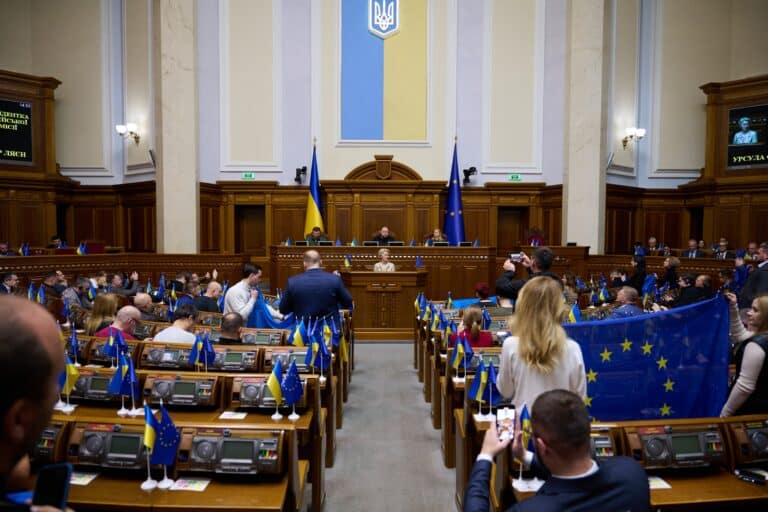
The launch of the Carpathian Integration Initiative in September 2026 captured the strengths and weaknesses of Kyiv’s regional diplomacy. Its strategic logic is compelling. Russia’s war has increased the importance of Ukraine’s western regions, alternative trade and energy routes and cross-border infrastructure, while EU accession requires closer structural integration with neighbouring EU member states. However, the launch was rushed, and the initiative was presented as an established political format before all its prospective participants had agreed to join.
Kyiv initially promoted the “Carpathian Eight” as bringing together Ukraine, Poland, Slovakia, Hungary, Romania, Czechia, Austria and Serbia, with EU participation. In practice, the summit declaration was signed by Ukraine, Austria, Poland, Romania, Serbia and Slovakia. Czechia participated without signing, while Hungary sent its chargé d’affaires but rejected Kyiv’s presentation of the country as a member. The initiative began with uncertain boundaries between signatories, participants and prospective members.
The summit demonstrated considerable convening power. Kyiv announced more than 50 agreements worth over €1 billion. Around half of the investment portfolio is related to renewable energy. The declaration connected regional infrastructure and economic cooperation with EU enlargement, Interreg, European Groupings of Territorial Cooperation and the possible creation of an EU macro-regional strategy for the Carpathians. It also called for modern border infrastructure, closer energy links and integration of both branches the Corridor into European networks.
The Carpathian Integration Initiative is a response to a genuine structural transformation. Russian attacks against Odesa, the Danube corridor and Ukraine’s internal infrastructure make diversification a matter of national resilience. It also seeks to connect Ukraine to Via Carpatia, the Three Seas Initiative and the EU’s TEN-T network rather than leave the country merely abutting the transport corridors developing along its western frontier. It can give Kyiv greater influence over this process, attract EU financing and position western Ukraine in an integrated European macro-region. The actual value, however, will depend on whether it improves delivery through existing bilateral, regional and EU mechanisms rather than duplicating them.
The problem at Bukovel was not the initiative’s premise, but the gap between ambition and preparation. Membership had not been settled, the relationship with existing organisations remained unclear and the announced investment portfolio was not yet a coordinated programme of bankable . Kyiv’s emphasis on political presentation created visibility but also avoidable disputes. Ukraine’s 2027 presidency of the Central European Initiative (CEI) offers an opportunity to connect the Carpathian agenda with an established secretariat and membership, rather than construct another unsupported bureaucracy.
Hungary provides the clearest warning. Budapest should be treated as an invited prospective member while bilateral negotiations continue, not presented as a participant without its explicit consent. Its eventual involvement will depend on gradual political normalisation and on whether the Corridor advances the infrastructure and regional development priorities Hungary is already pursuing through .
Slovakia signed the declaration and has clear interests in stronger connectivity but is sceptical about creating another regional framework. Slovak officials argue that existing mechanisms should be used first, such as the Slovak-Polish-Ukrainian Initiative in . They also caution that an EU macro-regional strategy would probably reallocate rather than create resources under the 2028–34 Multiannual Financial Framework. As a candidate country, Ukraine should also draw on wider proposed instruments, such as Global Europe and its prospective Ukraine Reserve. The figures currently discussed – €215 billion for Global Europe and €100 billion for the reserve – are proposals rather than .
The Initiative also has a human dimension. As of August 2026, almost 150,000 displaced Ukrainians had been given temporary protection in Slovakia and around 46,000 in Hungary. Rather than simply temporary humanitarian populations, their language skills, employment, education, businesses and links with communities inside Ukraine make them part of the corridor’s economic and social infrastructure. A functioning strategy should support recognition of qualifications, vocational and university partnerships, cross-border employment services, Ukrainian entrepreneurship and circular mobility. Physical connectivity will have only limited developmental effects if businesses cannot find workers or qualifications are difficult to transfer.
Making the corridor work: conclusions and recommendations
Russia’s war has made western Ukraine the country’s principal economic, demographic and logistical rear. Business relocations, population movements and the growing importance of land routes are creating a new centre of production, labour demand and European connectivity beside some of the EU’s least-developed regions: eastern Slovakia, northeastern Hungary and northern Romania. The Carpathian Corridor can connect Ukraine’s need for secure access and productive capacity with its neighbours’ needs for investment, infrastructure and employment.
The corridor already has substantial railway and transshipment capacity, but technical barriers, slow border procedures and weak political coordination prevent it from operating as an integrated system. Mukachevo is the principal gateway to Hungary and requires better road access through Berehovo to Hungary’s motorway network. Uzhhorod is the gateway to Slovakia and requires greater border capacity and stronger connections with Michalovce and Košice.
The Carpathian Integration Initiative is one possible delivery mechanism, but not a substitute for bilateral cooperation or existing EU instruments. It will add value only if it coordinates these efforts, resolves political obstacles and converts attention into a limited number of implementable projects.
To Ukraine
- Incorporate the Carpathian Corridor into EU accession, reconstruction and regional development planning so that infrastructure and institutional reforms reinforce one another.
- Treat Mukachevo-Hungary and Uzhhorod-Slovakia as complementary gateways and give Zakarpattia an operational role in project selection and implementation.
- Combine construction with customs reform, vocational education, recognition of qualifications and safeguards against corruption, smuggling and institutional capture.
To Hungary, Slovakia and Ukraine
- Agree a small project pipeline with named implementing authorities, financing plans, deadlines and measurable results.
- Prioritise the Berehovo-Mukachevo road and Hungarian motorway connection; the Záhony-Chop and Eperjeske-Batovo railway facilities; expansion of Uzhhorod-Vyšné Nemecké; the Solomonovo-Čierna nad Tisou crossing; and improved rail connections to Košice and road connections to Michalovce.
- Give regional authorities, infrastructure managers, customs agencies and private logistics operators a direct role in implementation.
To the EU and international financial institutions
- Organise CEF, TEN-T, Interreg, the Ukraine Investment Framework, and EIB and European Bank for Reconstruction and Development financing around a coherent cross-border programme.
- Fund joint feasibility studies, coordinated border procedures, and vocational and labour market cooperation alongside physical construction.
- Use the Carpathian Initiative and Ukraine’s 2027 CEI presidency to coordinate existing instruments, recognising that a new macro-regional strategy would not itself create additional EU resources.
The Carpathian Integration Initiative was launched as a political rhapsody: strategically relevant but improvised and structurally loose. Its future depends on whether Kyiv can build ownership with its neighbours rather than merely claim leadership of the regional agenda. If it succeeds, the Carpathian Corridor can turn western Ukraine’s wartime transformation into a shared European development project. If it does not, the initiative will remain a persuasive idea whose publicity moved faster than its politics.