The plateauing of Russia’s military strategy in Ukraine
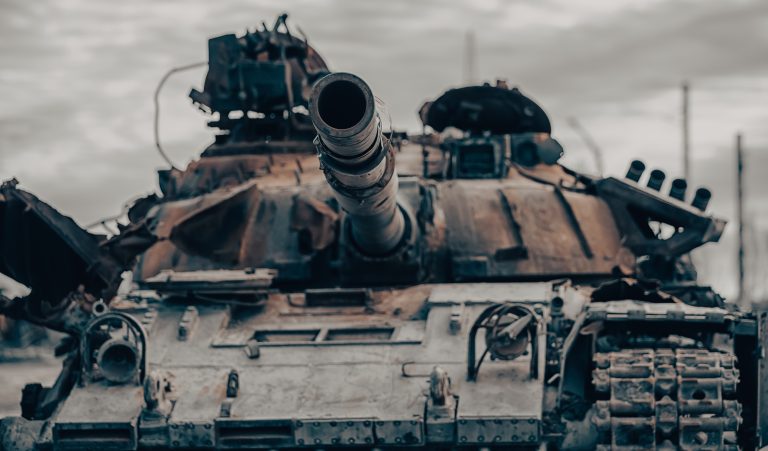
Russia’s battlefield strategy in Ukraine has plateaued and, if nothing radically changes, Russia cannot expect any significant progress on the battlefield in 2026.
Mykola Bielieskov
Policy briefs
Robots take the risk: Ukraine’s UGV ecosystem and what Europe should learn from it
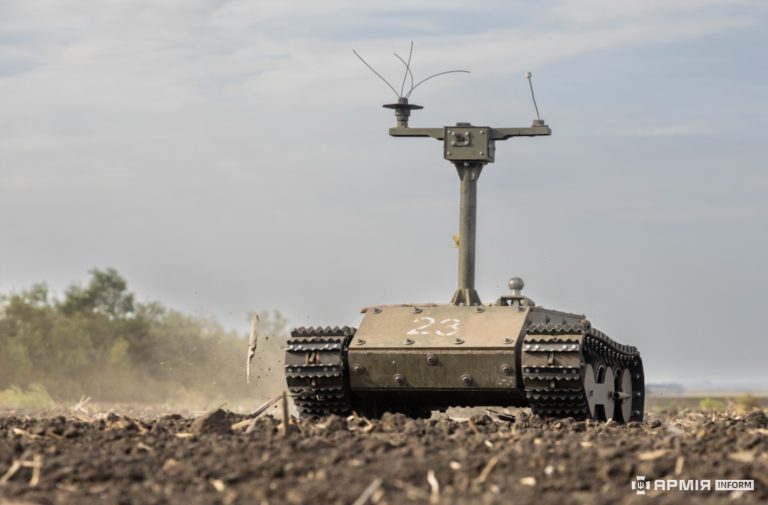
Ukraine has systematically removed humans from roles that don’t require human judgment, letting machines absorb the danger soldiers would otherwise face. What UGVs can and can’t do, and what lessons European institutions can draw from Ukraine’s experience.
The day after: Six post-war challenges for Ukraine
A ceasefire is nowhere in sight. Putin sees no interest in ending his war. Even so, the EU should start preparing for the many post-war challenges Ukraine will face.
Oleksandr Kraiev
Andreas Umland
Policy briefs
Failure is not an option: the EU’s essential role in securing Ukraine’s future
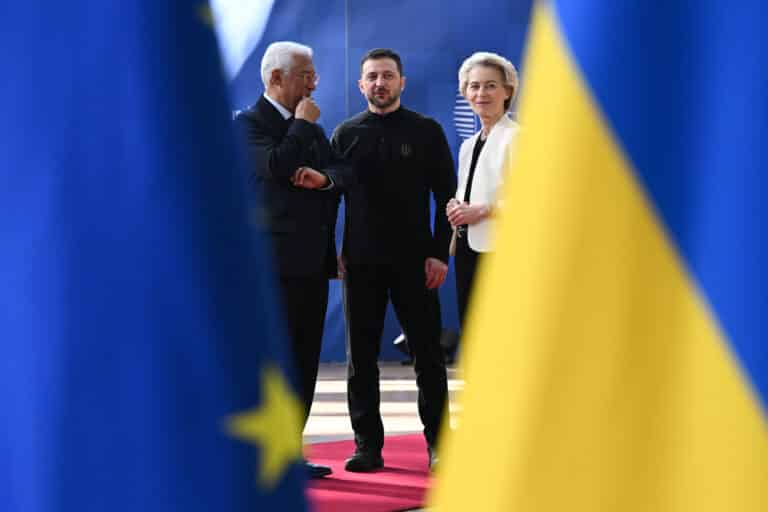
Four scenarios for Ukraine’s future after 2027: from continued war to a lasting peace deal, and what role the EU must play in each
Membership First or Accession Treaty First? How to revive EU enlargement
The European Union’s accession promise loses credibility if it continues to keep the most significant benefits of accession until the end of the process. Its two political options for bringing membership forward – Membership First and Accession Treaty First – must both pass the same four tests.
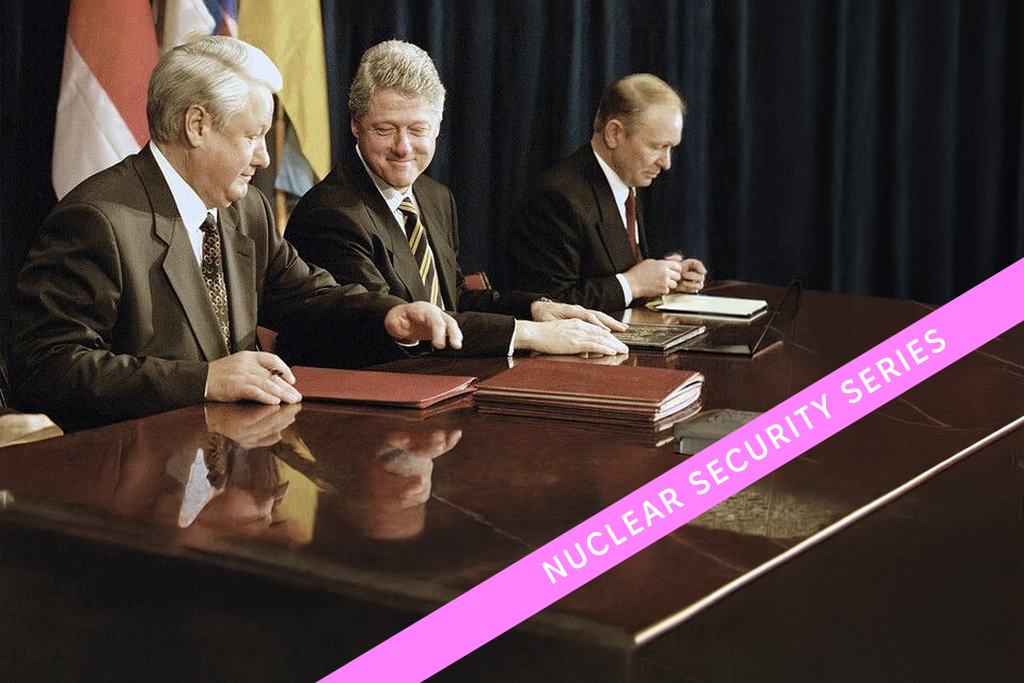
Photo: Russian president Boris Yeltsin, left, and US president Bill Clinton, middle, bump elbows after the signing of the Budapest Memorandum with Ukrainian president Leonid Kuchma on the far right and British prime minister John Major, not in the photo, on 5 December 1994. Photo credit: Greg Gibson, AP Photo.
It cannot be stressed enough that without Ukraine, Russia ceases to be an empire, but with Ukraine suborned and then subordinated, Russia automatically becomes an empire. Zbigniew Brzezinski, Strategic Vision: America and the Crisis of Global Power
On 5 December 1994, on the sidelines of the summit of the Conference on Security and Cooperation in Europe (CSCE) in Budapest, Hungary, the heads of state of Ukraine, the United States, the United Kingdom, and the Russian Federation signed what would become known as the Budapest Memorandum. The full name of the document was “Memorandum on Security Assurances in Connection with Ukraine’s Accession to the Treaty on the Non-Proliferation of Nuclear Weapons” and it became the final stroke in a deal, negotiated over the preceding two and a half years, to settle the question of nuclear weapons inherited by newly independent Ukraine from the defunct Soviet Union.
Outside of Ukraine and the people who were directly involved in the negotiation and signing of the Budapest Memorandum, its conclusion went largely unnoticed. The CSCE Budapest summit itself was overtaken by the transformation of the Conference into a more permanent Organization for Security and Cooperation in Europe (OSCE) and the announcement by US president Bill Clinton that the United States would support NATO enlargement to Eastern Europe.
Following its signature, the Memorandum lay dormant for two decades, until it reemerged into public awareness and political significance in February 2014. At that time, one of the signatories of the Memorandum, the Russian Federation, sent unmarked troops to Ukraine’s Crimean peninsula to carry out a military takeover, promptly followed by an illegal annexation. Such Russian actions were in blatant violation of its commitments under the Memorandum to respect Ukraine’s sovereignty and existing borders (Article 1), as well as to refrain from the threat or use of force against the territorial integrity or political independence of Ukraine (Article 2).
Ukraine promptly called for consultations provided for in Article 6 of the Memorandum. Ukraine’s foreign minister Andriy Deshchytsia, US secretary of state John Kerry, and UK foreign secretary William Hague, representing three out of the four signatories of the Memorandum, convened in Paris on 5 March 2014. Russia’s foreign minister Sergei Lavrov boycotted the meeting, despite being in Paris at the time. The consultations yielded a statement stressing that “Ukraine voluntarily surrendered the world’s third largest nuclear weapon arsenal in exchange for… assurances” pledged in the Memorandum, condemning Russia’s actions, and warning that “Russia’s continued violation of Ukraine’s sovereignty and territorial integrity can only degrade Russia’s international standing and lead to greater political and economic consequences.”
The March 2014 meeting was the first and, thus far, the only time the consultations under the Memorandum were convened, despite the ever-increasing Russian military threat to Ukraine, which ultimately culminated in Russia’s full-scale invasion of Ukraine on 24 February 2022. Ironically, the Budapest Memorandum became much more famous, or rather infamous, once it was violated than in the two peaceful decades after its signature. In Ukraine, the Memorandum itself and the decision to surrender nuclear weapons came under much public scrutiny and have been held responsible for exposing the country to undeterred Russian aggression.
The history of Ukraine’s nuclear disarmament and the signature of the Budapest Memorandum are far more complex than their treatment in public discourses. Furthermore, the consequences of Ukraine’s disarmament decision and of Russia’s violation of security commitments pledged in connection with it go far beyond the borders of Ukraine. At stake is the robustness and credibility of the nuclear nonproliferation regime and the role of international agreements, rules, and norms more broadly. The lessons are still in the making and will depend, to a great extent, on the outcomes of the Russo-Ukrainian war.
Born nuclear
As a constitutive part of the Soviet Union, the world’s largest nuclear power possessing over 30,000 nuclear weapons at the end of the 1980s, Ukraine played a significant role in Soviet military planning and deployments, both in conventional and nuclear domains. When the Soviet Union disintegrated in 1991, Ukraine overnight became home to some 5,000 nuclear weapons, over 1,200 strategic nuclear warheads for intercontinental ballistic missiles, over 600 nuclear-tipped cruise missiles for strategic bombers, and nearly 3,000 tactical nuclear weapons. To put this arsenal in perspective, today, France possesses 290 nuclear weapons, the United Kingdom – 225, and China, after a recent aggressive buildup of its nuclear forces, is now believed to possess 600 nuclear weapons.
This staggering nuclear inheritance – as well as that of Belarus and Kazakhstan, the other non-Russian Soviet nuclear inheritors – instantly became the subject of much proliferation anxiety and a primary focus of US foreign policy towards the newly independent states. That Russia should emerge as the only nuclear successor of the USSR and succeed it in the UN Security Council and as a recognised nuclear weapon state under the Treaty on the Non of Nuclear Weapons (NPT) was a matter of a broad-based international consensus. The United States quickly formulated a policy that no more than one nuclear state should emerge from the Soviet collapse and that it expects Ukraine, Belarus, and Kazakhstan to relinquish nuclear weapons on their territories and join the NPT as non-nuclear weapon states.
At the time, the nuclear disarmament of Ukraine came as a reasonable and realistic expectation. Throughout the 1970s and the 1980s, non-proliferation policy became ingrained into US grand strategy, and Washington expended effort to dissuade many countries, including some of its allies, from acquiring their own nuclear weapons. With the end of the Cold War, the international nuclear Zeitgeist shifted decidedly in favour of nuclear reductions and diminishment of the salience of nuclear weapons in world politics. In 1991, South Africa joined the NPT after dismantling its indigenous nuclear programme. The two nuclear superpowers, the United States and the USSR that together possessed over 90 per cent of the world’s nuclear weapons, signed a seminal arms reduction treaty – START – on 31 July 1991, that would slash their arsenals by nearly half. The NPT was going into its 1995 NPT Review and Extension Conference, and the United States and its allies were determined to extend the treaty indefinitely, cementing its role as a keystone in international non-proliferation architecture.
Ukraine itself entered its independent statehood with a declared preference to become a non-nuclear state. On 16 July 1990, nearly a year and a half before the Soviet Union ceased to exist, the Ukrainian parliament adopted the Declaration of State Sovereignty, a founding document that outlined a vision of Ukraine’s independent statehood. Article IX of the Declaration stated that “Ukraine solemnly declares its intention to become in the future a permanently neutral state that does not participate in military blocs and abides by three non-nuclear principles: not to receive, manufacture or acquire nuclear weapons.” The reasons behind this unilateral nuclear renunciation were two-fold: the deep anti-nuclear sentiment caused by the 1986 Chornobyl accident; and the desire to disentangle itself from Moscow, which oversaw, in a strictly centralised and secretive manner, all military matters, especially those pertaining to the Soviet nuclear arsenal. The authors of the Declaration believed that without severing military tethers binding Ukraine to Moscow, the country could never truly become independent.
The Soviet collapse and Ukraine’s independence happened more precipitously than anyone imagined, however. After an ill-conceived and short-lived coup staged by Soviet conservatives in August 1991, the Soviet empire rapidly faded into history. By December 1991, political authority shifted to the capitals of constitutive Soviet republics, with Moscow now a capital of the newly independent Russian Federation, which promised to relinquish its imperial ambitions and, in the words of Russia’s first president Boris Yeltsin, become an “equal among equals.” Meanwhile, the Soviet Union’s gargantuan conventional military would be divided between former Soviet republics, essentially based on existing deployments, with officers choosing which new country they wanted to serve. The nuclear part of the Soviet military inheritance, however, fell under a different set of rules: the former Soviet republics decided to preserve unified command and joint control over the vast strategic nuclear arms complex that was now situated on the territory of four sovereign states, until the non-Russian successors disarm.
Mariana Budjeryn, Inheriting the Bomb: The Collapse of the USSR and the Nuclear Disarmament of Ukraine (Baltimore, MD: John Hopkins University Press, 2023), 34–36.
James Baker A. and Thomas DeFrank M., The Politics of Diplomacy. Revolution, War and Peace, 1989-1992 (New York: G.P. Putman & Sons, 1995), 525–26.
James Baker A. and Thomas M. DeFrank, The Politics of Diplomacy. Revolution, War and Peace, 1989-1992 (New York: G.P. Putnam & Sons, 1995), 525–26.
Hans Kristensen et al., “Status of World Nuclear Forces,” Federation of American Scientists, 26 March 2025, https://fas.org/initiative/status-world-nuclear-forces/.
Security and guarantees
While Ukraine remained committed to nuclear disarmament, as stated in its Declaration of Sovereignty, its position concerning the fate of its nuclear inheritance gained much more nuance when the country stepped into its independent statehood. To begin with, Ukraine-Russia relations became riddled with tensions already in 1992, over Russian territorial claims to Crimea and the division of Soviet assets, including the Black Sea Fleet and the strategic nuclear forces. Underlying these tensions was Russia’s unwillingness to fully accept Ukraine’s independence. Reporting for the Wall Street Journal at the time, Anne Applebaum recounted how in the early 1990s Russian diplomats told their western counterparts not to bother establishing diplomatic relations with Ukraine because its sovereignty is bound to be short-lived.
In addition, Ukraine encountered a reluctance by the United States and other western interlocutors to regard Ukraine as entitled to a voice in nuclear matters. Decades of relations with Moscow and the perennial conflation of the USSR and Russia left the West blind to the non-Russian parts of the Soviet Union, which in 1991 suddenly became international actors in their own right. Ukraine found itself having to insist that, even though it intended to disarm, it was a legal successor to the USSR on a par with Russia and that it had rightful and legitimate claims to its share of the Soviet inheritance, including the nuclear component.
While the tactical nuclear weapons were transferred out of Ukraine hastily by the former Soviet military loyal to Moscow by May 1992, before any negotiations could transpire, the strategic nuclear arms remained in Ukraine with operational control still in the hands of Moscow. Ukraine’s capacity to establish direct control over nuclear forces on its territory remains a matter of debate. Whatever it might have been, there is no doubt that Ukraine’s nuclear inheritance extended well beyond the deployed weapons and included elements of the Soviet nuclear enterprise, research, and know-how that would have amounted to a generous proliferator “starter package” for any country that decided to pursue a nuclear option.
Ukraine, however, maintained its commitment to disarm, and the voices that argued otherwise were marginal in Ukraine’s political sphere. What Ukraine wanted was a fair deal and a way to provide for its security after relinquishing a strategically important asset. In April 1992, Ukraine’s parliament formulated a demand that Ukraine’s disarmament would be conditional on financial compensation as well as security guarantees to Ukraine from nuclear states. This was not an outrageous demand. Indeed, it was the overwhelming focus of the United States on nuclear matters, to the detriment of other issues that were deeply important to Ukraine, such as mitigating a severe economic crisis and building democratic institutions, that contributed to elevating the value of its nuclear inheritance. If Ukraine’s nuclear arms were so important to the United States, they surely should be important to Ukraine, the thinking went in Kyiv.
Consultations with the United States about security guarantees for Ukraine began in June 1992. But the Ukrainian diplomats soon understood that what the United States was willing to pledge would be limited to security assurances, not the robust security guarantees Ukraine sought. In American political parlance, the distinction between “assurances” and “guarantees” was meaningful, as the latter included a military dimension and a commitment to mutual defence. Assurances, on the other hand, meanta restatement of existing commitments.
Hopes that the new US administration of Bill Clinton who in January 1993 succeeded George H.W. Bush, would be more amenable to Ukraine’s demands proved futile. While the Clinton administration proved more understanding of Ukraine’s economic needs, it did not budge on the overall policy of disarmament, nor was it willing to pledge greater security commitments to Ukraine. In June 1993, Ukrainian diplomats drafted and presented to their US interlocutors a draft Treaty on Security Guarantees to Ukraine. But the US diplomats were instructed not to take on any new security commitments in relation to Ukraine. In addition, any international treaty would have had to go to Congress for consent for ratification, a process that would have required an investment of political capital Clinton was unwilling to spend on Ukraine. Russia, which was another party to the negotiations, was willing to recognise Ukraine’s territorial integrity only “within the borders of the CIS” (the Commonwealth of Independent States, a Russia-dominated intergovernmental organisation of post-Soviet states).
On the issue of Ukraine’s nuclear disarmament, the interests of the United States and Russia coincided, and the two put diplomatic and political pressure on Ukraine to achieve disarmament in the shortest possible time. Both countries also held important levers of influence over Ukraine: Russia – energy supplies and the United States – the promise of structural assistance to Ukraine’s economy, deep in a post-Soviet transitional crisis. In retrospect, given the asymmetry of power, with Ukraine on one side of the negotiating table and two nuclear superpowers holding a joint front on the other, the conclusion of any nuclear deal was an astonishing diplomatic achievement of the young Ukrainian state.
After arduous US-Ukraine-Russia negotiations throughout the second half of 1993, the comprehensive nuclear settlement with Ukraine was formalised in the so-called Trilateral Statement, signed by the three presidents on 14 January 1994. The Trilateral Statement addressed financial compensation to Ukraine for the value of fissile material, highly enriched uranium and plutonium, contained in the Ukrainian warheads, the technical assistance for implementing the dismantlement of strategic nuclear forces, and, importantly, security assurances for Ukraine. In the formulation of these security assurances, Ukraine received far less than it had wanted, but it succeeded in removing the Russian conditionality of recognising Ukraine’s border only within the CIS. The process of the removal of Ukraine’s nuclear warheads to Russia began shortly after.
At the time, Ukraine had not formally acceded to the NPT. With the election of Ukraine’s new president, Leonid Kuchma, a former director of a missile factory, in July 1994 and with the accession to the NPT the only remaining lever, Ukraine made one last attempt to obtain substantive security commitments from the nuclear powers. As a result, Ukraine negotiated that it would sign a separate document, not a legally binding treaty, but a political memorandum of understanding, with the three NPT depositary states, the United States, the UK, and Russia. This was the document signed in Budapest on 5 December 1994, and attached to Ukraine’s instruments of ratification of the NPT, to which Ukrainian parliament voted to accede just a few weeks prior.
The Budapest Memorandum essentially copied verbatim the security language from the Trilateral Statement. It included a reaffirmation of commitments per the UN Charter and the 1975 CSCE Helsinki Final Act to respect Ukraine’s independence, sovereignty, and existing borders, to refrain from threat or use of force against its territorial integrity and political independence, and to refrain from economic coercion against Ukraine. In addition, the Memorandum included the so-called positive and negative security assurances the NPT nuclear weapon states pledge to NPT non-nuclear weapon states: not to threaten or use nuclear weapons and to seek action at the UN Security Council should a country come under such threat. The only element of the Budapest Memorandum that was not a restatement of the existing commitments was the provision for consultations of the signatories “in the event a situation arises which raises a question concerning these commitments.”
While Ukrainian- and Russian-language versions of the memorandum used the words “security guarantees” in the title, the English version used “security assurances.” This was not a ruse, and the Ukrainian leaders and negotiators understood well the nature – and the limitations – of these commitments. Yet given the US and Russian positions and the mounting pressure to resolve the Ukrainian nuclear issue before the impending 1995 NPT Review and Extension Conference, this was the boundary of the possible for Ukraine. Following the signature of the Budapest Memorandum and Ukraine’s accession to the NPT, Ukraine’s nuclear disarmament proceeded swiftly, and President Kuchma announced on 1 June 1996, that the last shipment of nuclear warheads had left Ukrainian territory.
Anne Applebaum, “How We Bombed on Nukes in Ukraine,” The Wall Street Journal, 30 June 1993.
“Draft Treaty on National Security Guarantees for Ukraine in connection with her accession to the 1968 Nuclear Non-Proliferation Treaty,” 3 June 1993, Fond 5233, Opis 1, Delo 280, Central State Archive of Ukraine.
“Zaiavlenie o Garantiiakh Bezopasnosti Ukraiiny [Statement on the Security Guarantees to Ukraine],” July 1993, Fond 10026, Opis 4, Delo 1279, State Archive of the Russian Federation.
onproliferation of Nuclear Weapons” Articles 1, 2, and 3.
“Ukraine: Kuchma Issues Statement on Removal of Nuclear Weapons,” Kiev UT-1 Television Network in FBIS-SOV-96-107, June 1, 1996.
“Memorandum on Security Assurances in Connection with Ukraine’s Accession to the Treaty on the Nonproliferation of Nuclear Weapons” Article 6.
Insecurity and consequences
The value of the Budapest Memorandum went beyond its written word: it was a recognition of Ukraine’s rightful claim to its nuclear inheritance and of its justified security concerns. Even if it was not legally binding and included only assurances, not guarantees, the Budapest Memorandum was signed on the highest political level by the heads of state and carried much political clout. Attached to Ukraine’s accession to the NPT and registered as an official UN document, it became part and parcel of the broader international nuclear non-proliferation regime. Because of this, Russian violations of the Memorandum have a significance beyond Ukraine’s security and bear consequences for the credibility and salience of the non-proliferation norm.
The Memorandum was never designed to deter a Russian invasion; it outlined no consequences for its violation. Certainly, the negotiators of the Memorandum, as well as many Ukrainian and Western leaders who came after could not have foreseen that someday Ukraine would become the victim of overt Russian military aggression and high-intensity warfare. Yet the Budapest Memorandum could have served as a framework for security and defence cooperation between Ukraine and those signatories who were willing to contribute to Ukraine’s security. After all, the value of most international documents is in how they are operationalised over time.
This did not come to pass. Between 1994 and 2014, Ukraine’s priorities shifted to stabilising its economy, building state institutions, and grappling with dark exigencies of post-Soviet transition – oligarchy and corruption – while balancing between Russia and the West. European attentions turned to deepening and widening integration and reaping the peace dividend, with matters of hard security generally relegated to antiquated past. The United States, following the 9/11 attacks, was mired in the Middle East, and later increasingly focused on China, whose precipitous rise was seen as a greater long-term threat than Russia.
In retrospect, the Budapest Memorandum was a missed opportunity. The 1994 juncture could have been a moment to think of a more creative solution to the problem of Ukraine’s security, which seemed peripheral at the time but proved deeply consequential for Europe and international order more broadly. The insufficient attention to hard security in the post-Cold War settlement in Europe left Ukraine in a geostrategic vacuum, wedged between the expanded NATO and increasingly revanchist and authoritarian Russia. As every student of international politics knows, power abhors a vacuum. That Europe’s next major war should erupt in this grey security zone should have come as no surprise.
When Russia invaded Ukraine and violated its obligations under the Budapest Memorandum in 2014, the United States and the UK took a minimalistic view of their obligations. While the United States introduced personal sanctions against people close to President Putin, it failed to impose significant costs on the Russian state for its violations. Pointedly, both the United States and the UK chose to abstain from the negotiations on the settlement of the 2014-15 war in Donbas, instigated by Russia, handing the file to Germany and France. Military aid extended to Ukraine after 2014 by the United States and its allies was not framed as fulfilling obligations under the Memorandum. Beyond the Paris statement of the Budapest Memorandum signatories on 5 March 2014, the document was sidelined entirely.
The bitter lessons of the Budapest Memorandum and its violation now contribute to Ukraine’s stance on security guarantees as part of negotiations to terminate the ongoing war. The demand for robust, binding, and operative security guarantees became the sine qua non of the Ukrainian negotiating position. Ukraine now understands that no matter how strong the language of a written document, it must be backed by concrete commitments of allies to weapons sales, intelligence sharing, joint exercises, defence technologies, and force deployments. Ukraine also understands that even the most iron-clad and generous security guarantees will not – and should not – substitute for its own capacity to deter and defend against the aggressor.
In the 1990s, Ukraine’s decision to disarm was shaped as much by its agency and preferences, as by outside pressure from powerful states. In the final count, Ukraine disarmed not only for the benefits it wanted to obtain and the negative consequences it wanted to avoid. It disarmed because of the kind of country it wanted to become – an international citizen in good standing and a contributor to international peace and security. Putting faith in the signatures below the Budapest Memorandum was to put faith in the international system writ large, its institutions, laws, and rules. This system ultimately failed Ukraine, as it is failing other small and medium powers by leaving them unprotected from predation by those who wield preponderant brute force, a brute force that includes nuclear weapons and a willingness to threaten their use. It is no exaggeration to say that what is being decided on the battlefields of Ukraine is not only the security of Europe but the very value of nuclear weapons as tools of international politics.
Mariana Budjeryn, “Distressing a System in Distress: Global Nuclear Order and Russia’s War against Ukraine,” Bulletin of the Atomic Scientists 78, no. 6 (November 2022): 339–46.
A senior researcher at MIT’s Center for Nuclear Security Policy in Cambridge, Massachusetts, USA, and the author of Inheriting the Bomb: The Collapse of the USSR and the Nuclear Disarmament of Ukraine
Membership First or Accession Treaty First? How to revive EU enlargement
The European Union’s accession promise loses credibility if it continues to keep the most significant benefits of accession until the end of the process. Its two political options for bringing membership forward – Membership First and Accession Treaty First – must both pass the same four tests.
Alexander Sicheneder
Policy briefs
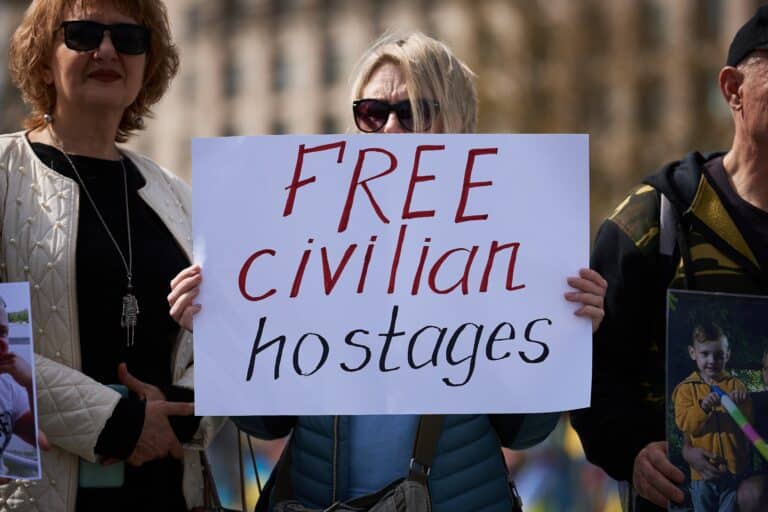
Ukrainian civilians in Russian prisons: a problem without a solution
{"forms.error.required":"{field} is required.","forms.error.required_generic":"This field is required.","forms.error.email_invalid":"Please enter a valid email address.","forms.error.email_no_cyrillic":"Email address cannot contain Cyrillic characters.","forms.error.phone_invalid":"Please enter a valid phone number.","forms.error.min_length":"Must be at least {min} characters long.","forms.error.max_length":"Must not exceed {max} characters.","forms.error.invalid_chars":"Contains invalid characters.","forms.error.emoji":"Emoji are not allowed.","forms.error.html_tags":"HTML tags are not allowed.","forms.error.control_chars":"Contains invalid control characters.","forms.error.no_digits":"Numbers are not allowed.","forms.error.digits_only":"Only numbers are allowed.","forms.error.digits":"Numbers are not allowed.","forms.error.username_spaces":"Username cannot contain spaces.","forms.error.username_invalid_chars":"Username contains invalid characters.","forms.error.password_obvious":"Password is too simple. Please choose a stronger password.","forms.error.password_matches_email":"Password cannot be the same as the email.","forms.error.password_matches_username":"Password cannot be the same as the username.","forms.error.server_error":"Server error. Please try again later.","forms.error.file_type_invalid":"Failed to upload the file due to an unsupported format. Please upload a file in one of the following formats: {formats}.","forms.error.file_too_large":"Failed to upload the file because it exceeds the maximum allowed size. Please select a smaller file.","forms.error.file_duplicate":"This file has already been added.","forms.error.file_max_count":"You can upload no more than {max} files.","forms.ui.max_chars_reached":"Maximum number of characters reached ({max}).","forms.ui.min_chars":"At least {min} characters required.","forms.ui.fix_errors":"Please fix the errors in the form first.","forms.ui.loading":"Submitting…","forms.ui.success":"Submission successful."}
Thank you!
You will now receive EPIK’s latest analysis, publications, event invitations, and other updates directly in your inbox.
Thank you!
You will now receive EPIK’s latest analysis, publications, event invitations, and other updates directly in your inbox.