Executive summary
- Kyiv’s relations with Beijing have experienced highs and lows, often linked to Ukraine’s geopolitical alignment, but also dependent on factors internal to each country.
- Even though broader economic cooperation has encountered difficulties, China has become Ukraine’s main trading partner. Trade flows have continued to grow in spite of problems with political relations, but the balance of trade is overwhelmingly in Beijing’s favour.
- Despite China’s increasingly obvious support for Russia and its lack of interest in a Ukrainian victory, Kyiv has been reluctant to risk an overt rupture with Beijing.
- The EU and Ukraine need to ensure that their approaches to China are compatible, not least because of the ongoing accession process, but also because China seems likely to be involved in Ukraine’s reconstruction.
Introduction
The increasing interconnectedness between various international actors and theatres makes the relationship between Ukraine and China more relevant to developments in Europe. The ever-closer ties between Beijing and Moscow, the spillover effects of the US–China relationship into the situation in Europe and the likely participation of Chinese state and business actors in Ukraine’s reconstruction – all in the context of Ukraine’s future membership of the EU – mean that how Ukraine and China interact will have implications far beyond those two countries. Russia’s aggression against Ukraine since 2014, and in particular since 2022, has placed clear limits on the development of Ukraine–China relations. Nonetheless, other factors, such as existing economic ties, Ukraine’s growing reconstruction needs and Ukrainian reliance on certain Chinese components to sustain its war effort, are also playing a role.
The wave effect takes root
Three key trends can be identified in the early phases of the Ukraine–China relationship. The first began with China’s acquisition of a Ukrainian aircraft carrier, the Varyag, which was actually a Soviet-era vessel that was never completed. This carrier was purchased by a Chinese businessman for $20 million in 1998 and later transferred to the People’s Liberation Army (PLA). This event is seen as establishing a positive background for the further development of Chinese-Ukrainian relations. The PLA was able to convert the hull of the Varyag into the Chinese aircraft carrier Liaoning. The extensive technical specifications that were delivered together with the Varyag advanced Chinese naval development and whetted Chinese interest in profiting from Ukrainian military technology.
Second, during the presidency of Viktor Yanukovych (2010–2014), two key agreements were signed that still constitute the formal basis for Ukraine’s relations with China: the “Joint Declaration on the establishment and development of strategic partnership between Ukraine and the People’s Republic of China”, signed on 20 June 2011, and the “Treaty of Friendship and Cooperation between Ukraine and China”, signed on 5 December 2013. The latter was signed during the Euromaidan protests, which led Yanukovych to flee to Russia in February 2014. This framework was accompanied by a series of projects either envisaged or begun during Yanukovych’s time in office. However, following the change of regime, many of these were not pursued.
Third, this early period of relations illustrates a “wave effect”. After a phase of intensifying relations under President Leonid Kuchma, and one of relative inactivity under Viktor Yushchenko, the relationship again picked up speed during the Yanukovych period. Like Kuchma, Yanukovych played interlocutors in the West and East off against each other in an attempt to get the most out of the various relationships. This applied in particular to Russia in the East, but also to China to a lesser degree. This pattern indicates both the cyclical nature of the relationship and its geopolitical component.
After the Euromaidan: a mixed picture
The Ukrainian Parliament ratified the Treaty of Friendship in May 2015, sending a signal of a certain continuity in relations with China. Two months earlier, a Memorandum of Understanding had been signed with CITIC Construction, indicating that Ukraine would receive $15 billion over 15 years at a minimal rate of interest to build housing and relevant infrastructure, and a $3.6 billion loan agreement concluded under Yanukovych had been renegotiated. In addition, China significantly increased its imports of Ukrainian corn and iron ore.
Nonetheless, the relationship with China remained complicated and failed to achieve the potential that would have been possible under different circumstances. Despite clear Ukrainian interest in constituting part of the Belt and Road Initiative (BRI), which was launched by China in 2013, significant involvement never materialised. The full-scale Russian invasion in February 2022 essentially closed the door to Ukrainian engagement in the BRI for a number of geographical, geopolitical and economic reasons.
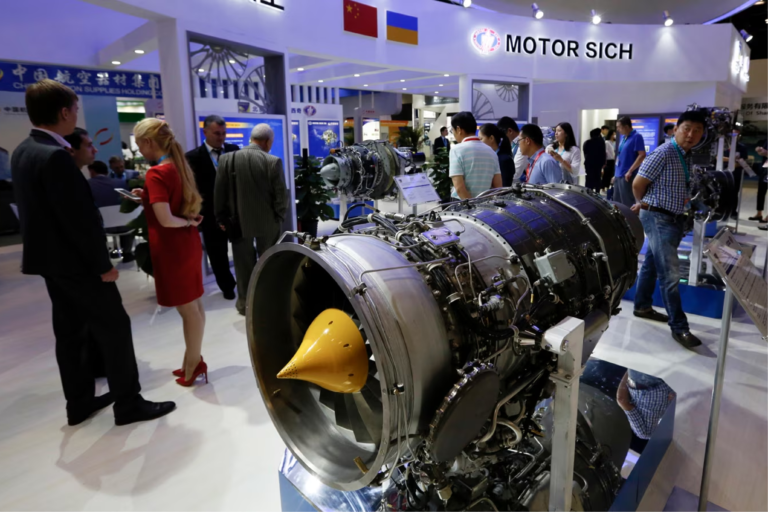
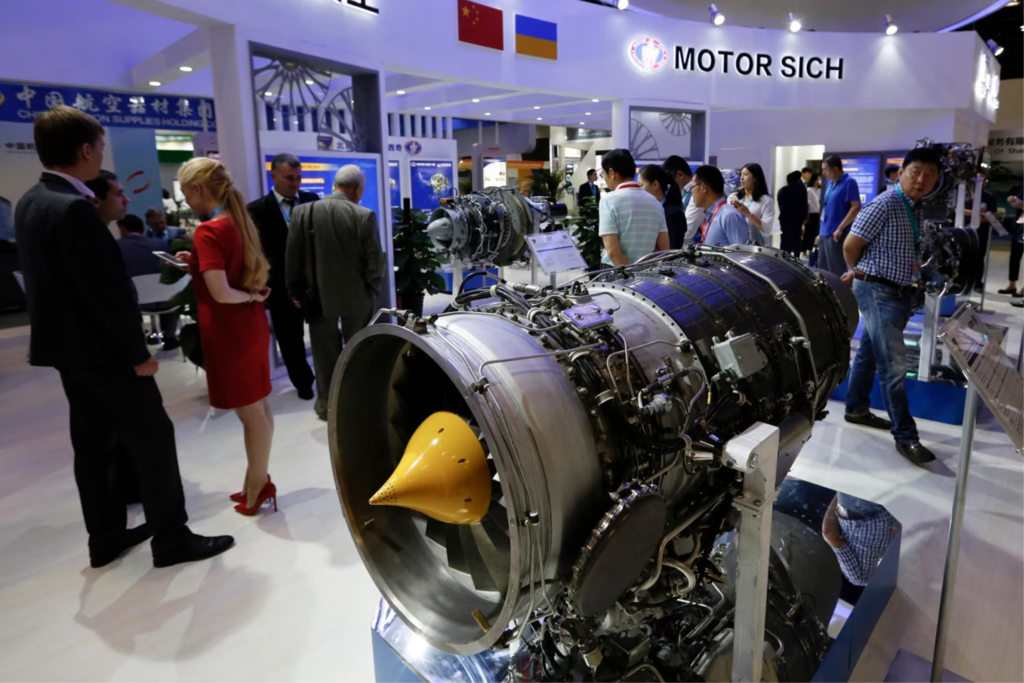
Other types of cooperation also ran into difficulties. The best-known case is that of Motor Sich, a flagship company that played a key role in the Soviet aviation sector, responsible for the production of helicopter and cargo aircraft engines. It remained active in independent Ukraine and was of great interest to Beijing due to its access to advanced military technology. The Ukrainian security service (SBU) became concerned about Motor Sich deals with Russia and the occupied parts of the Donbas, but also about a creeping takeover of the company by the Chinese company Skyrizon Aviation. Even more importantly, the United States exerted significant pressure on Ukraine to prevent that takeover from taking place. Washington was unhappy about the implied technological transfer to China and argued that this knowledge would also end up in Russian hands. The Ukrainian antitrust authority repeatedly rejected Chinese requests to take a controlling interest in Motor Sich. The company was nationalised in 2022, which was seen as a strategic decision in favour of the US. Skyrizon filed a suit against Ukraine at the Permanent Court of Arbitration in The Hague for compensation. Kyiv, for its part, has imposed sanctions on Skyrizon.
This is only the most public example of problematic relations with China. Other cases include cancelled contracts for work on roads in two Ukrainian regions, an aborted project to construct an express railway line to Boryspil airport and a violated agreement concerning a loan from China in exchange for grain deliveries and the purchase of Chinese agricultural equipment. Thus, while there is still interest in cooperation in both countries, many attempts have been stymied either by changing domestic or international circumstances, or due to corrupt practices or mismanagement by one or both parties.
Despite these problems, China became Ukraine’s number one trade partner in 2019. Trade between the two countries had been growing steadily since 2016, and reached over $21 billion in 2025. There has consistently been a strong trade imbalance skewed heavily in favour of Beijing. However, growing trade flows have not led to major Chinese investments in Ukraine or to other forms of deeper economic cooperation.
That said, China has invested in various projects involving renewable energy, agriculture and port infrastructure. In addition, the Chinese multinational Huawei has been present in the Ukrainian telecommunications sector for decades, and in 2019 was tasked with providing an internet service for the Kyiv subway system. Many projects involve loans or contract-based cooperation rather than foreign direct investment (FDI). Even if the term “strategic partnership” used in the 2011 declaration has not been borne out in practice, Ukrainian presidents continued to see the economic component of the relationship as “strategic” and to emphasise not only growing trade flows, but also hopes for greater Chinese investment and cooperation in certain sectors, notably agriculture. In addition, while Kyiv wishes to continue the trade partnership at the same or an even higher level, it also wants to improve the trade imbalance, and to shift Ukrainian exports to China away from raw materials and towards products with greater added value.
Developments under Zelenskyy: from hope to frustration
Zelenskyy’s election as president in 2019 opened up new opportunities for the relationship with China. He expressed an interest in a stronger focus on Asia, where some short-term gains could arguably be achieved, and as a counterweight to relations with the West, on the one hand, and Russia, on the other. This was eagerly supported by the then foreign minister, Dmytro Kuleba, who was taking a growing interest in the region. On being appointed to head the foreign ministry in March 2020, he launched an Asia strategy focused on the ASEAN countries and China. The goals of this strategy were primarily economic, working to increase trade and investment, but also to attract more Asian students to Ukraine. While this heightened emphasis on Asia failed to achieve major visibility or results, China’s primary place with regard to trade persisted, indicating that trade flows are not overly dependent on political developments.
Thus, while the trade relationship between Ukraine and China was flourishing at the time of the Russian invasion, the potential for further economic and political developments appeared limited. However, this did not prevent Kyiv from seeing Beijing as a possible resource in helping to convince Moscow to end the fighting or work towards a peaceful settlement. For a year or more following the invasion, Ukraine believed that China might be interested in restoring stability, and thus willing to refrain from supporting Russia and even to contribute actively to achieving peace. For Kyiv, it was important that Beijing did not supply Moscow with weapons and made clear its support for the principle of territorial integrity. Its rhetoric on China remained cautious to avoid pushing Beijing into backing Russia more overtly and to preserve Ukraine’s economic relationship with China.
This approach coincided with Ukraine’s broader approach to the Global South. In October 2022, Zelenskyy presented a 10-point “Peace Formula”, which was regarded by the Ukrainian side as so general that most countries would be willing to support at least some of the points. Ukraine hoped to engage with a variety of states, disseminate its views on the invasion and gain wider backing for some of its goals, including territorial integrity, food security and nuclear security. This initiative led to a series of meetings, the most visible of which was a Summit on Peace in Bürgenstock, Switzerland, in June 2024. Kyiv made significant efforts to convince China to attend the summit, but in the end Beijing not only failed to send a representative, but actively discouraged certain other countries from doing so. In addition, it joined with Brazil in proposing a six-point plan that ignored key Ukrainian positions, including any mention of territorial integrity.
This and other disappointments in their interactions with China led Ukrainian officials to abandon their initial hopes that Beijing might play a role in working for peace, or at least in ameliorating certain problems created by the war. Kyiv had, for example, believed that China might have an interest in pressuring Russia to allow Ukrainian grain exports through the Black Sea to resume after Moscow pulled out of an agreement regulating them in July 2023. However, despite being negatively affected by the blockade of Black Sea transit routes, China failed to put any pressure on Russia. Nor was there any of the desired Chinese support in the areas of nuclear safety or the return of abducted Ukrainian children. Kyiv thus entered into a new phase of its relationship with Beijing characterised by harsher rhetoric on the Ukrainian side. For example, Zelenskyy described China and Brazil’s six-point plan as “destructive”.
Ukrainian disillusionment became even more pronounced in 2025, when China’s lack of neutrality and its drift towards Russia became ever clearer. Kyiv began to accuse Beijing of overt support for Moscow, including in the military sphere, and of tolerating Russia’s recruitment of Chinese mercenaries. In addition, in May 2025 Zelenskyy stated that only those countries that had helped Ukraine would be given an opportunity to take part in reconstruction, since it would not be logical for those who had contributed to Ukraine’s destruction to profit from rebuilding the country. This was seen as an exclusion of China, which had expressed an interest in being involved in reconstruction projects, as well as a way to curry favour with a Trump White House apparently at odds with Beijing.
Trading carefully despite scepticism
At the same time, however, Ukraine’s approach to China has remained cautious, not least because Kyiv is loath to lose China as an important trading partner, but also – and perhaps especially – because Ukraine is dependent on Chinese components for its drones and other war-related items. These components often reach Ukraine indirectly, but the assumption is that China could put a stop to their supply if it wanted to. Thus, although China is clearly supporting Russia in its war against Ukraine in multiple ways, Kyiv does not want to jeopardise its reliance on China for products essential to its war effort. This is one reason why there is no inclination in Kyiv to conclude that, as a key supporter of Ukraine’s enemy, China is an adversary. This approach persists despite additional aggravating factors, such as China’s increasing activity in parts of Ukraine currently occupied by Russia.
In fact, when addressing counterparts in Beijing, Kyiv has to some extent reverted to similar rhetoric to that of the first year after the invasion. Following Ukraine’s Independence Day celebrations in 2026, on the occasion of which Xi Jinping sent congratulations, Zelenskyy responded: “We count on further cooperation and on China playing a strong diplomatic role in bringing Russia’s war against our country to an end”. The Ukrainian ambassador to China, Olexander Nechytaylo, echoed this sentiment, noting that “Ukraine is convinced that China has sufficient international weight, political authority and diplomatic tools to make its contribution to bringing peace closer, more tangible”. It therefore appears that, in addition to being an indispensable trade partner, China is seen as too significant on the international stage to ignore or rebuff. It would be too dangerous to risk Beijing coming out overtly against Ukraine.
Thus, even during a period of more open frustration with China’s position, Kyiv still attempted to maintain some form of political dialogue with China. In July 2024, for example, shortly after the Summit on Peace in Bürgenstock, Kuleba travelled to Beijing to meet with his Chinese counterpart, Wang Yi. This was portrayed as a follow-up on contacts between the Chinese and Ukrainian leaders, even though their only previous personal interaction had been a telephone call in April 2023.
Nonetheless, some Ukrainian politicians have voiced clear scepticism regarding the Chinese position and Beijing’s willingness to play an active role in peace efforts. Oleksandr Merezhko, Chair of the Committee on Foreign Affairs and Interparliamentary Relations in the Ukrainian Parliament, and a member of the ruling Servant of the People faction, has warned against focusing too much on Chinese rhetoric rather than its actions, which are clearly supportive of Russia.
Another parliamentarian, Mykola Kniazhytskyi of the European Solidarity faction, has taken a strong interest in Taiwan, which he visited for a third time in August 2025, together with a multi-party delegation from the Verkhovna Rada. Taiwan has provided significant humanitarian assistance to Ukraine since February 2022, and business contacts have been growing, including with regard to drone production. At the same time, however, Ukraine has repeatedly stressed that it adheres to the “One China” policy, which it associates with support for territorial integrity. The contradiction implicit in engaging with Taiwan while adhering to this policy has not been addressed and Ukraine has been careful not to overstep certain limits. For example, establishing Taiwanese representation in the country has so far been avoided. Taiwan, however, has come out clearly in support of Ukraine both officially and more informally.
Despite increasing scepticism, the prevailing sense in Kyiv seems to be that it is important not to alienate China for a variety of reasons. One reason is that trade with China is seen as significant, with the potential to increase as wartime conditions evolve or in a less hot phase of the war when transport corridors are more accessible. Another is that Beijing is viewed as one of the few countries capable of influencing Russia, due to the latter’s political and economic dependence on China. This may become more important if US reluctance to put pressure on Moscow continues or even increases. Third, Ukraine is also dependent on China for key components for its drones and for other essential industrial needs linked to the war effort. All these factors contribute to a strong tendency to seek to preserve a good working relationship with Beijing, despite the relatively low level of interest shown by the Chinese leadership in recent years.
China’s role in Ukraine’s reconstruction: under certain conditions
With regard to the future, this tendency implies a willingness on the part of numerous Ukrainian actors to foresee a role for China in the reconstruction of Ukraine. While, as discussed above, Zelenskyy has appeared to rule this out, his statements need to be placed in a wider context. Experts on China in Ukraine repeatedly stress that Kyiv does not have a developed strategy on China, which means that positions are in the process of development and should not be seen as hard-and-fast elements of future policy. This is likely to be true of Zelenskyy’s statement, as various other actors, from analysts to academics to former diplomats and politicians, have expressed an openness to including China in reconstruction projects. There have even been suggestions that some aspects of the Chinese economic development model should be used as a guide during Ukraine’s recovery. At the same time, some experts with long experience in China argue in favour of excluding it from reconstruction efforts altogether, based on their negative assessments of Beijing’s goals and methods.
Indeed, previous experience of Chinese involvement in economic projects in Ukraine has raised a number of red flags, leading to a heightened awareness among many Ukrainian policymakers of the need to take security concerns into consideration when deciding on the type and extent of Chinese participation. Numerous experts and academics have highlighted the need for “limited” or “selective” involvement of China in reconstruction. The Motor Sich experience in particular demonstrated how security issues could affect Ukraine and the extent to which questions of Chinese engagement are intertwined with Ukrainian foreign policy and bilateral relationships with other actors. The Motor Sich case involved the United States, but the interests of the EU and its member states are also likely to play a significant role in reconstruction issues. Türkiye will no doubt come into the picture too.
Since Ukraine is on a path to EU accession, it will need to align its foreign policy with that of the EU, including its trade policy. This means that EU concerns about the Chinese role in Ukrainian recovery will have to be taken into account. At the same time, however, the enormous cost of reconstruction could push both Ukraine and the EU into embracing certain types of Chinese involvement. The forms this might take and the sectors included, however, will need to be the subject of regular interaction between Brussels and Kyiv. In fact, questions regarding Ukraine’s approach to China will no doubt arise in the process of negotiating the sixth cluster of the EU acquis communautaire, which was opened in July 2026 and includes questions of common commercial policy in general and FDI screening rules in particular.
The broader geopolitical context: increasingly disturbing
While the supposed “no limits” partnership between Russia and China is generally seen as having limits after all, it is nonetheless clear that Chinese actions have strongly enabled Russia to pursue its war aims in Ukraine. This applies not only to direct support, such as drone components, training for Russian soldiers and the supply of dual-use goods that have been used for military purposes, but also to more indirect backing. The latter comprises importing much of the energy Russia previously exported to western countries (albeit at discounted prices), as well as assisting in sanctions evasion mechanisms. Even if China’s relations with most of Europe have suffered, overall Beijing has gained both economically and in terms of military technology and lessons learned from the Russian battlefield.
Despite the unexpected policy shifts of the Trump administration, and its declared intention to drive a wedge between Beijing and Moscow, such a split has not occurred and is perceived as unlikely. Indeed, in addition to the economic and military aspects mentioned above, Russia and China have similar (though not identical) ideological approaches regarding the role of the US and the need for changes to the existing world order. Putin and Xi Jinping have also developed an excellent working relationship. While Russia’s predilection for violence and harsh rhetoric sometimes places China in a difficult position, it also serves as a means of testing the waters in the international arena. Nonetheless, the relationship remains asymmetrical, which means that in some areas Beijing has the upper hand. Despite official statements to the contrary, there is little trust between the two sides.
That said, Trump obviously has a penchant for interacting with powerful world leaders, which he perceives both Xi and Putin to be. Despite having shifted back and forth on his approaches to China and Russia, thus far there are few indications that he is inclined to spoil his relationship with either head of state. Indeed, it is possible that the recent deal struck with Putin on exports of Russian diesel in exchange for a temporary lifting of sanctions against Russia is a herald of future economic cooperation to come. Following the reciprocal state visits of Xi and Trump in Beijing in May and Washington in September, the current trajectory does not appear to involve an increase in animosity between the US and China.
If Trump continues to cosy up to both Putin and Xi, Ukraine’s position will become increasingly difficult. Even temporary cooperation among these three leaders would increase the pressure on Kyiv to a dangerous level. While Ukraine can count on continued European support for now, neither Trump nor Xi cares particularly about Ukraine’s survival, and Russia is working hard to destroy it. The results of the mid-term US elections will create domestic problems for Trump and he could respond by acting even more harshly and erratically as a result. The outcome of his battle with a Democratic Congress is hard to predict, but likely to damage the US further on the international stage. Difficulties at home could make him more susceptible to flattery and appealing offers from abroad, which will strengthen Putin’s hand – as well as Xi’s. China’s interest in a weakened Ukraine is likely to decrease, since even now Beijing does not perceive Kyiv as a genuinely sovereign actor. If reconstruction appears to recede into the distant future, there will be fewer incentives for Chinese engagement. China might begin to prepare for a Russian victory as a more probable outcome, and intensify its relations with Moscow accordingly.
Ukraine will need to work even more closely with Europe on an overarching geopolitical strategy, and attempt to influence politicians in the US other than Trump in preparation for a new administration. De-risking with regard to China will become even more important.
Conclusions
A review of Ukraine’s relations with China identifies several important elements. First, it is evident that both countries currently have sufficient interest in developing the relationship to ensure that it continues to evolve rather than fades away. Second, numerous significant disappointments have accumulated over time, creating a difficult background for moving forward. Many factors prevent the emergence of a positive dynamic. The complex and dynamic geopolitical environment is prominent among these. More specifically, China’s close relationship with Russia, which is conducting a brutal war against Ukraine, and its ambivalent relationship with the US impose shifting but undeniable limits on Kyiv’s interactions with Beijing. However, the internal mechanisms of the Chinese and Ukrainian political and economic systems have also served as impediments to the successful implementation of previously agreed projects.
Trade flows between Ukraine and China have proved to be robust over time, even if the trade balance is increasingly unfavourable to Kyiv. Other types of economic cooperation have been less successful, and political relations have experienced highs and lows depending on Ukraine’s other foreign policy alignments. In the current environment, a mixed bag of elements is affecting the development of the relationship. While China has remained aloof from any efforts to achieve a ceasefire or peace settlement, Beijing has expressed a clear interest in participating in reconstruction projects. However, Ukraine’s emerging China policy will need to be compatible with that of the EU, while also taking the US–China relationship into account. This means that while no major breakthrough can be expected in relations between Kyiv and Beijing, attempts to deepen certain aspects of their economic component are probable. These attempts are likely to encounter difficulties, as has repeatedly happened in the past. However, if Ukraine’s relations with the EU become more problematic, Kyiv might try to intensify its interactions with Beijing (as well as other capitals) as a counterweight to its western partners. This would be a return to a pattern seen several times before. For Ukraine, as for most other states, China is too important a player on the international stage to disregard.
Recommendations
The above analysis gives rise to the following recommendations for the EU and Ukraine:
- Use the ongoing negotiations on the sixth cluster (external relations) in the EU accession process to ensure that Ukraine’s China policy evolves in a direction that is compatible with that of the EU. This also presents the EU with an opportunity to concretise specific aspects of its own policy.
- Agree relevant criteria for determining what types of Chinese investment in Ukraine are desirable. This could be based on general FDI screening procedures, but should be tailored to the specific risks posed by China in the Ukrainian context. At the same time, the approach should be kept as simple and clear as possible to allow for rapid application where necessary.
- Work to set up a comprehensive programme of Chinese studies in Ukraine, as mentioned by President Zelenskyy in an interview with the Xinhua news agency.
- Incorporate discussions on how the respective sides perceive China into EU–Ukraine formats at various levels, involving EU institutions, member state governments and parliaments, academics and civil society experts, and business representatives.
- Use formats focused on Ukraine’s reconstruction to debate questions pertaining to possible Chinese involvement and the conditions in which this could be envisaged. A special focus on the pros and cons of potential Chinese participation in renewable energy projects would be useful.
- Ensure that ongoing European efforts to produce drones in and with Ukraine involve plans to reduce the number of drone components originating from China.
- Cooperate on the exploitation of critical raw materials in order to reduce dependence on China in this area as far as possible. This should include not only projects in Ukraine, but also joint cooperation with relevant partners outside the EU.
Acknowledgements
I would like to thank the experts on China and international relations who took the time to discuss their views with me during my research stay in Kyiv in May–June 2026. I very much appreciated the opportunity to be a Visiting Policy Fellow at EPIK during this period. In addition, I would like to express my gratitude to Yurii Poita for his comments on a previous draft of this paper.