Executive summary
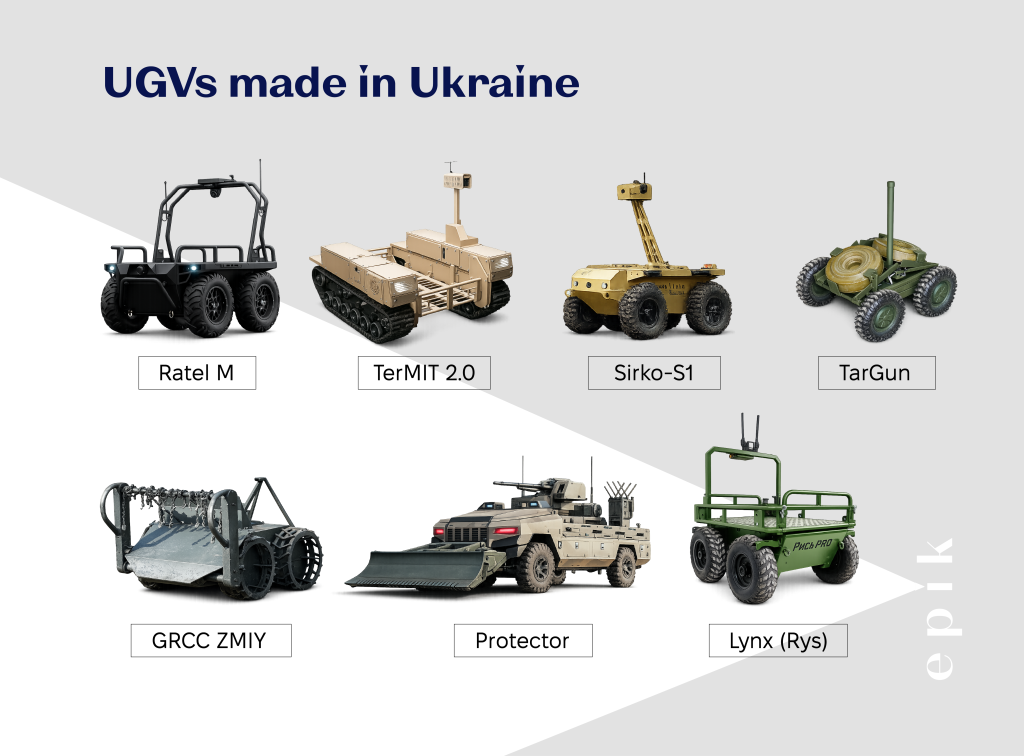
- Ukraine’s successes with drone warfare have solved one problem but created another. Expansion of the frontline kill zone has made traditional logistics, casualty evacuation and crew rotation impossible. Ground robots have filled the gap. In the most advanced Ukrainian battalions, Unmanned Ground Vehicles (UGVs) now handle up to 90 percent of frontline supply missions, at an average of 455 missions per day by mid-2026.
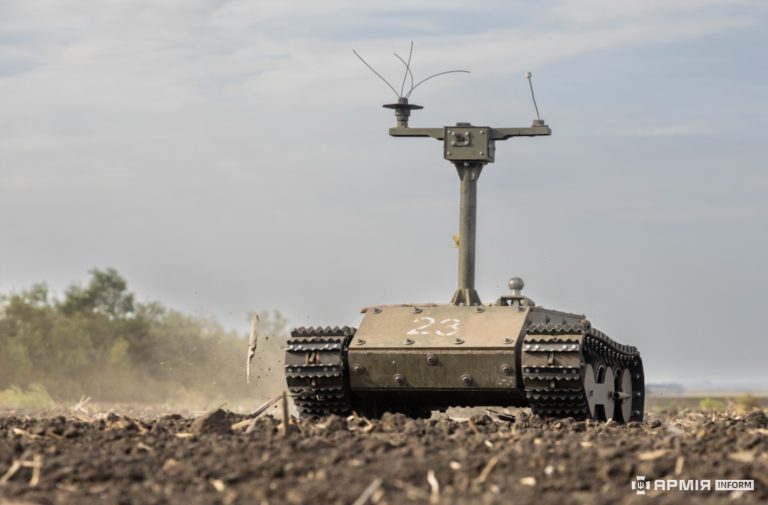
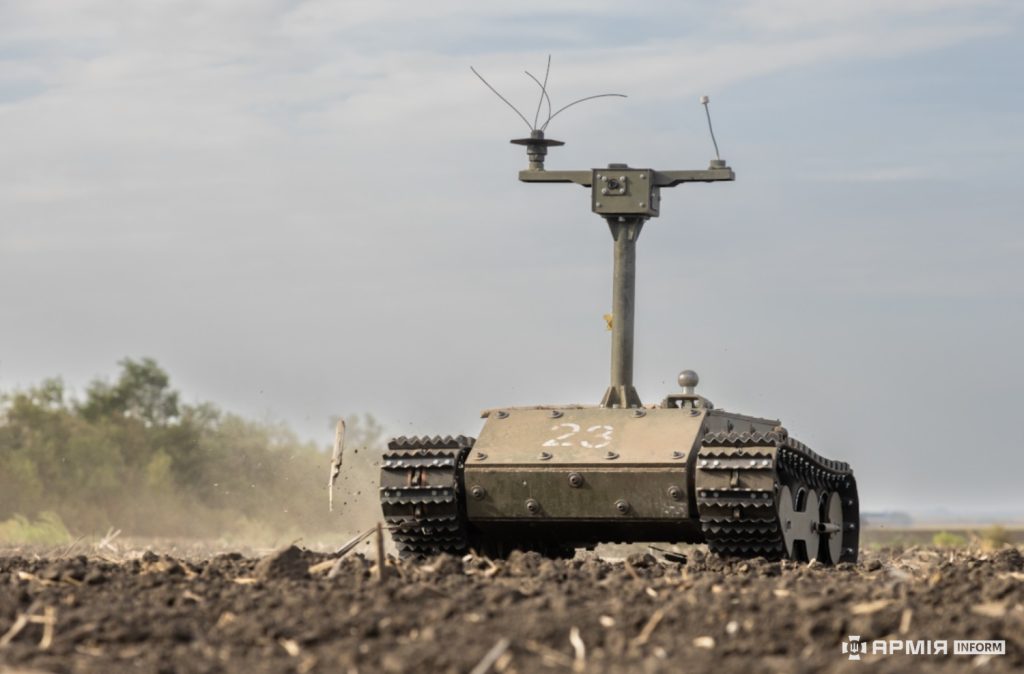
- Ukraine’s “IKEA model” treats ground robots as expendable: good enough to use, cheap enough to lose, simple enough to fix in the field. At $8,000–$20,000 per unit, a UGV is closer to a round of ammunition than a piece of high-tech equipment. Russian and some western programmes are building the opposite – systems that are too expensive to risk and too fragile to survive.
- Europe should not treat Ukraine as a low-cost R&D department. Ukrainian battlefield data and operational knowledge could save Europe years of development and billions in expenditure. Without data-sharing agreements, IP safeguards and genuine joint ventures, Europe risks extracting short-term value while hollowing out the ecosystem it needs from a long-term partner.
- Finland, the Baltic states and Poland face the same terrain and the same adversary: this is a preview. Russia’s answer to battlefield attrition is to spend people. Ukraine’s answer has been to spend machines. For democracies with limited manpower and little tolerance for mass casualties, only one of these models is sustainable.
Introduction
As of mid-2026, the decisive contest in high-intensity warfare is no longer primarily over territory. It is over the ability to move ammunition, evacuate casualties and maintain supply under constant drone surveillance. Regardless of how many tanks it fields, the side that loses this contest loses the war.
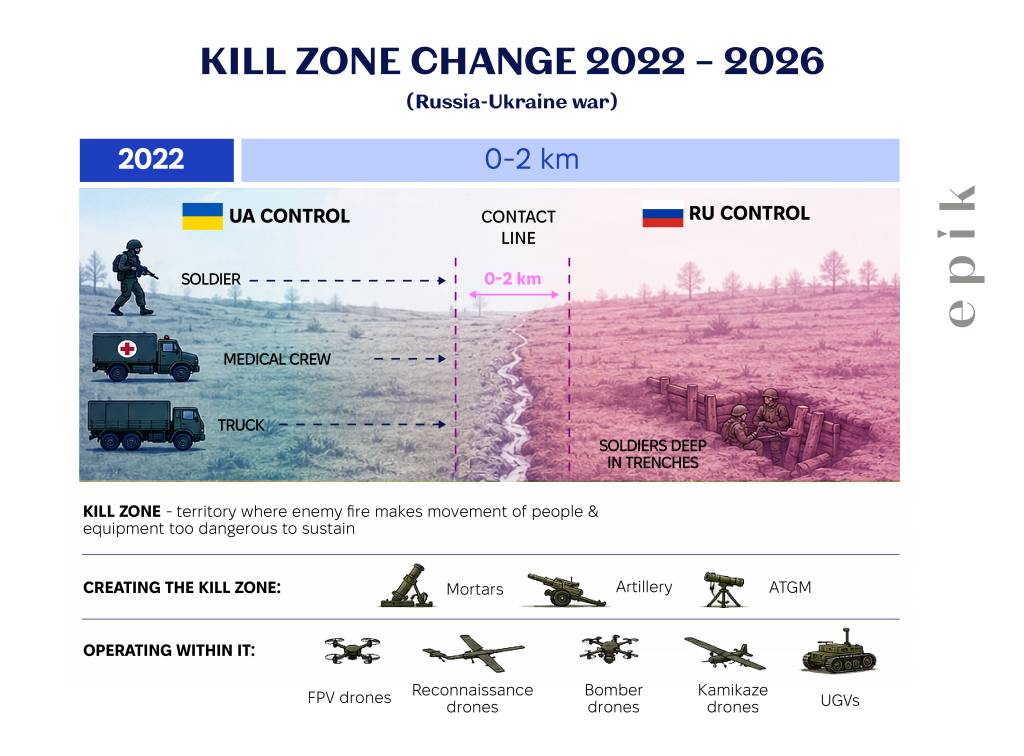
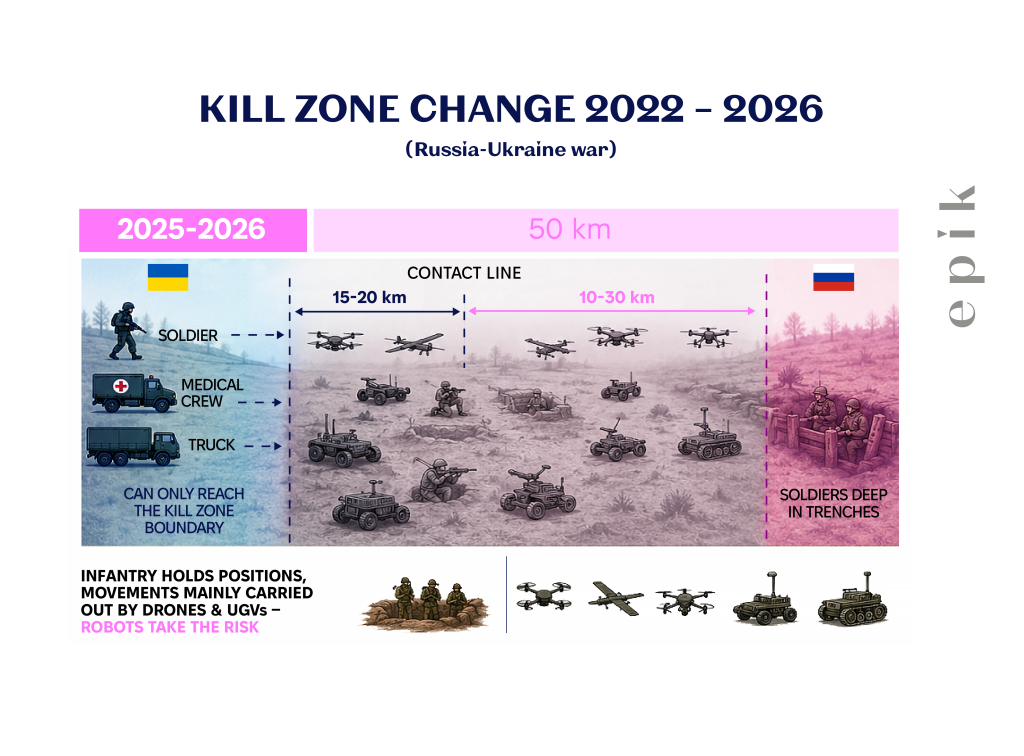
When western military aid fell short in 2024, Ukraine expanded its network of civilian engineers and volunteer groups to compensate. In the air, this worked. Unmanned aerial vehicles (UAVs) addressed critical shortages in fire support, reconnaissance and strike capability at low cost, and transformed the battlefield in the process. Success in the air, however, created a new problem on the ground. The area closest to the frontline became a multi-kilometre kill zone in which traditional logistics and routine tasks such as casualty evacuation or crew rotation could no longer function.
Ukraine’s response was a new principle: robots take the risk. It systematically removed humans from any role that does not require human judgment and let machines absorb the danger that would otherwise fall on soldiers.
Sceptics are correct that small ground robots cannot restore battlefield movement or replace armoured combat vehicles. They are wrong to conclude from this that ground robotics is a niche capability. Logistics and evacuation – the foundations that determine whether a force can be sustained – account for the overwhelming majority of Ukrainian Unmanned Ground Vehicle (UGV) missions.
This brief is a companion to EPIK’s earlier analysis of Ukraine’s UAV ecosystem and drone economy. The two stories share a common structure: bottom-up innovation, decentralised production and a procurement culture that Europe is yet to build. The difference is that ground robotics is roughly where UAVs were in 2023 – past the experimental phase but not yet at industrial scale. The platforms that emerge from this environment are not sophisticated. They are cheap, modular and expendable, and designed to absorb the risk that would otherwise fall on soldiers. This brief calls this design philosophy “the IKEA model”.
Buying Ukrainian platforms is straightforward. What cannot be purchased is the process behind them – the tight loop between the soldier who uses the machine and the engineer who fixes it and keeps it running while continuously under fire.
Russian forces have spent years fighting against Ukrainian UGVs, studying what works, what fails and how try to replicate this at scale. NATO’s eastern flank will face an opponent with operational experience in precisely this domain. By engaging with Ukraine’s UGV ecosystem, Europe will come to understand what is being built against it.
From chaos to ecosystem: The institutional history
The Shablia combat module, produced by Roboneers, has operated in live combat for nine years. This remote-controlled machine gun turret was designed to engage targets while keeping soldiers safe. First deployed in 2014 and certified in 2023, this gap is a description of how Ukrainian military innovation actually works: deployment precedes certification.
The first two years of the full-scale invasion was an experimental period, and frankly chaotic. Ground robots were treated mainly as remote-controlled mines or kamikaze platforms. Their logistical potential was largely overlooked. When a Rys platform simply arrived unordered at one battalion in 2023, the commander found it slow and expensive. He took it apart and worked with the manufacturer to make it function. Rejection, engagement, reconstruction, use is the sequence of how almost every significant UGV in Ukraine has been developed.
The first case of a robot battle in history took place in Bakhmut in March 2024 when Ukrainian drones destroyed Russian ground robotic platforms. The fall of Avdiivka to Russian encirclement in early 2024 was, paradoxically, the proof of concept the sector needed. No conventional vehicle could move in that environment without a near-certain drone strike but UGVs could. Concerns about evacuating wounded soldiers on platforms without certified medical suspension systems faded as evidence accumulated of the lives saved. The last-mile problem had found a practical answer that was imperfect but functional.
In November 2024, the government allocated $6.8 million for the first state UGV procurement contracts. The first operator school opened in the same month. By early 2026, seven private sector operator schools had received Ministry of Defence certification. As of June 2026, 4,000 military personnel are currently undertaking courses and 1,500 have already qualified. The UGV market was valued at $43 million in 2024 and $252 million in 2025 – a 488 percent increase in a single year, led by logistics platforms whose output grew by 556 percent. Over 200 companies are producing UGV systems.
The institutional peak occurred in June 2024, when Ukraine formed its Unmanned Systems Forces – the first branch in the world to combine aerial, maritime and ground drone operations under a single command. Russia followed with its own equivalent in November 2025. Ukraine built an institution from operational necessity; Russia built one in response. This asymmetry – innovation versus replication – defines the competitive dynamic that European partners are now entering.
The honest account is messier. Of the 250 models registered on the Brave1 defence technology platform, only 50 have received operational certification; among these, only 20–30 percent are consistently frontline ready. The gap between what is being produced and what the frontline needs has been closed not by the state, but by frontline workshops. Mechanics, engineers and operators modify platforms under fire and share the results with manufacturers within days. They serve as the sector’s research lab, quality control and selection filter.
The use of robots is increasing every month. Ukrainian forces have carried out more than 50,000 logistics and evacuation missions since January 2026 at an average of 455 missions every day. The number of units using ground robots has increased. Specialised UGV companies have been formally established with full staff positions for operators, engineers and technical specialists. This breakthrough demonstrates the ability to make different systems work as one. Integrated air-ground operations are planned and executed as a single manoeuvre, including in some cases the capture of enemy personnel.
What UGVs do and don’t do
Ground robots in Ukraine emerged primarily to resolve a logistics problem and only later acquired other functions. Monthly missions increased from more than 7,500 in January 2026 to over 14,000 in May, and the number of military units operating ground robots nearly doubled, from 117 to 230. Ukraine’s Defence Minister has set a target that 100 percent of frontline logistics should be performed by robotic systems.
By 2024, Ukrainian assessments were already suggesting that systematic use of robotic systems had reduced personnel losses in supported units by up to 30 percent.The kill zone has since expanded well beyond the range for which most early platforms were designed, making these systems even more relevant.
Logistics and ammunition delivery. In some of the most robotised battalions, UGVs now fulfil up to 90 percent of total frontline supply needs, replacing vehicle convoys that can no longer move safely within five kilometres of the frontline. Within that zone, a UGV carrying 200 to 300 kilograms costs far less than the vehicle it replaces – and nothing close to the human life it protects. It also frees up aerial platforms (bombers and reconnaissance drones) to perform their primary functions rather than be diverted to supply runs. In the 3rd Assault Brigade alone, the monthly logistics volume transported by UGV grew from 30 tonnes in January 2025 to 300 tonnes in January 2026.
The operational standard that has emerged organically across units is simple. A platform must fit into a pickup truck and be loadable by three or four soldiers. Otherwise, a UGV cannot be deployed at the required frequency.
Casualty evacuation is the second most common UGV mission and the most consequential. The 3rd Assault Brigade now conducts all evacuations of wounded and killed by UGV. Wounded soldiers are deliberately not strapped to evacuation platforms, so they retain the ability to jump off if they hear a first-person view (FPV) drone approaching, a decision that has already saved lives multiple times. This is the robots-take-the-risk principle at its most direct: the machine absorbs the danger that would otherwise fall on the medic, the stretcher bearer and the soldier close enough to help.
Nonetheless, the technology is still immature. Most current evacuations rely on adapted logistics platforms, as dedicated evacuation UGVs are rare. These repurposed systems lack adequate suspension, sufficient ground clearance for speed and proper fixtures for patients with injuries of varying severity – a capability gap that represents one of the more pressing development priorities in the sector.
Minelaying and demining is another area where Ukraine is applying the robots-take-the-risk principle. Around 23 percent of Ukrainian territory has been mined and the frontline is constantly shifting across contested areas, making the ability to lay and clear mines without putting personnel at risk essential for ongoing operations.
Minelaying has proved relatively straightforward. Logistics platforms are routinely adapted to deploy anti-tank mines, while some units have experimented with remote emplacement of anti-personnel mines. In practice, this is an extension of the logistics mission where a robot transports a payload and releases it at a designated location.
Demining is much more difficult. A failed logistics mission can result in lost equipment; a failed demining mission could result in the death of the next person who enters the area. Reliable demining requires advanced sensors and precise navigation before systems can be trusted in operational use. This is an area that is still developing rather than a fully established capability.
Fire support and assault. Armed UGVs are the newest and least mature application category. Despite media interest in machine gun- and grenade launcher-equipped platforms, fire support and assault missions account for only a small fraction of UGV use in Ukraine’s most experienced units. Logistics and casualty evacuation are still overwhelmingly dominant.
The key innovation is not the weapon mounted on the platform but its integration into a wider unmanned system. The NC13 Strike UGV Company within the AFU’s 3rd Army Corps reportedly held a position for 45 days without Ukrainian losses by combining UGV fire support with UAV reconnaissance and FPV strikes in a single kill chain. In April 2026, President Zelenskyy announced that Ukrainian UGVs and UAVs had captured an enemy position without infantry participation, in the first publicly acknowledged operation of its kind.
These successes should not obscure the limitations of the technology. Armed UGVs are expensive in terms of operator time, vulnerable to FPV drones and dependent on specialist training that is still scarce across the force. Larger platforms are frequently destroyed before reaching effective firing positions. One-way attack variants are more immediately promising — simpler, cheaper and free of the complications of sustained engagement. For now, armed ground robots are best understood as an emerging capability whose primary value lies in developing concepts for future unmanned operations rather than replacing infantry on today’s battlefield.
Limitations and constraints
The same philosophy that produced Ukraine’s UGV ecosystem – treat the platform as expendable, iterate fast, let the battlefield select what works — is now producing its most serious institutional problems.
Technical constraints are real but solvable
Many platforms continue to struggle with complex terrain, in particular destroyed urban environments, dense woodland and the heavy clay soils prevalent in the Donetsk and Luhansk regions. It is not always possible to replicate these conditions on test ranges, which means that platforms frequently encounter their most demanding operational environment for the first time in live combat conditions.
Communications remain persistently vulnerable. On average, the kill zone has expanded 15–20 kilometres into Ukrainian-controlled territory, while the Russian side varies between 10 and 30 kilometres depending on the operational situation and landscape. As a result, operators increasingly require reliable control links at longer distances than the 2–5 kilometres for which many earlier systems were designed. Given typical platform speeds of just 6–15 kilometres per hour, even modest latency can have significant tactical consequences.
Electronic warfare (EW) compounds the problem. Ukrainian forces now control UGVs using multiple methods – from Starlink satellite links to radio frequency line-of-sight radio, fibre-optic cables or aerial relay nodes – depending on range, terrain and EW conditions. Starlink is the primary solution for beyond-line-of-sight control. However, its data transfer rates of just 10 megabits per second under operational conditions provide poor video quality, which affects battlefield effectiveness. It is also vulnerable to targeted jamming, and Russian tactics deploy multiple terminals to overload coverage in specific grid squares.
In 2023, up to 50 percent of Ukrainian drones were lost to friendly EW fire as own-force jamming destroyed own-force platforms. When hundreds of incompatible EW systems operate simultaneously without synchronisation, the electromagnetic environment becomes as dangerous to Ukrainian platforms as enemy action. This has been partially managed through horizontal communication between units, but has not been completely resolved.
Thermal signature reduction is an unaddressed gap. Their height and absence of masking make most platforms conspicuous to FPV drones. Attrition in active sectors might reach two to five platforms per day – a rate that validates the expendability logic.
Genuine autonomy is largely aspirational. Most of what is labelled autonomous is pre-programmed automation. These are platforms that follow set routes or scan defined sectors but require a human operator for any consequential decision. AI in Ukraine’s unmanned systems remains primarily human-in-the-loop, with value concentrated in computer vision for threat detection and GPS-denied navigation rather than independent action.
The first three constraints are serious but can largely be addressed with ongoing engineering investment and improved field feedback loops. European R&D partnerships could provide direct help in these areas. Autonomy is different. It is not simply a gap to be closed; it is a path to be sped up. The way in which European AI and navigation technology join this path will define the next phase of the ecosystem.
Structural constraints: the harder problems
The most persistent constraints are not technical but institutional. They are embedded in the legal and industrial frameworks that have struggled to keep pace with the speed of bottom-up innovation. These are also the constraints that require action at the European level.
The standardisation deficit is the most visible. By 2025, units were operating platforms from dozens of manufacturers with incompatible connectors, batteries, communications protocols, motors and software. A workshop optimised for one manufacturer cannot efficiently service another. Changing a single component triggers a full re-certification process that requires new technical documentation, Ministry of Economy approval, factory and field trials, and a new NATO stock number. The minimum cycle is two months. The operational lifespan of the communications solution being replaced is often shorter. Procurement standards drafted in 2023 continued to govern some 2025 contracts, even though the battlefield had fundamentally changed in the intervening period.
For most of the war, intellectual property has existed in a legal grey zone. Innovation has emerged through informal cooperation between frontline units, engineers, volunteers and manufacturers, with few clear rules governing ownership. In late 2025, legislation was amended to establish that the state can claim ownership of technologies developed under government contracts or with military involvement. This protects sensitive capabilities but introduces commercial uncertainty for manufacturers, which cannot predict whether jointly developed platforms will remain legally theirs. In April 2026, the Cabinet of Ministers approved a formal policy establishing uniform rules for working with technologies created or financed by the state. Together, these measures represent the first serious attempt to bring legal clarity to a sector that has grown faster than its regulatory foundations. Whether this will be successful remains to be seen.
The challenge is pressing because Ukraine’s most valuable asset is not equipment but the operational knowledge gained in combat conditions. Foreign companies test platforms on Ukrainian soil and sell derived products to European militaries. Technology transfer agreements often undervalue Ukrainian contributions, and manufacturers are increasingly relocating abroad to access capital unavailable at home. The result is that knowledge generated in Ukraine creates value elsewhere without strengthening the ecosystem that produced it. This could be called “industrial espionage” and should be regulated nationally.
The data dimension magnifies the problem. Ukraine has the world’s only large-scale operational dataset on UGV and UAV performance under combat conditions. This is millions of hours of footage and telemetry that constitutes the raw material for the next generation of autonomous navigation, target recognition and decision-making systems. However, most Ukrainian manufacturers cannot access it. Legal and security restrictions keep operational data inside military systems, while some datasets have already been shared with foreign partners before domestic industry could benefit from them and without clear reciprocity arrangements.
The strategic significance of this knowledge extends beyond Ukraine. Russia’s approach reminds us that Ukraine’s structural constraints are being actively exploited. Ukraine remains clearly ahead in ground robotics. Russian UGVs such as the Uran-9, Marker and Shturm demonstrate mixed results. Many have been destroyed by Ukrainian FPV drones before completing their missions. The bigger picture, however, is that Russia’s Rubicon centre, for instance, prioritises degrading Ukrainian logistics infrastructure over frontline targets and more than half of its strikes target drone antennas, EW assets and supply routes. This target selection confirms Ukraine’s operational experience: logistics capability is not peripheral.
As noted above, Ukraine established its Unmanned Systems Forces in June 2024 as the first dedicated branch in the world to integrate aerial, maritime and ground drone operations under a single command. Russia followed in November 2025, institutionalising drone warfare across its force structure. Russian planning documents envisage an eventual force of around 210,000 personnel and 977 units and subunits, although implementation remains uncertain. Phase Two of the expansion plan faces an estimated $900 million funding shortfall. The broader direction is clear, however, as both sides treat unmanned systems not as a supporting capability, but as a permanent pillar of future warfare. For NATO’s eastern flank members, this is the operational environment for which they are preparing.
The IKEA-isation of military robotics
In one documented operation (HVER), a severely wounded soldier remained pinned at his position for 33 days. Seven UGVs were dispatched to recover him. Six were destroyed by mines, FPV drones or small arms fire. The seventh, although damaged, covered 64 kilometres and completed the evacuation. Platforms are expendable; people are not.
This is what this brief calls the IKEA-isation of military robotics. The platform is treated as a consumable — priced and managed like ammunition rather than capital equipment. Everything else that makes Ukraine’s ground robotics ecosystem distinctive — modularity, rapid iteration and the frontline workshop culture — follows from this single premise.
Ukrainian logistics platforms such as the Vepr cost $8,000 to $20,000. The US Army’s equivalent, the Small Multipurpose Equipment Transport, costs approximately $100,000. This price allows Ukrainian forces to treat platforms as expendable in high-risk logistics roles, while the US procurement system remains oriented towards durable multi-year assets. The total operational requirement (the platforms required across all brigades to sustain frontline logistics against ongoing attrition) The market currently supplies tens of thousands. The distance between these two numbers highlights an opportunity for industrial partnership that European states have not yet taken advantage of.
Cheap, simple and replaceable. The economic standard that has emerged across units is straightforward: if losing a UGV feels like expending a round of ammunition, the price is right. A UGV survives an average of 9–10 missions before becoming unserviceable, either through technical failure or battle damage. Some platforms have reached 60 missions but in easier operational conditions – and that is a design specification, not a design flaw.
The frontline workshop as R&D laboratory. European UGVs observed at exhibitions in 2025 were, according to Ukrainian practitioners’ assessments, approximately where Ukrainian platforms were in the spring of 2024. This not because European engineers are less capable. A Ukrainian manufacturer corrects a design mistake within days because the feedback loop runs directly from an operator’s message to the production line.
The distinction between manufacturer and user has largely ceased to exist. Ukrainian brigades embed 10–12-person engineering workshops directly within their unmanned systems battalions. These workshops diagnose technical failures, fabricate replacement parts on demand, respond to new Russian EW threats by changing frequencies and software configurations in real time and adapt commercial munitions for drone delivery – all without routing requests through distant depots or manufacturers.
The output is a growing library of field adaptations. Some units operate chassis with 18 different module configurations: logistics, casualty evacuation, minelaying, fire support, demolition and reconnaissance are swapped in the field as the mission changes. The Lyut robotic complex, developed with Brave1 support and deployed by Special Operations Forces in the Kursk region, captures where this logic leads. It is a modular platform that has coordinated machine gun fire, FPV drones and mortar strikes in a single operation, survived direct hits from an FPV drone and a rocket-propelled grenade, and been returned for repair rather than being written off. This is a combination that no western programme has yet produced.
Operators are drivers not pilots. One of the more surprising lessons from Ukrainian practice is that the most effective logistics UGV operators are often not drone pilots, programmers or electronics specialists. They are people with practical driving experience: farmers, truck drivers, tractor operators and mechanics. They read terrain and make conservative decisions under pressure more quickly. This matters because it lowers the human capital requirements for scaling. A force that is struggling to train thousands of FPV pilots can draw UGV operators from a far broader personnel pool.
The limits of the model. Two hundred manufacturers producing incompatible systems means that a workshop stocked for one manufacturer cannot service another. However, scaling degrades the core advantage: when a manufacturer produces ten platforms, the founder supervises each one; when state contracts are awarded for 500, subcontractors multiply, incoming inspection weakens and platforms that performed reliably at low volume begin to fail in the field. The IKEA model generated the innovation. The innovation generated the state contracts. The state contracts generated the scale. The scale is now threatening the quality that made the innovation worth contracting.
The model also has a structural weakness it cannot address from within. Ukraine cannot produce the component base needed for its UGV ecosystem. Electric motors are entirely sourced from China. Microelectronics, communications hardware and precision sensors depend on the same supplier, which is an active partner of Ukraine’s enemy. That is the gap Europe is in a position to fill.
What Europe should learn and who needs to learn it first
Ukraine’s battlefield is defined by three interrelated features: high-intensity combat, ubiquitous drone presence and industrial-scale electronic warfare along a largely static front. A platform optimised for these conditions will not perform identically in sand, coastal wetland or tropical vegetation.
The Baltic states face a potential Russian ground incursion across terrain that more closely resembles eastern Ukraine than any other threatened NATO territory: flat, forested, with limited natural defensive depth and a front that would form quickly along narrow corridors. Finland shares a 1,340-kilometre border with Russia across ground that would demand precisely the kind of last-mile logistics solution Ukraine has built. For these members, Ukrainian UGV doctrine is the closest available approximation of the operational environment for which they are preparing.
The role of other EU member states is not necessarily to adopt Ukrainian UGV doctrine, but to enable those countries for which it is most relevant to do so. States with larger industrial bases can contribute manufacturing capacity, investment and critical components that frontline countries cannot provide on their own.
Against this backdrop, Ukraine’s own scaling challenge remains unresolved. State procurement has covered at most 30 percent of the platforms actually used. The remaining 70 percent are purchased by units independently. The gap between institutional commitment and operational reality is not closing — and it will not close without external partnership.
The real lessons for the EU are not technical
Much of the discussion around military robotics focuses on platforms: range, payload or autonomy. Ukraine’s experience suggests that the most important lessons concern procurement, industrial organisation and knowledge management. The challenge for Europe is therefore not simply to acquire better robots, but to build the institutions that make them useful.
Lesson 1: Logistics first, not weapons first
Armed platforms, kamikaze robots and combined assault operations account for roughly 2 percent of current UGV missions in Ukraine’s most experienced units. The rest are logistics and evacuation: ammunition delivered where no vehicle can go and wounded soldiers retrieved from ground no medic can cross. Ukraine built logistics capability first. Assault capability grew from the infrastructure that logistics created. These are also the applications most directly relevant to NATO’s eastern flank, where sustaining a force under persistent drone surveillance will be the decisive challenge in the opening phases of any potential conflict.
Lesson 2: Good enough to use, cheap enough to lose
A constant issue in ground robotics development is the tendency to over-specify platforms. Requirements for protection, payload and sensors usually lead to larger, heavier and much more expensive vehicles. This creates the mini-tank trap: systems that are too costly to lose in significant numbers but still vulnerable to inexpensive FPV drones, mines and EW.
Russia’s Uran-9 and Shturm are the clearest current examples. Both are large, costly and consistently destroyed before completing their missions. In contrast, Ukraine’s most effective UGVs are cheap enough to be expendable, and simple enough to be repaired quickly in the field and produced at scale.
Procurement requirements must emphasise low unit costs and replaceability from the start. Otherwise, Europe will repeat the classic mistake of creating expensive mini-tanks that are too valuable to risk and too fragile to survive.
Lesson 3: Test locally, integrate early
This is where ground robotics diverges from aerial drones. Ukraine’s UAV innovations travel more easily, as aerial flight physics are the same over Donetsk as over eastern flank countries or the Gulf states and, with adaptation, drone doctrine developed in one theatre transfers to another. Ground mobility, however, is terrain-specific. A UGV that can navigate Donetsk clay reliably might be defeated by Baltic mud or suburban tall grass, by Nordic forest undergrowth or Polish plains in spring thaw. Terrain requirements must be specified from the very beginning.
Integration matters as much as the hardware. Ukrainian UGVs have proved most effective as part of combined air-ground operations. Replicating this will require shared doctrine and joint training, not just compatible equipment. Both dimensions – terrain adaptation and doctrinal integration – should be planned from the outset.
Lesson 4: Protect the lessons of the war
Europe is not a passive observer of Ukraine’s knowledge drain. In many cases, it is the destination. Ukrainian operational knowledge arrives at European commercial partners through platform testing and undervalued technology transfer agreements. The constraints section of this brief describes the process. This lesson addresses what Europe should do differently.
Battlefield footage and software adaptations are the raw material for the next generation of autonomous navigation and target recognition. Access to Ukrainian battlefield data could accelerate. AI development by years and save billions in R&D costs. The raw material for the next generation of battlefield decision making exists. The question is whether Europe treats Ukraine as a co-owner of that resource or merely as its source.
Importing Ukrainian innovation without strengthening the ecosystem that produces it might generate short-term gains, but it weakens the foundations of future cooperation. A partnership that extracts knowledge without replenishing it is not sustainable.
Recommendations
For the European Parliament
- Provide a legislative framework for the fast-track certification of autonomous and unmanned ground systems within the European Defence Fund. Shorter contracting timelines, simplified qualification and continuously updated specifications would help to prevent obsolescence.
- Enforce low unit costs and replaceability as binding procurement criteria. Platforms too expensive to lose in significant numbers replicate the mini-tank trap that Ukraine’s experience has already discredited.
- Integrate UGVs into EU reconstruction planning. Ukrainian ground robots developed for military logistics, casualty evacuation and engineering tasks have direct civilian applications in rubble clearance, hazardous-area operations and infrastructure reconstruction. Post-war reconstruction programmes should include dedicated funding streams for dual-use robotic systems.
For the European Commission
- Require intellectual property and knowledge-sharing safeguards in all defence-industrial cooperation agreements with Ukraine. Current arrangements leave the valuation of Ukrainian operational knowledge to commercial negotiation between parties with unequal leverage.
- Establish a structured European-Ukrainian component supply and joint venture framework. Ukraine gains reliable, non-Chinese inputs and faster scaling; Europe gains access to real-world operational testing, rapid feedback loops and validated integration knowledge.
- Fund operator training and frontline workshop capacity in NATO eastern flank member states. The decisive advantage in Ukraine’s UGV ecosystem is the human infrastructure around it – trained operators, embedded engineers and field repair capability within kilometres of the frontline. The Baltic states, Finland and Poland are the natural first movers.
- Create a reciprocal framework for operational data and AI development. Give Ukrainian manufacturers structured, secure access to battlefield datasets in exchange for priority access to the AI models, training outputs and autonomous capabilities developed from them.
Conclusion
Ukraine’s ground robotics emerged from a single imperative: to protect personnel in conditions where every casualty carries strategic weight. The guiding principle that robots take the risk is a humanitarian aim rather than a technological ambition.
This stands in direct contrast to Russia’s methods. Mass assault, expendable conscripts and indifference to losses are tools available to a regime that does not account for the human cost. Ukraine has built a different answer: unmanned systems that lower the price of deterrence and do not demand a permanent militarisation that open societies cannot sustain. As EPIK’s earlier analysis of Ukraine’s drone economy argues, this may be the most consequential contribution of this war – not battlefield innovation, but proof that democracies can defend themselves on democratic terms.
Ukraine has accumulated adaptability and operational knowledge under the most demanding conditions in the world. Europe possesses advanced manufacturing, capital and technological depth. For NATO’s eastern flank and Europe’s strategic autonomy, an EU-Ukraine security partnership is one of the shortest and most effective paths to building credible defence capabilities in the era of layered remote warfare.
Commissioner Kubilius has argued that modern war doctrine, the demand for military innovation and a competitive defence market are indivisible elements of the same formula. Ukraine’s ground robotics ecosystem is that formula made visible. Europe does not need to theorise the model. It needs to engage with the country that is operating it.