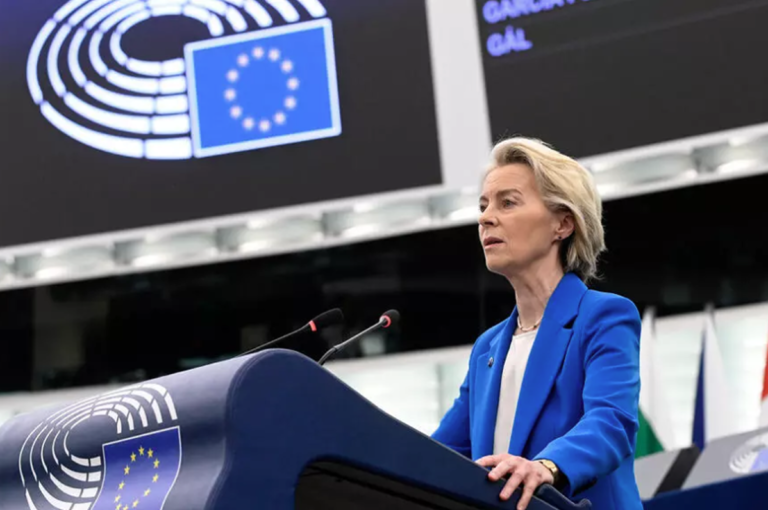
On 4 November, the European Commission published its annual Enlargement Package, the set of reports on each country hoping to join the EU, together with a general Communication on the state of enlargement policy. For the first time, it includes ‘roadmaps’ for the four most advanced candidates: Montenegro, Albania, Moldova and Ukraine. Serbia, North Macedonia, Bosnia and Herzegovina, Georgia and Türkiye are all lagging behind, for different reasons.
Roadmaps and gaps
The roadmaps are indicative. They show how the Commission expects the talks to unfold. For Moldova, the 2027 roadmap foresees provisionally closing 25 of the 35 negotiating chapters (policy areas). For Ukraine, it foresees just seven.
This gap sits uneasily with the package’s political message. Ukraine remains one of the four frontrunners, although the overall assessment in the Commission’s report on Ukraine has barely changed, with only one upgrade: the fight against corruption. Most of the ten priority reforms agreed between the Commission and Kyiv in December 2025 remain unfulfilled.
Ukraine’s place in the frontrunners’ group is an advance on future performance, granted for geopolitical reasons, not a reward for breakthrough results.
In 2026, Ukraine and Moldova started from the same position. Under a procedure known as ‘frontloading’, the EU gave both countries its interim rule-of-law benchmarks. These are the conditions a candidate must meet before any chapter can be closed. Both received these benchmarks months before the formal opening of the first cluster (‘Fundamentals’), the group of chapters on the rule of law and democratic institutions.
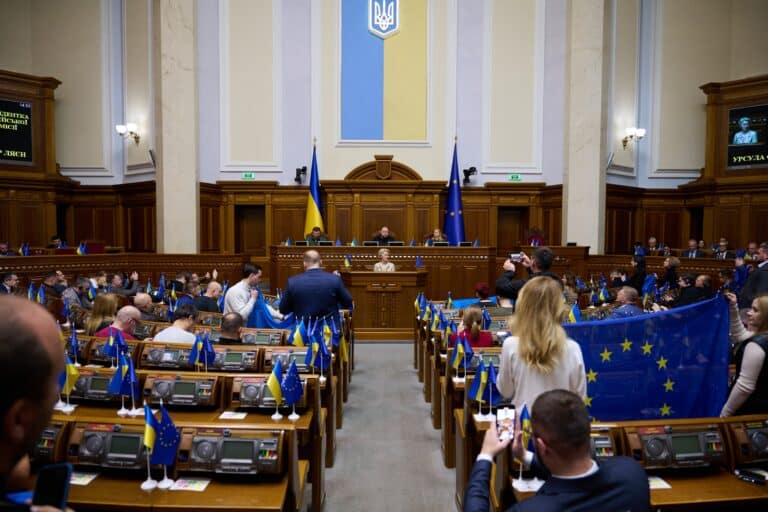
Moldova made use of this early start. The Commission now considers it well advanced and will send its assessment to the Council, where Member States decide. For Ukraine, the Commission can only welcome Kyiv’s intention to meet the benchmarks in the first half of 2027. It has set up a joint task force with Kyiv to support rule-of-law reforms. The task force can help to draft and sequence the laws. It cannot pass them: that still takes votes in the Verkhovna Rada, Ukraine’s parliament.
Since they applied for membership within days of each other in 2022, Ukraine and Moldova have moved as a pair: candidate status in June 2022, the formal start of negotiations in June 2024 and, this year, the opening of four clusters each.
The Commission wants the last two of the six clusters to be opened for both countries by the end of 2026. After that, the joint track can end, because chapters are closed for each candidate on its own merits. If Moldova keeps to its schedule, the two processes will decouple in practice, with Moldova moving ahead on its own.
The seven chapters pencilled in for Ukraine are revealing. Four are the same chapters Albania closed first this year. But for Ukraine, only three of the seven get convincing assessments in the report: education, science, and foreign, security and defence policy.
Social policy and employment (Chapter 19) shows the gap. The roadmap places it in the second half of 2027. Yet the report finds Ukraine still at an early stage of preparation in this area.
A place on the roadmap is a plan, not a promise. No chapter can close until the Commission confirms that Ukraine has met the interim rule-of-law benchmarks. After that, all 27 Member States must unanimously agree on a joint EU position that confirms it.
The Commission’s language on dates is just as careful. It presents closing the talks by the end of 2028 as the Ukrainian government’s objective, not its own. It pledges support but says this requires a faster pace of reform. Albania’s and Moldova’s targets, by contrast, are described as ambitious but achievable.
A self-imposed and unrealistic deadline
Even if seven chapters close in 2027, 28 chapters would still remain for 2028, including every chapter of the Fundamentals cluster. Ukraine’s own plan for adopting EU law, the ‘National Programme for the Adoption of the Acquis’ (NPAA), rests on the same optimism. Most of its deadlines stem from a political target set in 2024, rather than from what ministries and parliament can deliver.
Ukraine’s underlying problem is how it passes EU-related laws. The report calls the slowdown in law-making “a point of concern”. This is, if anything, an understatement, since there is still no single, coherent procedure for adopting laws linked to EU integration. The Verkhovna Rada has passed mainly the reforms tied to the conditions of EU and IMF financing, and not even all of those. Adoption of EU law is treated as a necessity for funding, not as preparation for membership.
The government’s anti-money laundering bill is a case in point. It would create a register of bank accounts and is central to Ukraine’s entry into the Single Euro Payments Area (SEPA), which makes euro transfers faster and cheaper. SEPA is one of three long-standing priorities for 2027 under the EU’s ‘gradual integration’ approach. The other two are an agreement allowing industrial goods certified in Ukraine to be sold in the EU without further checks, and another linking Ukraine’s electricity market to the EU’s. All three would bring tangible benefits before membership. Yet the bill remains blocked in parliament.
Why is parliament impeding progress? Three reasons stand out. First, the hardest reforms would take political control over law enforcement away from those who hold it today: who can open a case against an MP, and who picks the Prosecutor General and the head of the State Bureau of Investigation. These politically tinged, factional issues are the main bottlenecks. Second, the arithmetic: the ruling party has a formal majority but has not passed a law on its own votes alone since 2023. Therefore, every EU-related bill needs a new coalition, and small groups can block it. The third reason progress is slow is that martial law has suspended elections, so any delay costs MPs little. Many of them also see EU commitments as deals the government made without them. In practice, only deadlines for receiving EU funds concentrate minds.
To be fair, the Commission notes that reforms have picked up since late summer, during a particularly difficult period of the war. Defence and security spending was 42.8 per cent of GDP in 2025. Seen this way, the closing of seven chapters in 2027 looks more reasonable.
The war limits what the administration can do, but it does not determine which laws parliament puts to a vote. It is no coincidence that the recent acceleration of reforms has followed the conditions of the EU’s two main finance packages for Ukraine: the Ukraine Facility, worth up to €50bn for 2024-2027, and the €90bn Ukraine Support Loan for 2026-2027.
Geopolitics has done its part, until now
Some in Kyiv still expect ‘geopolitical enlargement’ to carry Ukraine into the EU regardless of benchmarks. Yet keeping Ukraine among the frontrunners despite an almost unchanged assessment is already a form of ‘geopolitical enlargement’, gifted by the European Commission. Brussels cannot go further than this. The process is driven by results, Ukraine has not yet done its homework, and every chapter still needs the consent of all 27 Member States.
The choice lies with Kyiv. Either the government and the parliamentary majority agree on a single package of laws for the interim benchmarks and pass it within months, or Ukraine should stop talking about joining the EU any time soon. The real deadline is not 2028, or indeed any other date. Membership will happen when Ukraine delivers.