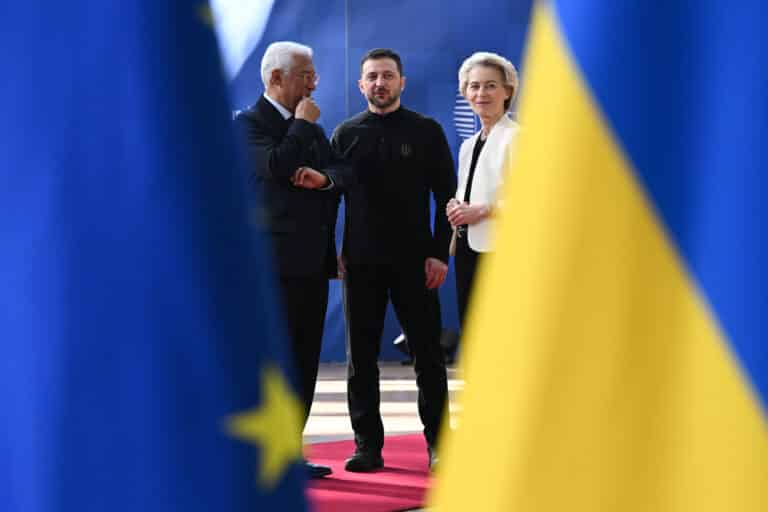
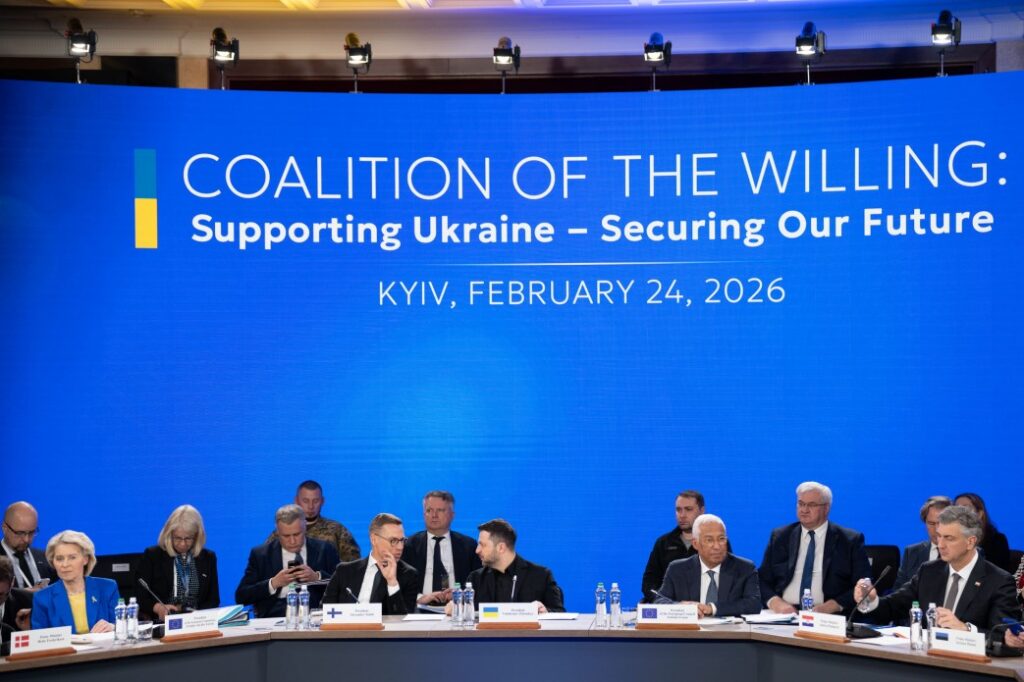
On 24 August the Coalition of the Willing met in Kyiv to mark the thirty-fifth anniversary of the restoration of Ukraine’s independence. Andy Burnham, a co-chair on his first foreign trip as British prime minister, was there alongside the European Council’s António Costa, Finland’s Alexander Stubb, Lithuania’s Gitanas Nausėda, Moldova’s Maia Sandu, the prime ministers of Latvia and Luxembourg and Sweden’s foreign minister; most participants, including the two other co-chairs, Emmanuel Macron and Friedrich Merz, joined by video. In his article for European Pravda, Burnham restated what the format is for: to form a plan for how a Ukraine-led peace deal will be sustained. The real discussion, however, went elsewhere.
While the Coalition’s primary task is to organise a multinational force that would underpin security guarantees once a ceasefire is reached, its recent meetings have delivered in other dimensions: support for Ukraine’s defence industry through technology transfer and licensing, a forum for the most pressing questions of Ukraine’s resilience and defence, and an opportunity to advance bilateral defence initiatives with individual members.
First, Burnham approved the transfer of Storm Shadow technology so that the missiles can be manufactured on Ukrainian territory, and asked British industry to back Freyja, the Ukrainian-European anti-ballistic interceptor project intended as a cheaper alternative to Patriot. Macron undertook to accelerate deliveries and the licensing agreed at the previous Coalition meeting in July, when France authorised Ukrainian manufacture of AASM bombs and SCALP missiles and, with Italy, of Aster 30 interceptors, and pledged support for Freyja. The July Coalition statement welcomed the Anti-Ballistic Missile Coalition and the licences granted for interceptor production, as well as new commitments on operations against the shadow fleet, intelligence sharing and coordinated support to national operations.
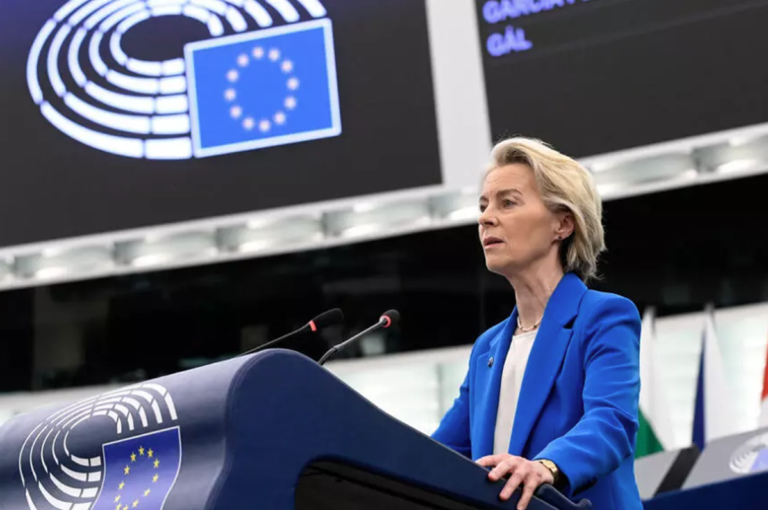
Second, Zelenskyy pressed for the most urgent needs of Ukrainian defence: a winter assistance package against ballistic strikes, with at least 300 Patriot interceptors, financial support for Ukraine’s Defence Ministry, carrying a deficit of 27 billion euros, including by returning to the question of frozen Russian assets; and the unblocking of the Black Sea and the use of the Solidarity Lanes for exports. That day, Ursula von der Leyen announced an additional $7 billion of EU military assistance for air and missile defence, missiles, ammunition and radars. Zelenskyy promised to inform the meeting’s participants about the negotiations at some later point but plainly treated it as a secondary matter.
Third, the Coalition works as a high-level forum attracting multiple partners and resolving bilateral issues. For instance, a day before the Coalition meeting an in-person NB8-Ukraine summit took place in Kyiv, and some defence-related bilateral documents were signed, among them a declaration on strategic partnership and a Drone Deal with Norway, and further agreements with the UK and Finland. As the American lead recedes from the Ukraine Defense Contact Group, which met eight times in 2025 and three times this year, with its September session to be held online, the Coalition is beginning to take up the same questions as Ramstein.
The Coalition’s current work corresponds to Chancellor Merz’s reading of its tasks, set out in July: first to press Russia into negotiations, then to sustain Ukraine for as long as it must defend itself, and only then, with the United States, to be ready to monitor a ceasefire and underwrite guarantees. These initiatives of the last two months, inside the Coalition and outside it, come against a clear escalation in North Korean and Chinese support for Russia, combined with further American disengagement from Europe and its open preference for appeasing Putin rather than forcing him.
On the first, the US-China Economic and Security Review Commission reported in August that China accounted for 90 per cent of all sanctioned technology entering Russia in 2026, and has reportedly supplied satellite imagery used to guide Russian missile strikes. After a year’s pause, Pyongyang resumed supplying ballistic missiles at the end of July 2026 and has deployed to Russia its own crews and six launchers for a unit that is able to fire up to 120 missiles.
Western interceptor deliveries to Ukraine have meanwhile fallen to a third of their 2025 level. Washington neither sells Kyiv the PAC-3 interceptors it asks for nor grants the production licence Trump half-promised in Ankara and reconsidered three weeks later. Zelenskyy told journalists on 23 August that Russia can produce up to a hundred ballistic missiles a month and that the worst estimate for the coming autumn and winter is 1,300 missiles including North Korean ones. This asymmetry in allied assistance certainly demands more resolute actions from Ukraine’s partners that form the Coalition.
Washington’s distance from the Coalition is part of a wider drift. Its presence in Europe is progressively diminishing: the Pentagon has formally launched a review of American force posture and basing in Europe, and Elbridge Colby is actively working in the allied capitals on the handover of primary responsibility for conventional defence to Europe. The 5,000 troops Trump promised Poland by way of compensation for the same number of American troops pulled out of Europe this spring have neither a date nor a place of deployment. Notwithstanding Russia’s numerous hybrid and sabotage campaigns, Trump continues to deny that Russia poses any threat to NATO.
On 16 August, the day before annual military exercises with South Korea were due to begin, Trump ordered the Pentagon to scale them back, citing his good relationship with Kim Jong Un and calling the drills a signal that was inappropriate and hostile towards a North Korea that had been, in his words, unthreatening and respectful — in the same month that Russia resumed firing North Korean missiles at Ukrainian cities. Canada, a treaty ally, is offered no such courtesies: Trump has imposed additional suffocating tariffs on Canadian goods, questions the border — drawn, as he puts it, arbitrarily “with a ruler” — and renames Lake Ontario as Lake America. None of it supports transatlantic trust and credibility, undermining current strategies of staunchly pro-American states such as Poland and Italy.
American indifference and disengagement hinder the original aim of the Coalition and downgrade the security environment in which it functions. Its air component was designed to depend on US enabling capabilities. The Coalition’s Paris Declaration of January 2026 placed an American-led ceasefire monitoring and verification mechanism at the centre of the guarantees; officials cited by Reuters have said this would mean American drones, sensors and satellites. The declaration carries no American signature, and language on the use of American capabilities to support the force was removed from an earlier draft. The scope and the ambition of the force that would have to support such an arrangement were cut back long ago. Zelenskyy’s initial January 2025 benchmark of 200,000 European soldiers had shrunk, by January 2026, to a combined French-British offer of up to 15,000. Among the bigger European states, neither Germany nor Italy nor Poland is offering ground troops: Berlin has floated stationing forces on NATO territory neighbouring Ukraine, Warsaw confines itself to logistics and hosting, while Italy, on the day the exercises were announced, confirmed it would not take part. Nevertheless, keeping the original aim alive, Macron named October and November for the Coalition’s first full-scale exercises, to be hosted by Poland with French and British troops to test command and control, logistics and deployment. The mandate, the desired end state and the rules of engagement of the force remain undefined, and the preparation is slow and politically contested. Launched in March 2025, the Coalition has since acquired a permanent three-star headquarters in Paris, a coordination cell in Kyiv and some two hundred planners from more than thirty nations. After seventeen months, that apparatus is being tested for the first time.
Most importantly, while the Multinational Force Ukraine is still the organising idea of the whole Coalition, what it was meant to guarantee has not yet materialised. At that same 23 August closed briefing, Zelenskyy reportedly told the room that not a single influential ally yet gives any guarantee that anyone would come to Ukraine’s rescue if Putin went further. The attempts to relaunch peace talks follow the usual scheme with the usual results: another one-page proposal on the ceasefire, another innovative “territorial arrangement” for Donbas, another high-profile envoy sent to Moscow to talk Putin into taking a deal, another rebuke from Russia, and a renewed announcement that peace talks will resume in autumn.
What should the meeting point be between what the Coalition was designed to do and what it actually does at the current stage of the war? There is no permanent membership, no institutional structure and no decision-making procedure, and often no common vision. That keeps the Coalition wide, but weakens it whenever common decisions are needed. Tellingly, the result of the 24 August meeting was again a statement by the three co-chairs, not by the Coalition as a whole, betraying the absence of unity. Politically, the situation is no more stable. Macron leaves office next spring and his probable right-wing successors are against both sending French troops and providing more weapons to Ukraine, Merz’s standing at home is weakening, and Poland and Italy face elections of their own; the format has no assurance of continuation beyond the personal commitment of a leader in office. In this context, Burnham’s arrival in Kyiv is a rare show of continuity. For now, the meeting point lies less in the force the Coalition was meant to field and more in the function it has actually acquired: binding Ukraine’s defence into Europe’s — through assistance, through the Drone Deals and other agreements that run in both directions, through joint production and the strategic anti-ballistic projects such as Freyja — all of it real, none of it yet irreversible or structural.
Zelenskyy left the August meeting asking not for deployment but for frequency of meetings — no long pauses, another session in September, he said. That is a rational use of a format whose value now lies in assembling partners often enough to keep Ukraine’s defence agenda high on their list of priorities and for Ukraine to be integrated into European defence — something those who favour a compromise with Russia at the expense of Ukraine’s sovereignty say openly that they fear. The task for Kyiv is to make that function permanent before electoral cycles take away the leaders who sustain it. The greater danger for the Coalition is not dissolution — formats this loose rarely dissolve — but settled routine, in which Europe rehearses responsibility for a war it still expects others to end, while hoping that this ending would not be detrimental to its interests.