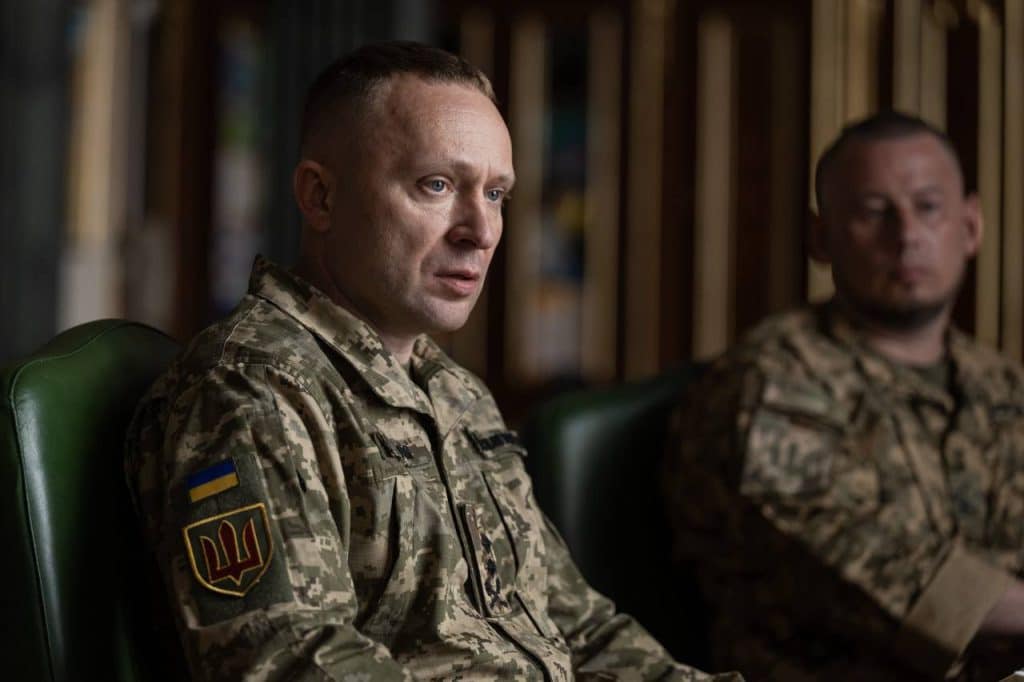
In May 2014, a Ukrainian infantry fighting vehicle accelerated towards a barricade in Mariupol. “Hit the gas,” battalion commander Mykhailo Drapatyi told the driver, and the vehicle burst through. This episode, now reshown on TV screens all over the world, is often used to explain Drapatyi’s decisiveness. Twelve years later, as commander-in-chief, the same man cannot deal with his army’s institutional problems as if they were another barricade. His authority is, at least, strong over command culture, delegation and accountability; while mobilization, procurement and force-generation policy are shared with the Defence Ministry and the presidency.
This division of authority shapes what he can actually transform. Drapatyi can reform how the military thinks, but not what constrains it. The appointment satisfies critics where he has authority while leaving intact the political economy of defence where the deepest rot lies.
The war Drapatyi inherits
There is a temptation to see Mykhailo Drapatyi’s appointment as a clean break with the era of his predecessor, commander-in-chief Oleksandr Syrskyi, marked by suppressed initiative and loyalty-based advancement. But a new commander-in-chief does not get to design the war he inherits. Drapatyi will face the same shortage of personnel, the same dependence on Western supplies and the same Russian advantages in mass and firepower. Any Ukrainian commander would have to hold the front and continue striking Russian forces beyond the immediate line of contact.
The first months are therefore likely to see continuity in strategy. Under Fedorov, medium-range strikes developed into something resembling battlefield air interdiction: attacking roads, depots, command posts, air defences and reserves to isolate Russian forces at operational depth. Without air superiority and unable to achieve a major ground breakthrough under persistent surveillance, Ukraine turned to relatively cheap drones for missions Western militaries would normally conduct with aircraft and precision missiles carrying heavier payloads.
This campaign also exploits a mismatch in Russia’s air-defence architecture. Its systems were designed primarily to engage limited numbers of expensive aircraft and missiles, not constant flows of dispersed drones hunting moving targets. For Drapatyi, continuing the campaign therefore means preserving one of Ukraine’s few ways of producing operational effects without breaking through on the ground – at least before the Russians adapt to this new tactical challenge.
Can the General Staff learn?
If operational strategy remains recognizable, the more consequential change may be in how decisions are made. Brigade commanders who served under Drapatyi told Rob Lee of the Foreign Policy Research Institute that Drapatyi asked what support they needed and listened to their assessments of conditions in their sectors. This sounds like ordinary competent management. But it depends on creating conditions where subordinates can speak truth to power. If HQ punishes bad news, armies operate on distorted information. Drapatyi is said to reward truthful reporting—making it safe for commanders to report problems.
He is also expected to reduce the tendency to micromanage and give corps and brigade commanders more room to act. He may also overhaul the promotion system, rewarding officers who preserve their units and solve problems rather than those who simply avoid contradicting their superiors. None of this guarantees better decisions, but it improves the army’s chances of recognizing mistakes before they become operational failures.
Technology is the second area to watch for change. Drapatyi publicly supported former defence minister Mykhailo Fedorov’s reforms and singled out Drone Line, a programme concentrating specialist drone units and resources on priority sectors of the front, as an example of how a political decision could quickly change conditions at the front. He also acknowledged that many valuable initiatives still succeeded despite the system, rather than because of it.
Fedorov had accelerated battlefield innovation by replacing closed procurement networks with competitive tenders. This model produced results but created powerful enemies within the military-industrial establishment. Drapatyi’s public backing signals he will defend this approach against institutional resistance—not just the technological innovations themselves, but the procurement reform that enables them.
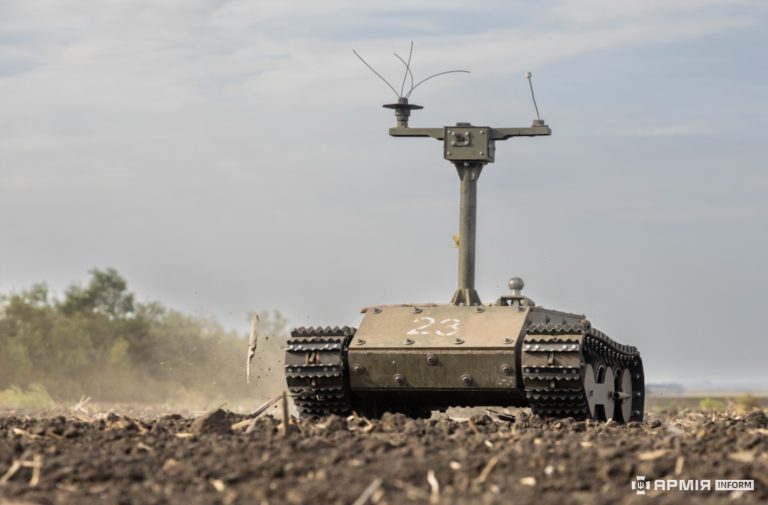
As commander-in-chief, Drapatyi will be better placed to connect innovations developed in individual units with operational planning across the front. Ground-based robots and heavy aerial drones can move supplies through areas where sending a manned vehicle or a group of soldiers has become prohibitively dangerous. This reframes attritional aspect of this war. Ukraine cannot win a manpower competition with Russia, but it can sustain losses in cheap dispersed systems. To sustain this shift, Drapatyi will need to ensure regular technical adaptation.
Reform with the presidency watching
Military-operational reform will not take place in a political vacuum. Politically, Drapatyi may find the job harder than Syrskyi in some respects. The new commander-in-chief’s name reached high office partly through the “cardboard placards” of protesters. This could encourage parts of the military and political system to treat him as a body imposed by the street. In reality, Drapatyi is a career officer who has served for over twenty years.
His popularity is nevertheless a vulnerability. The experience of this war’s first commander-in-chief, Valeriy Zaluzhnyi shows how an admired commander can become a political liability if his public standing exceeds presidential comfort. Syrskyi had stronger presidential protection but was hamstrung by public scepticism. Drapatyi begins with substantial public expectation but also with the paradox that if he succeeds his popularity will be unwelcome.
The circumstances of his appointment reinforce that vulnerability. Drapatyi was chosen not only to replace Syrskyi, but also to defuse the backlash over Fedorov’s removal. As Jaroslava Barbieri of Chatham House argues, Drapatyi’s appointment was widely interpreted as a way of preserving the tech-first direction associated with the former defence minister. This gives Drapatyi an unusual initial mandate, but it also narrows his room for failure: any slowdown in drone integration, procurement reorganization or force protection will be used as evidence that the old system has prevailed.
The first evidence of Drapatyi’s success will probably not appear on a map of force positions. It will be whether corps headquarters receive genuine authority; whether commanders can report that a mission is unworkable without endangering their careers; and whether promotions and dismissals begin to reflect performance rather than proximity to leadership. Another indicator will be force preservation: more predictable rotations, better preparation of replacements and fewer soldiers used for tasks that drones or ground-based robots can perform. Critically, this also depends on mobilization reform, which remains outside Drapatyi’s authority. If these indicators move, Drapatyi’s appointment will mark a genuine change in how Ukraine fights. If they do not, he will inherit not only Syrskyi’s army, but eventually the blame generated by the same system.
What’s next?
Drapatyi’s operational improvements should reduce casualties through better coordination enable more honest upward information flows and young officers to advance on merit. This new level of modernization creates pressure on Zelenskyy to address the rot in the political-miliary establishment.
Alternatively, Drapatyi might improve operations but hit limits when mobilization and procurement issues are not addressed. He might then be blamed for not reforming enough even while Zelenskyy locks Defence Ministry authority into presidential control. If this happens, it would demonstrate not Ukraine’s capacity to transform under fire, but its inability to do so when power is fractured between competing centres.