Categories
Trending Searches






Robots take the risk: Ukraine’s UGV ecosystem and what Europe should learn from it
Ukraine has systematically removed humans from roles that don’t require human judgment, letting machines absorb the danger soldiers would otherwise face. What UGVs can and can’t do, and what lessons European institutions can draw from Ukraine’s experience.



Team members





No Results Found
Infrastructure mission kill: Russia’s jet-powered drones and how to stop them
Russia no longer needs to destroy a bridge in order to shut it. New jet-powered drones, which are faster than its older ones and far cheaper than missiles, are shutting bridges in Kyiv – and they still contain western parts. Europe must build cheap interceptors now, while Ukraine remains the only target.
19 November 2026
25 min
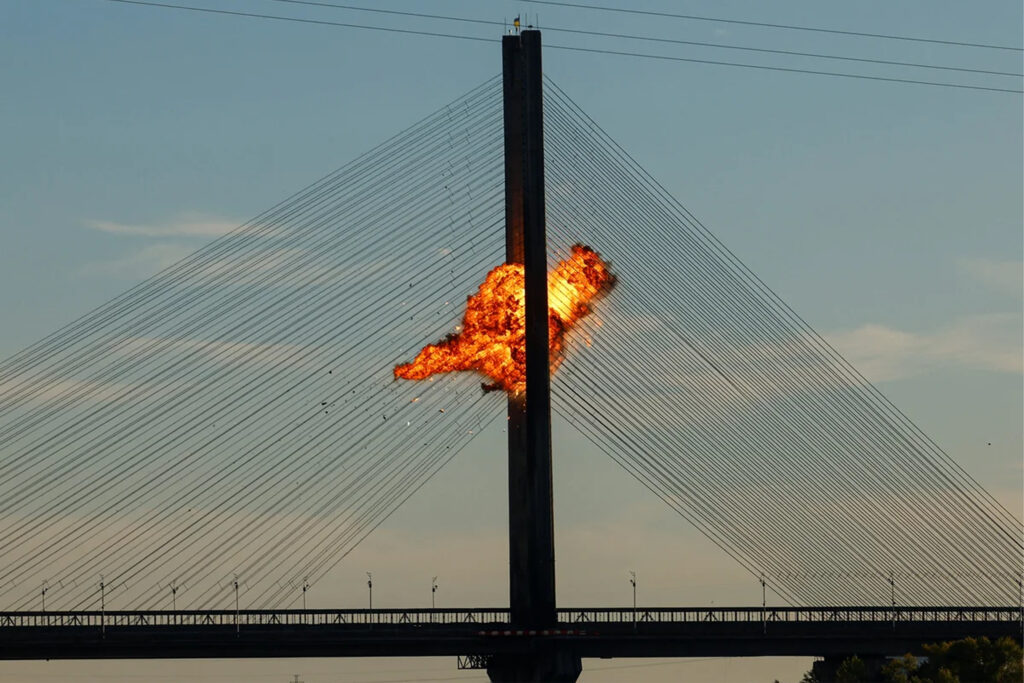
A Russian jet-powered drone strikes the Southern Bridge in Kyiv, Ukraine. Photo credit: Valentyn Ogirenko, Reuters
Text size:
Executive summary
- Russia’s jet-powered drones (the Geran-4, Geran-5 and Banderol) are faster than its propeller-driven Shahed-type Geran-2. They fly at 320–600 km/h (compared to 185 km/h) and cost around $100,000 each. Ukraine is intercepting around 60% of Geran-4s, against 85–90% of the older types.
- Jet-powered drones can inflict enough damage on some infrastructure to be used instead of cruise missiles and cost about one-20th as much, freeing up Russia’s heavier weapons for other targets. Because the ‘Geran family’ shares most of its key components, cutting off a single foreign part, such as the US-made navigation sensor, would slow the production of several weapons at once.
- Russia’s strikes on Kyiv’s bridges create a mission kill: a crossing cannot perform its transport function for a period that is important operationally. Damage, the need for safety inspections, air-raid alerts and power failures can interrupt use even if the bridge remains standing. In November, Russia launched ballistic missiles against Kyiv’s crossings and Ukraine struck the Kerch Bridge.
- A jet-powered drone launched from near Belarus could reach Vilnius in three to six minutes, which is less than NATO’s 15-minute scramble window. Claims that drones ‘drifted’ over the Baltic states are now routine. A deliberate strike on infrastructure such as the LitPol Link power line that connects the Baltic grid to continental Europe would be likely to come with a ready alibi.
- Production capacity is limited as few countries are capable of casting the turbine blades that jet engines need at scale. The advantage will go to whoever is first to build missile-class weapons at drone prices. For Ukraine, this would achieve some of the reach of an air force without aircraft or pilots. This would force Moscow to recalculate the defence of its rear against the needs of its offensive.
Introduction
Early October Russian strikes on Kyiv’s bridges over the Dnipro used its new jet-powered drones, mainly the Geran-4, Geran-5. While they failed to bring any of them down, relatively minor damage to road surfaces, overhead cables and areas near metro tracks was sufficient to place three of the capital’s six road crossings under full or partial restrictions and to temporarily halt metro services across the river. Since more than one-third of the city’s residents live on the left bank while most jobs are located on the right, Russia’s campaign achieved a great deal while leaving every span standing. In military terms, a mission kill occurs when a target can no longer perform its assigned function for an operationally significant period. This might involve physical damage, a closure on safety grounds or uncertainty that forces the authorities to keep the target out of service.
Russia’s newest long-range strike drones have replaced propellers with jet engines. The Geran-4 and Geran-5 build on the Geran-2, Russia’s mass-produced version of Iran’s Shahed; the Banderol is a separate design. All follow a pre-set route and explode on impact. However, jet propulsion makes them up to three times faster and much harder to shoot down. The extra speed also adds punch on impact, but the blast is still down to the warhead. Their cost is well below that of the cruise missiles used for similar strikes.
The disruption to bridges increases when restrictions on bridge traffic coincide with failures of the electricity supply. On 8 October, a voltage drop halted Kyiv’s metro trains and escalators, although services resumed that evening, initially at longer intervals. Further power-related stoppages followed on 10 October and 14 October. Although the cause of the 8 October outage was not specified, repeated interruptions exposed how power failures compound bridge restrictions, disrupting movement across the Dnipro even when the crossings remain intact.
The drone and missile alerts have themselves become part of Russia’s campaign. Throughout September, Russia sent jet-powered drones to the capital every 15–25 minutes, keeping the alert in place for hours regardless of whether a drone got through. Since early October, Kyiv has restricted traffic on several Dnipro bridges for the duration of an air-raid alert. Ukraine’s Economy and Environment Minister Oleksandr Kravchenko estimates the cost of each hour of alerts at $45 million in lost economic activity.
The implications go beyond commuting. Kyiv serves as one of the passages by which western military supplies cross the Dnipro en route to the east, while the crossings from Kyiv feed into the roads leading to Chernihiv, Sumy, Poltava and Kharkiv. Although just one such crossing point, when traffic is restricted in Kyiv it is diverted to other routes which slows movement throughout the entire network.
The campaign has since escalated. A strike on 22 October damaged the metro line that runs over the Southern Bridge, and before dawn on 27 October a ballistic missile hit the bridge again during an attack on the capital. The city closed the bridge in both directions, including to metro trains crossing the river. On 30 October, one lane reopened from the left bank to the right, limited to vehicles up to 10 tonnes. On the night of 6–7 November, Russia hit the Northern Bridge with four ballistic missiles; on 16–17 November, ballistic missiles struck the Northern and Southern bridges, closing both. Russia is firing ballistic missiles, each of which costs $2.4–3 million, at a bridge that cheap drones have already made unreliable. Drones wear a crossing down and missiles inflict heavier damage on top. Against bridges, a jet drone makes a crossing unreliable; heavier damage still requires a ballistic missile.
Five factors determine a bridge’s functionality following an attack: safety, capacity, repair times, alternative route redundancy, and air-raid alerts regardless of direct hits.
Kyiv’s Southern Bridge is suspended from 144 steel cables and can lose one or two without danger. This margin keeps the bridge standing, which is a lower bar than keeping it open. No responsible authority would allow traffic over a crossing after repeated strikes near its supporting pylon, stays and deck. Every attack means another inspection, another closure and another call on a small pool of specialist repair crews, and raises the odds that the next hit lands on something already weakened. The crews themselves are also at risk, because a follow-up ‘double tap’ strike on a site where they are working is a tactic Russia has previously used. Russia has produced the same effect on Kyiv’s Northern Bridge by damaging the road surface and trolleybus overhead lines.
Ukraine took same approach against Russian forces in occupied Kherson in 2022. Repeated strikes by HIMARS rocket launchers left the Russia-held Antonivskyi Bridge standing but pushed Russian supplies on to ferries and barges. The threat of being cut off was key to Moscow’s decision to abandon the city. The parallel is imperfect, however, as Kyiv has more crossings and the capital cannot be cut in two in the same way. An army uses a damaged crossing as long as trucks can physically get over it. A city, however, closes one as soon as engineers can no longer vouch for it. Kyiv’s bridges will therefore go out of service at a far lower level of damage than the Antonivskyi did.
In December 2025, successive days of around 20 drone and ballistic missile strikes on a narrow bridge in Mayaky, on the M-15 Odesa-Reni highway, closed a major international route and squeezed access to the Moldovan border crossings. Such a bridge needs far less damage than a large urban one to cease functioning but Mayaky demonstrates successful recovery. Odesa’s southern region was never completely cut off: a floating pontoon crossing with alternating traffic, rerouting and extra rail and border capacity carried the load until the road reopened. This episode shows that a local mission kill is entirely achievable but that alternatives prepared in advance shrink both the duration and the strategic value for Russia.
Seen nationally, a temporary loss of reliable capacity is a network problem. Counting road, rail and dam crossings, Ukraine has well over a dozen routes across the Dnipro, but they are far from equal in terms of capacity, strategic location and ease of repair. Russia is now striking several of them at once. By mid-November it had hit nine of the 29 key crossings over the Dnipro and the Dniester, by one open-source count. In October it struck one of Zaporizhzhia’s nine Dnipro bridges. On the Dnipro, this slows the movement of personnel, fuel, ammunition and repair materials to the east. On the Dniester, where all four bridges linking southern Bessarabia to Odesa have been hit, it squeezes the road to the Danube ports and the Moldovan and Romanian borders.
On 16–17 November, Ukraine struck the Kerch Bridge with missiles and drones. Russia built the bridge after annexing Crimea, and Ukraine has never recognised it as legal. Whether the strike amounts to a mission kill will depend on how long the bridge stays out of service and how much of its role other routes can take on. Since 2022, Russia has built ways around the bridge using ferries and a land corridor through occupied southern Ukraine, but Ukraine has been hitting those too. In effect, Ukraine has applied the Mayaky lesson in reverse: it is striking these alternatives as well as the bridge itself.
The drones that outran the defence
Ukraine has developed an effective layered defence against propeller-driven Shaheds, destroying 85–90 per cent of them according to Ukrainian government figures, as of the spring of 2026. Against the jet-powered Geran-4, the General Staff reports an average of almost 60 per cent in the past three months, rising to 80 per cent in some attacks. The faster drones are already a substantial part of Russia’s arsenal. It used around 2,400 jet-powered Gerans in August alone, roughly matching the number of conventional models deployed in that month.
The blanket term ‘jet-powered drone’ covers three different weapons. The closest relative of the original is the Geran-4, which is Shahed-shaped with a strengthened airframe, a turbojet engine and a warhead of roughly 50 kg. It retains the economics of a mass-produced propeller-driven drone while giving defenders far less time to respond. The Geran-5 has a much larger (6.5-m-long) airframe, and can reportedly carry a 90-kg warhead at 450–600 km/h over a range of up to 950 km, although some accounts say about 600 km. It can climb to 6 km, although so far it has been recorded at altitudes of 2–3 km. In the air it behaves like a light cruise missile; on the production line it is still a drone. It is built at Alabuga in Tatarstan (Russia’s largest and most active industrial production special economic zone) and shares most of its key components with the rest of the Geran family. The S8000 Banderol is a separate design, closer to a compact cruise missile, fired from the air (mainly from Orion drones) and, more recently, from ground launchers. Ukrainian intelligence gives it a 500-km range and a cruising speed of 520–560 km/h. Its warhead weighs about 115 kg, about 50 kg of which is explosive material. A single raid can combine propeller drones, decoys, Geran-4s, Geran-5s and Banderols, each of which calls for a different response. Defenders face multiple trajectories, altitudes and guidance systems all at once.
Defence against propeller-driven systems rests on reaction time and jamming ability. The Geran-4 and Geran-5 take away some of both. In so doing, they are filling the gap between a cheap one-way attack drone and conventional cruise missile. Speed is the obvious change. Altitude squeezes the defenders from both ends. Flown high, the drone is out of reach of machine guns and some interceptors; flown low, it uses terrain and buildings to stay hidden until late.
Ukrainian intelligence estimates that Russia is already building 3,000 Geran-4s and Geran-5s a month, or around 100 a day. Both have flown on the same Chinese Telefly turbojet; the newest variant, the Geran-5 K5-K, uses an engine assembled in Russia from Chinese components. Ukrainian intelligence’s teardown of the Geran-5 K5-K found 93 foreign-made electronic components, 52 of them US. Russia has tried to hide the markings on some parts, which suggests sanctions are making supply more difficult.
Range and payload dictate where and how the jet-powered drones are used. Russia has traded range for speed: the Geran-4 flies about 450 km, against roughly 2,000 for the Geran-2. The Banderol’s short reach explains why Russia fires it at Odesa from Crimea or launches it from aircraft closer to the target, as in the attack on Kyiv in June. Short-range weapons concentrate on Kyiv and cities near the front and the border, which tells planners where scarce defences should go first. The warheads are small: 50 to about 115 kg, against 480 kg for an Iskander-K cruise missile, about 400 kg for a standard Kh-101 and 800 for its modified version. A Geran cannot bring down a bridge span. It has to hit the right component and keep hitting it, which is the pattern of the Kyiv campaign and the reason the navigation upgrade matters so much (see below).
An even more consequential change is that the drone has learned to ‘look down’. Since 2022, the cheapest way to stop a Shahed was to blind it and allow it to wander off course. A Geran-4 modification introduced this autumn, examined by Ukraine’s Defence Intelligence, adds magnetic correction and an optical system known as ‘Susanin’ to its guidance. Susanin compares what an onboard camera sees with reference images stored in the drone’s computer, and so checks its route against the ground below. A similar system has appeared on a new Geran-5 variant. Drones modified in this way hold their course even through jamming. For a campaign against bridges, this matters more than speed. A jet-powered drone that cannot be blinded can be sent back to the same location until it hits its intended target.
A weapon for components
Ukrainian intelligence has identified a new warhead on the latest Geran-4, designed to cut through bridge structures and electricity pylons. It works on the principle that demolition engineers use to sever steel beams. The explosive is designed in such a way as to drive its force into a narrow line instead of spreading it in every direction. The two upgrades suit each other. Navigation gets the drone to the right spot on the target, and the charge makes the most of arriving there. Fifty kilograms is small by missile standards but if the steel is not thick enough, it may be enough.
This changes what a Geran is for. The early Shaheds were blunt instruments: explosives delivered in bulk to large, fixed targets far away. The new ones are increasingly able to pick out a constituent part of a target, and bridges, power grids and railways all contain a few elements that matter far more than their size suggests. Destroying pylons can cause mission kill when a power station remains intact but its electricity cannot reach consumers.
How closely this weapon is tied to the bridge campaign is open to question. Russia introduced the new Geran-4 this autumn and within weeks was repeatedly attacking Kyiv’s bridges. Russia’s bridge strikes now form a campaign from Kyiv to Zaporizhzhia and the Dniester, but whether every strike used this configuration has not been established. Nonetheless, it suggests that Russia expects infrastructure attacks to remain a regular assignment for the Geran family. A jet-powered Geran costs roughly $100,000 by open-source estimates. The comparison that matters is with the weapons it is starting to replace: a Kalibr or a Kh-101 cruise missile costs about $2 million apiece according to Russian procurement documents reported by Militarnyi. Thus, for the price of one missile Russia can launch about 20 drones.
Wherever a Geran can take on a mission that previously required a cruise missile, the savings include a Kh-101 or Kalibr left in reserve. Across a prolonged campaign, that could give Moscow considerably more freedom to sustain attacks. Ukraine could face growing pressure even if Russian cruise-missile production remains unchanged. These savings have limits, however, as Kyiv’s bridges show that where Russia wants heavier damage, it still turns to ballistic missiles. The drone can keep a target unreliable; breaking it still takes a missile.
The engine is the most expensive imported part. Earlier jet variants used Chinese Telefly engines estimated at around $40,000 each. Ukrainian intelligence reports that the K5-K uses a turbojet assembled in Alabuga from Chinese components, and that the upgraded Geran-4 carries a ‘localised’ Russian equivalent, without saying how much of it is still made in China. The upgraded navigation system still uses a US-made sensor. Because the Geran-4 and Geran-5 share most key components, one imported part can feed several models at once. Much therefore turns on what domestic production covers and how readily the foreign parts can be replaced.
Who controls the connection?
In February 2026, Ukraine and SpaceX shut out the Russian Starlink terminals that had been using the network without authorisation. It happened fast and demonstrated how directly whoever runs a communications network can reach into a war. Since then, Russia has been putting money into satellite and radio links of its own and into drones that rely less on outside signals to find their way. The cut-off cannot take all the credit, but it provides an obvious motive.
A Geran can fly its programmed route without a Starlink connection. Ukrainian intelligence has identified both a mobile-network modem and a mesh-network modem on a single Geran-5. The first lets the drone connect via ordinary Ukrainian mobile phone networks, as earlier Gerans did with Ukrainian SIM cards. The second allows drones to pass data to one another, so a message can travel further than a single connection would carry it. These links allow an operator to adjust the drone’s course during an attack. The hardware alone, however, cannot tell us whether anyone was steering the strikes on Kyiv’s bridges in real time.
In September 2026, Ukraine’s border service claimed that relay stations in Belarus had supported Russian drone strikes on western Ukraine. Hosting such infrastructure allows a government to assist a campaign without supplying aircraft or launching weapons. This broadens responsibility to include states whose territory sustains the attack.
Ukraine’s own, fully authorised access has proved fragile too. On the night of 13–14 October, Ukrainian units ran into new limits (a speed cap of about 161 km/h) on military Starlink-guided drones. Strike drones and interceptors alike began to drop off the network. An interceptor fast enough to catch a jet-powered drone flies well above that cap. As of 24 October, Starlink operations have been restored to the speeds Kyiv had before restrictions were put in place.
Ukraine can design an interceptor, build it at volume and train crews to fly it, but the conditions for using it may still be set in another country. A shared network also ties together missions that governments would rather keep separate. A limit that affects strike drones also affects interceptors guarding cities on the same night. Whatever the reason for the October drop-offs, a decision taken in the United States, whether by SpaceX or by the US government, cut Ukraine’s drones from the network for 10 days.
Building defence in layers
No single weapon will stop a jet-powered drone: a system does. By mid-October, seven different interceptor designs had shot down jet-powered drones and the government had ordered more than 1,000 units. In all, 22 teams are working on the problem, 12 of them with state funding through Brave1, the government’s defence-technology platform. They are experimenting with three kinds of propulsion: small jet engines, fast electric propellers and battery-powered fans enclosed in a tube. That variety helps. An electric fan costs about one-eighth of a small jet engine and does not need scarce parts.
Ukrainian drone maker Wild Hornets says that it has destroyed Geran-4s and Geran-5s in combat testing and plans mass production within a month of finishing trials. Its crews already fly the company’s older interceptors every night, which should shorten the ramp-up.
Until 2025, no private Ukrainian company was making small jet engines. Brave1 began to fund them in that year and serial production took more than 18 months. Six companies now produce them and five more are developing them.
The easy parts were localised first. Ukrainian producers now make casings and combustion chambers in-country, but the turbine and control electronics still come from abroad and turbine shortages limit output. The turbine is the hardest part: it spins in the hottest section of the engine and needs heat-resistant alloys and precision manufacturing. An engine assembled in Ukraine around an imported turbine still depends on foreign suppliers, much like the satellite link. Joint ventures with European firms, such as the one agreed in June with the Czech AviaNera, could help.
Interceptors also compete with long-range strike drones for engines, which rely on the same European suppliers. Czech makers already report capacity stretched to the limit. Ukrainian Defence Minister Yevhen Khmara expects 2027 demand for one engine type alone to reach about 10,000 a month. An interceptor asks the least of its engine: modest power for a few minutes of flight. The state will have to decide which programmes get jet engines and which will have to make do with simpler ones. Left to the market, engines go to whoever pays most.
Two Ukrainian anti-aircraft missiles are close to combat use. The price of each has been capped by Brave1 at $20,000. An AIM-9X fired from an F-16 costs about $500,000. At $20,000, a crew could fire two or three missiles at one jet-powered Geran and still spend less than Russia paid for the drone.
Existing European air-defence industries offer another route to scale. Radar-directed guns such as Rheinmetall’s Skynex are designed to shoot down drones and cruise missiles, and they complement short-range missile systems. Guns of this kind suit fixed sites such as bridges and substations, the very targets a mission-kill campaign returns to. Their contribution depends heavily on ammunition.
Detection is where Ukraine can turn the mission-kill logic around. It already combines radar, camera and acoustic data in preparation of its defence. A Russian jet-powered drone leaves only minutes to react, which is too little time to guard everything equally – but this is not necessary. To keep a bridge closed, Russia must keep hitting the same bridge, and the limited number of important crossings and key substations are known to both sides. Long-endurance drones carrying sensors can circle above the primary targets and spot low-flying drones that buildings hide from ground radar. The extra seconds gained can allow a second shot if the first one misses.
F-16s, when scrambled, add a 20 mm cannon layer, which saves missiles but costs fuel and the maintenance time needed for other missions. The last line of defence is robotic machine gun turrets that aim using cameras and tracking software. Ukraine’s Air Force confirms the turrets have shot down Geran-5s, but their short range only covers the final leg of an approach. In addition, Russia is adapting to Ukrainian electronic warfare. Jamming satellite navigation matters less on drones that navigate by camera and Russia’s newer antennae are much harder to jam. The new targets for Ukrainian electronic warfare are the mobile networks and relays a drone uses in its final seconds.
What do jet-powered drones change for NATO?
A Geran-4 launched from nearby Belarus could reach Vilnius in about six minutes and Warsaw in 35. A Geran-5 would need just a few minutes for Vilnius and under 25 for Warsaw. From Kaliningrad, a Geran-5 could reach Berlin in about an hour. From western Crimea, a Banderol could reach Constanța, Romania’s main Black Sea port and the site of a nearby NATO air base, in about 40 minutes. These are straight-line estimates.
A propeller drone is slow enough to allow defenders to wait until it is over open land. A jet leaves less time, so the decision to fire may come over a city or an airport, where debris and the warhead endanger people. A Geran-4 at cruising speed would cross the Suwałki corridor, the strip of Polish-Lithuanian border between Belarus and Kaliningrad that links the Baltic states to the rest of NATO by land, in about 12 minutes; a Geran-5 in seven to nine. At Šiauliai, a Lithuanian air base that hosts the NATO Baltic Air Policing mission, fighter crews must be airborne within 15 minutes of a scramble order. The clock starts only after the target has been detected and the scramble approved, which leaves little room for deliberation.
On 15 September, Italian Eurofighters shot down a Russian Gerbera, a cheap propeller-driven drone usually flown as a decoy, that had entered Lithuania from Belarus with explosives on board. President Gitanas Nausėda said it had probably been aimed at Ukraine and pushed off course by Ukrainian electronic warfare. It spent half an hour or more in Lithuanian airspace, long enough for it to be tracked and identified. A jet would cross that ground in minutes.
On 18 October, another object believed to be a drone entered Lithuania. Two Italian Eurofighters scrambled but thick cloud prevented the pilots from identifying it by sight and they held their fire. The object then vanished from radar, possibly after blowing itself up over Pasvalys district, where debris struck a passing car. Lithuanian officials said it was most likely Ukrainian. Kyiv suggested Russian jamming had diverted it.
Both drones were probably strays pushed off course by the other side’s jamming. Over the Baltic states, protestations that drones ‘drifted’ are now routine. A deliberate attack by Russia could well use such a scenario as cover.
On 17 October, Romanian F-16s shot down two jet-powered Gerans over the Black Sea. Bucharest’s defence ministry had recorded eight drones near the border in that week, four of which briefly entered Romanian airspace. Romania requested a special meeting of the North Atlantic Council, NATO’s main decision-making body.
So far NATO has answered incursions into its territory on a case-by-case basis, short of invoking Article 5. This keeps escalation political and leaves a grey zone where repeated attacks do real damage without being recognised as acts of war.
Incidents in the Baltic Sea illustrate the same grey zone. On Christmas Day 2024, the Russian shadow fleet tanker Eagle S was accused of dragging its anchor across the Estlink 2 power cable and several telecom cables. The power link was out of operation for several months. A case in the Helsinki courts was dismissed on jurisdiction grounds in October 2025 and revived on appeal in August 2026, but a judgment is still pending. A small physical act has produced a large effect without the clarity of a military strike.
What if the same logic moves inland? LitPol Link, a 400-kilovolt power line from Alytus in Lithuania to Ełk in Poland, connects the Baltic grid to continental Europe. A few drones hitting its pylons or substations might kill no one and might not cause total destruction but grid operators would still have to cut circuits, inspect the line and run the Baltic grid under strain. That is a mission kill. The line would still be standing but be unable to do its job. Small-scale attacks with increasingly sophisticated drones could impose significant military and political costs on NATO and Europe.
Straight-line distance divided by cruising speed (Geran-4, 320 km/h, per Ukrainian Defence Intelligence; Geran-5, 45–600 km/h; Banderol, 520–560 km/h). Distances: Belarusian border to Vilnius, about 33 km; Brest to Warsaw, about 186 km; Kaliningrad to Berlin, about 530 km; western Crimea to Constanta, 330–390 km. Real routes are longer, so these are indicative times at cruising speed. The author has found no public reports of launch sites for jet-powered drones in Belarus or Kaliningrad.
The corridor is about 65 km wide at its narrowest, between Kaliningrad and Belarus. At a cruising speed of 320 km/h, a Geran-4 would cross it in about 12 minutes. At 450–600 km/h, a Geran-5 would take 6.5–8.7 minutes.
Conclusions
‘Mission kill’ is a kind of attrition that conventional measures of military strength barely register. A state can keep most of its bridges, substations and refineries standing but still lose their ability to function. Cheap drones make such uncertainty affordable night after night.
Since 2022, the slow propeller drone has appeared to be the ideal weapon for this type of warfare: cheap enough to lose but good enough to matter. Its limitations have been exposed by Ukrainian defences but Russia has adapted and moved its drone ‘towards the missile’. The line between the two is now blurred, and price and warhead size are now the main differences. Jamming, long the cheapest answer to less advanced drones, still works against many types, as the Gerbera over Lithuania suggests, but is becoming less reliable against new models that navigate by camera and resist interference.
Russia’s pivot to more expensive drones is, in a sense, a Ukrainian achievement. Ukraine’s defences have forced Russia to pay for sophistication. This asymmetry runs both ways: Ukraine’s cheaper strike drones exploit Russia’s own short-range defences. Each adaptation in this war is now effective for only a few months. The logic that pushed Russia towards jet power will push Ukraine the same way as Russian defences improve. Ukraine’s own jet-powered weapons, such as Peklo (‘Hell’), are an early sign of this shift.
If 2026 was the year that jet-powered drones arrived in numbers, 2027 may well be the year they constitute the majority of all long-range strike drones. The contest is heading towards cheap missile-like drones in large numbers for both attack and interception. The underlying technology already exists: the small jet engine is 1950s technology, while small homing sensors can guide a weapon to its target, navigation is by camera and inertial sensors. What remains scarce – in Ukraine and Europe, and for Russia without Chinese components – is the capacity to combine these parts and build them at scale. Few countries are capable of casting turbine blades by the tens of thousands.
Jet-powered drones are missile-class weaponry. They depend on specialised propulsion, precision manufacturing, export-controlled components and a small pool of engineers. The advantage will go to the country or bloc whose defence industry first makes such missile-class weapons at drone-like prices and can keep making them in wartime conditions. The drone itself may end up as a carrier, a cheap truck that brings missiles within reach of their targets. A small missile can fly only about 200 km, so a drone must carry it the rest of the way, release it beyond the range of short-range air defences and, by design, fly home to be used again, although some experts doubt it could often survive a deep strike. Aviation experts expect some carriers to fly among ordinary strike drones to fire on air defences. Ukraine has already unveiled such a design, a version of its Liutyi long-range drone that carries missiles.
For a smaller state, cheap precision weapons offer some of the reach once reserved for a large air force without the demands on pilots and expensive aircraft. A credible prospect of sustained Ukrainian strikes using this adaptive technology will force Moscow to weigh the protection of its own rear against the needs of its offensive.
A ceasefire would leave Russia’s capacity for these attacks untouched. Launches would stop but the designers, factories, supply networks and engineers behind them would stay in place, ready to be put back to work. Without fundamental political change in Moscow, any settlement would be only as durable as the military and industrial balance behind it. Ukraine’s own long-range strike capacity is part of that balance.
Recommendations
- European governments should put drone factories on a retainer, providing a fixed payment to keep production lines staffed for three to five years. Any model ordered today will be outdated before a conventional contract ends. Contracts should stipulate a monthly volume and let Ukraine’s military choose the model each quarter in consultation with other European defence and military experts. When Russia changes its drones, the western production line must switch products while maintaining its workers, machines and suppliers. Engines, homing sensors and control boards should come first. Every new design needs them.
- NATO should require every system on its approved counter-drone list to prove it can bring down drones flying at a specified minimum speed. At NATO’s Ankara summit Defence Industry Forum on 7 July, members committed to spend more than $40 billion on counter-drone capabilities over five years and set a goal of training five times as many drone operators by the end of 2027. NATO also plans a counter-drone marketplace so that what members buy is NATO-tested and NATO-compatible from a vetted list. This grew out of a trial in which companies pitched their systems to NATO, which tested them at ‘innovation ranges’ in Latvia and elsewhere. To be funded, systems would have to stop targets flying at 600–800 km/h by 2028, which according to Ukraine’s defence minister is the velocity Russia is working towards. These systems will need to make the intercept head-on, against a manoeuvrable target, with the final interceptor approach automated, since at these speeds a human operator has too little time to react. Drone Deal partners, the 11 countries with bilateral agreements that fund Ukraine’s defence industry in exchange for access to its technology, can already negotiate access to Ukraine’s new interceptors. Finland, France and Sweden joined Flight Training Europe, NATO’s shared aircrew-training scheme, at Ankara, and NATO is extending it to drone operators. New courses taught by Ukrainian crews should include interception of jet-powered drones.
- The EU and Ukraine should keep a joint dependency register. There should be a classified list of every foreign part in Ukrainian jet-powered drones and interceptors, showing where it comes from and which parts have no alternative supplier. This could be updated every quarter. Orders for each part should be pooled in joint purchases across Ukraine’s programmes, European long-range strike programmes and NATO’s counter-drone purchases, so that suppliers see larger, steadier demand. Where supply is short, Ukraine’s front-line needs should come first.
The register should have a level below complex components for materials and tooling. Turbine blades are cast in precision moulds that wear out after a few hundred uses, and some casting materials come from a single supplier. Europe should fund new production lines and research into 3D-printing of engine parts that come into contact with extreme heat.
The parts Ukraine still imports for its jet-powered drones map Europe’s own weak points. When Peklo – Ukraine’s jet-powered drone-missile – entered serial production in December 2024, its developer (a Ukrainian company not named for security reasons) said roughly 30 per cent of it still came from abroad. Europe’s planned cheap strike weapons and its counter-drone interceptors need many of the same imported parts as Ukraine’s drones. According to Ukraine, China has already restricted sales of drone parts to Europe while continuing to supply Russia.
- Make manufacturers trace and cut-off the supply of every western-made part in a Russian drone within 30 days. When a western-made chip turns up in a Russian drone, the company that made it should be required to answer for it. EU rules already require exporters to ban re-export to Russia in their contracts and to run enhanced due diligence on a list of high-priority items – the EU’s list of dual-use components most often found in Russian weapons. These rules require firms to assess risk in advance but say nothing about what happens once a firm’s part has reached the battlefield. They also miss the many ordinary civilian components found in the drones that are not on the list. A documented find should give the manufacturer 30 days to trace the batch, cut off the distributor that sold it and make a report to the national authorities. Any component found in a Russian weapon should be automatically added to the high-priority list. The EU should press the US, the UK and Japan to apply the same rules.
Acknowledgements
I am grateful to military expert Antonii Palamar for discussions and for sharing his experience and insights on drone warfare and air defence. The analysis and recommendations are my own.
Authors

Lesia Bidochko
Policy Fellow


Thank you!
You will now receive EPIK’s latest analysis, publications, event invitations, and other updates directly in your inbox.
Thank you!
You will now receive EPIK’s latest analysis, publications, event invitations, and other updates directly in your inbox.
Go Home Page
Thank you!
The form has been successfully submitted. We value your time, so please expect a call or email from our manager shortly.
Go Home Page
Thank you!
You will now receive EPIK’s latest analysis, publications, event invitations, and other updates directly in your inbox.
Thank you!
You will now receive EPIK’s latest analysis, publications, event invitations, and other updates directly in your inbox.
Thank you for subscribing
You will now receive EPIK’s latest analysis, publications, and event updates directly in your email.
Go Home Page