The day after: Six post-war challenges for Ukraine
A ceasefire is nowhere in sight. Putin sees no interest in ending his war. Even so, the EU should start preparing for the many post-war challenges Ukraine will face.
Oleksandr Kraiev
Andreas Umland
Policy briefs
Robots take the risk: Ukraine’s UGV ecosystem and what Europe should learn from it
Ukraine has systematically removed humans from roles that don’t require human judgment, letting machines absorb the danger soldiers would otherwise face. What UGVs can and can’t do, and what lessons European institutions can draw from Ukraine’s experience.
Membership First or Accession Treaty First? How to revive EU enlargement
The European Union’s accession promise loses credibility if it continues to keep the most significant benefits of accession until the end of the process. Its two political options for bringing membership forward – Membership First and Accession Treaty First – must both pass the same four tests.
After the Fall: How US policy on Ukraine may change after the Midterms
The earthquake in American politics is probably good news for Ukraine. President Trump’s ambition for normalisation with – and appeasement of – Russia now faces serious obstacles. The reassumption of unambiguous support for Kyiv, though, is still subject to US political infighting.
The stunning victory of the Democratic Party in the US midterm elections was driven primarily by domestic economic concerns. But the consequences of that victory and the repudiation of the presidency of Donald Trump that it represents will have immense significance for the Euro-Atlantic alliance and for Russia’s aggression against Ukraine.
The scale of the majorities the Democrats have attained in the Senate (as many as 56 Senators out of 100) and in the House of Representatives (approximately 260 out of 435 seats) gives the party’s leadership scope for manoeuvre and marginalises the influence of a handful of far-left legislators, whose influence on foreign and security policy will likely be insignificant. Additionally, the Democratic victory means that the legislative committees that deal with foreign affairs, defence, and appropriations will be in the hands of longstanding Atlanticists and advocates of military and economic aid for Ukraine. Just as importantly, the rebuilding of a bipartisan pro-Ukraine and pro-Atlanticist foreign policy will be aided by the fact that the Republicans who will serve as ranking minority members of the defence and foreign affairs committees understand that Russia poses a direct threat to Euro-Atlantic security. A spirit of bipartisanship on national security issues could be aided by an emerging fight over the direction of a post-Trump Republican Party that will pit traditional national security Republicans against MAGA-linked isolationists.
The ideal would be for the new Congressional leadership to convince President Trump to abandon his policy of cooperation with Russia and shed his hostility to European and Euro-Atlantic institutions. But if such efforts fail – a distinct possibility – there are numerous legislative mechanisms by which the Congress can work to shift Ukraine policy and reinforce US commitments to its longtime allies.
How it could work
One such mechanism is the linking of funding for specific aims to larger pieces of legislation that are top priorities for the president. This could mean, for example, that new funding for Ukraine’s military needs or the enforcement of sanctions against Russia could be attached to the annual omnibus US defence appropriation or crucial domestic budget financing. In such a circumstance, if the main bill meets many of the President’s policy objectives, it is unlikely he would exercise his veto power.
In the Senate, such a tactic would require more than the House’s simple majority to invoke cloture (the process of consent by at least sixty Senators to move a bill to a full vote). With as many as 56 votes in hand, moving and amending legislation would require the support of just a handful of moderate Republicans, many of whom have disagreed with Trump’s approach to Russia, Ukraine, and the rest of Europe. Some of these moderates, who were heretofore silent, may today feel freer to act and speak out as Trump’s power wanes. The key Republican Senate voices on national security, Senators Roger Wicker and James Risch, are staunch Atlanticist supporters of Ukraine, as is the current Republican Senate leader, John Thune.
While much will depend on the emerging fight over the heart, soul, and direction of the Republican Party post-Trump, there is also the prospect that the Congress will occasionally muster bipartisan two-thirds supermajorities on key issues to override a Trump veto. In addition to military and economic aid to Ukraine, such veto-proof majorities could emerge in support of a cut-off of funding for the war on Iran, and agreement to annul or reverse Trump’s economically harmful (and inflationary) tariffs.
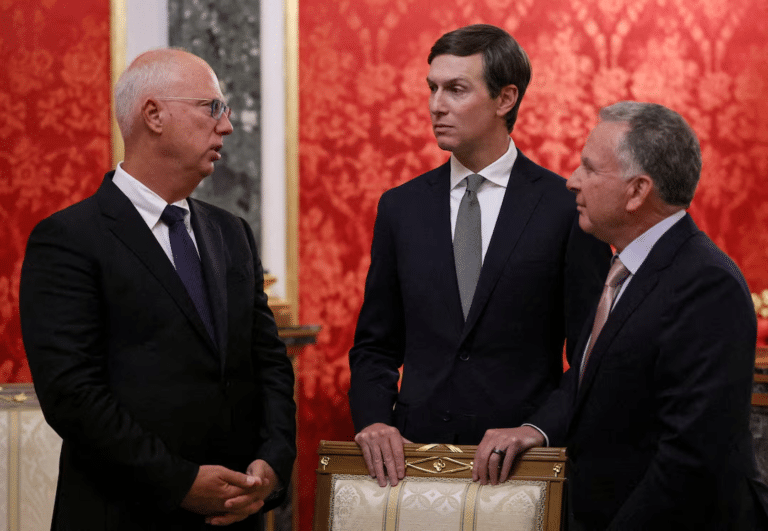
There are further reasons to anticipate a potential shift in the Administration’s Russia and Ukraine policies. The main cheerleaders for Trump’s pro-Russia tilt, Jared Kushner and Steve Witkoff, are likely to come under pressure from legislative committees investigating their commingling of personal business interests with diplomacy. Already, emerging Democratic leaders such as Georgia Senator Jon Ossoff have made economic relationships with Saudi Arabia, the UAE, and Russia the subject of sharp rhetorical attacks and suggested that commercial interests and personal gain are having a pernicious influence on US foreign policy interests.
Pre-election polling showed that corruption and conflicts of interest within the Trump inner circle were among the main issues that led to the Republican defeat. Democrats – as well as Republicans who seek to loosen their party from Trump’s grip – will likely use committee investigations and transform this issue into a cudgel in their efforts to ameliorate the President’s foreign policy tilt. Democratic legislators have made it clear that they favour the renewal of some direct military and economic aid for Ukraine. Unless there is a breakthrough in Trump’s thus far feckless efforts to broker an end to the war, such legislative efforts are likely to come to fruition as the National Defense Authorization Act is debated and shaped by the current “lame duck” session.
What will Russia do now?
Russia is already sensing the coming power shift. In the days since the seismic shift in US politics, its media has spoken of the likelihood that the power shift may derail Trump’s plans for US-Russia economic cooperation. There is a sense that the next two months represent a narrowing window of opportunity to broker an end to the war on terms favourable to the Kremlin.
This means that the coming weeks will be yet another test of Putin’s intentions. If he does not seek to strike a rational peace deal now, he will face a far more difficult US policy environment in 2027. Polls show the US public sympathises with Ukraine and is hostile to Putin’s Russia. This will engender confidence in the Democratic Party hawks and their ambitious Republican counterparts.
In this context, recent reports of attempts by President Trump to negotiate a wide-ranging European security agreement with Russia as part of a broader solution to the war in Ukraine are likely to meet with overwhelming opposition by the new Congress.
Conclusion
For the last two years, Trump has pursued an erratic foreign policy that has eroded the trust of traditional US allies in the democratic world and undermined Europe and Ukraine as they face an increasingly violent Russia. Now these policies will face more criticism and pushback by the Democratic majority as well as by moderate Republicans who are today emboldened to speak and act more clearly in support of the Atlantic alliance amid Trump’s growing unpopularity.
Trump will continue to wield significant power in this sphere and can, if he so chooses, attempt to pursue disruptive and destructive policies. His appointment of MAGA hardliner Stephen Miller as his new chief of staff points to a combative end to his presidency. But the return of the Democrats to power, the re-emergence of Atlanticist Republicans, and the re-engagement of the legislative branch as an important counterweight to executive power in the shaping of US policy are likely to check Trump’s worst excesses and to begin the gradual process of rebuilding trust among democratic allies in the reliability of the United States.
a Senior Fellow at the Atlantic Council and the author of Battleground Ukraine: From Independence to the War with Russia, published by Yale University Press. He was formerly President of Freedom House
A frontrunner by virtue of trust: what the EU’s 2026 report tells Kyiv
Ukraine is an EU membership frontrunner mainly because of its unique geopolitical status. The reality is that there is a substantial gap between this status and its performance in meeting the requirements for entry.
The crimes of the SS and Wehrmacht against millions of Ukrainians in 1941–44 mean that Germany has a special obligation to Ukraine. This makes the pseudo-pacifist arguments of some German politicians and intellectuals for reducing or ending support for Ukraine’s self-defence particularly abhorrent.
Peace plan or pipe dream? Washington’s gas gambit misreads the Kremlin
While Kyiv might be content with renewed transit of Russian gas to the European Union through Ukrainian pipelines as part of a ceasefire deal, Moscow is unlikely to trade its war aims for such an outcome.
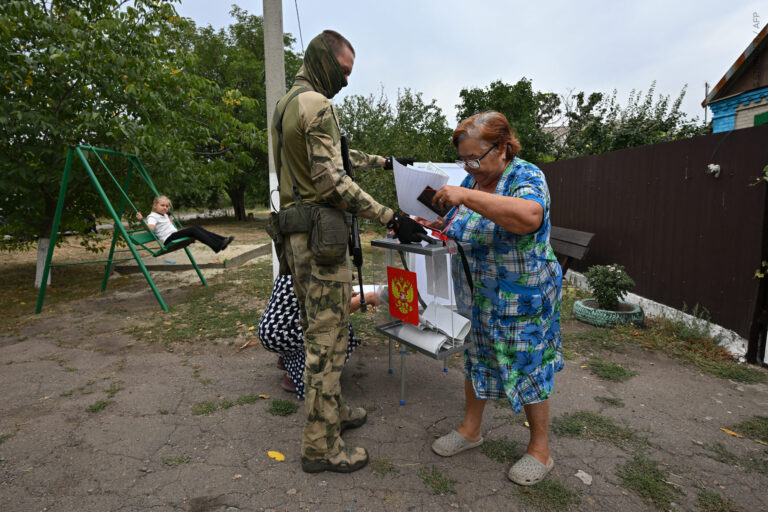
The sham voting in Ukraine’s occupied territories last month is further proof, if any were needed, that Russia still has no intention of good faith negotiations, much less backing down.
Maria Kucherenko
{"forms.error.required":"{field} is required.","forms.error.required_generic":"This field is required.","forms.error.email_invalid":"Please enter a valid email address.","forms.error.email_no_cyrillic":"Email address cannot contain Cyrillic characters.","forms.error.phone_invalid":"Please enter a valid phone number.","forms.error.min_length":"Must be at least {min} characters long.","forms.error.max_length":"Must not exceed {max} characters.","forms.error.invalid_chars":"Contains invalid characters.","forms.error.emoji":"Emoji are not allowed.","forms.error.html_tags":"HTML tags are not allowed.","forms.error.control_chars":"Contains invalid control characters.","forms.error.no_digits":"Numbers are not allowed.","forms.error.digits_only":"Only numbers are allowed.","forms.error.digits":"Numbers are not allowed.","forms.error.username_spaces":"Username cannot contain spaces.","forms.error.username_invalid_chars":"Username contains invalid characters.","forms.error.password_obvious":"Password is too simple. Please choose a stronger password.","forms.error.password_matches_email":"Password cannot be the same as the email.","forms.error.password_matches_username":"Password cannot be the same as the username.","forms.error.server_error":"Server error. Please try again later.","forms.error.file_type_invalid":"Failed to upload the file due to an unsupported format. Please upload a file in one of the following formats: {formats}.","forms.error.file_too_large":"Failed to upload the file because it exceeds the maximum allowed size. Please select a smaller file.","forms.error.file_duplicate":"This file has already been added.","forms.error.file_max_count":"You can upload no more than {max} files.","forms.ui.max_chars_reached":"Maximum number of characters reached ({max}).","forms.ui.min_chars":"At least {min} characters required.","forms.ui.fix_errors":"Please fix the errors in the form first.","forms.ui.loading":"Submitting…","forms.ui.success":"Submission successful."}
Thank you!
You will now receive EPIK’s latest analysis, publications, event invitations, and other updates directly in your inbox.
Thank you!
You will now receive EPIK’s latest analysis, publications, event invitations, and other updates directly in your inbox.