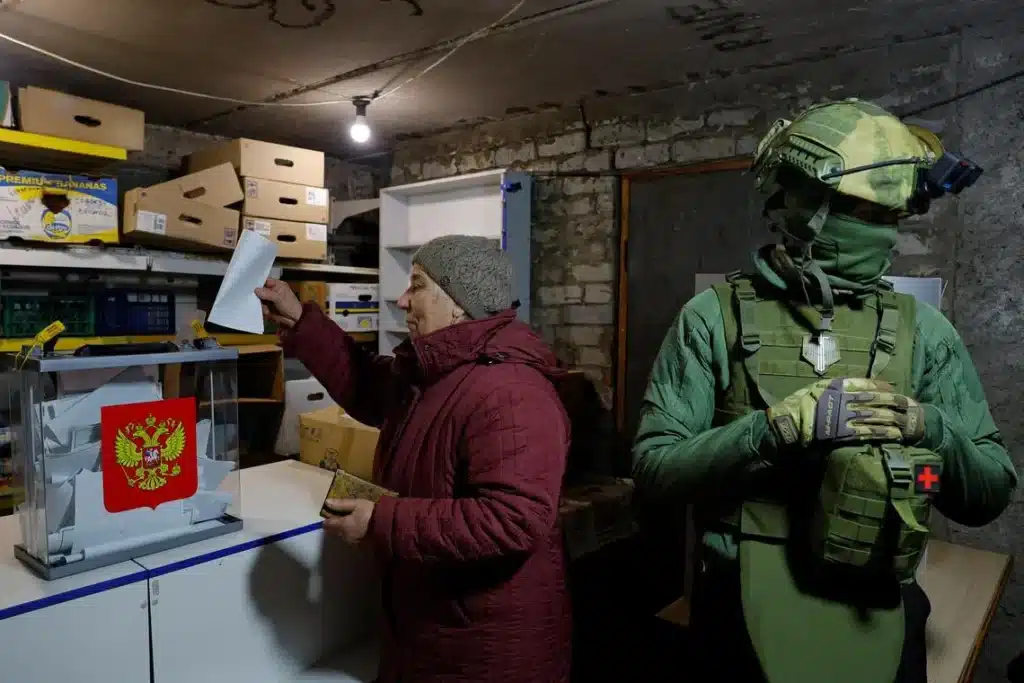
In March 2024, on the eve of the last Russian presidential vote, Russian officials carried ballot boxes into Avdiivka only weeks after its capture, when approximately 700 Ukrainians remained in the ruined city without reliable water, electricity or heating. This time around – for the orchestrated exercise for positions in Russia’s Duma – the ballot is ahead of the Russian army: one of Moscow’s new constituencies includes Kramatorsk and Sloviansk, cities Russia does not control.
Russian decision makers will effectively appoint officials to its State Duma on 18-20 September, the first such operation since the full-scale invasion and the first in which the four Ukrainian regions Moscow claimed to annex in 2022 will be ordered to take part, through seven constituencies drawn across them. People will vote on these dates, but this is not an election. No one is being elected. Even a “sham election” is inaccurate. That would imply falsifying the preferences of an existing electorate. Here, Russia has fabricated the jurisdiction, the constituencies and the electorate, and only after all that will it fabricate the result. Only amateurs falsify an election on the day. Russia’s a professional. The electoral map also anticipates the physical contours of Moscow’s supposedly non-negotiable positions. By placing Kramatorsk and Sloviansk inside a Russian constituency, Moscow writes into electoral law the same claim it is pressing in negotiations: that all of Donetsk region already belongs to Russia.
Putinism has travelled from ‘sovereign democracy’ (the claim that Russia could set its own democratic standards) through ‘electoral autocracy’ and now, on occupied Ukrainian territory, to blatant simulation. An electoral autocracy still uses controlled competition to measure discontent, mobilise supporters, discipline elites and renew its claim to popular legitimacy. But in Donetsk, even those limited functions are absent. The Russian state is so much manipulating elections in these territories as playacting their existence.
This simulation has been assembled in three steps. In 2021, Donbas residents with fresh Russian passports were bused to Rostov region, or voted online, nominally to ‘choose’ Duma deputies for districts they did not live in: in effect, an electorate without a territory. In 2023, these first votes under Russian law produced regional legislatures, which duly confirmed governors and senators. In 2024, the presidential vote showed the occupied regions as co-authors of Putin’s mandate – and, with results above the national average, among its most enthusiastic ones. In 2026, the constituency precedes the territory, and occupation officials say the vote is ‘the final stage of integration’.
Occupation has turned these territories into an electoral desert. For many residents of Crimea and the parts of Donetsk and Luhansk occupied since 2014, Ukraine’s 2012 parliamentary election was the last competitive national vote where they lived. Areas seized in 2022 participated in Ukraine’s presidential and parliamentary elections in 2019 and local elections in 2020 because large parts of those territories were not under Russian control, but occupation then removed the same foundations of political choice.
The (illegal) 2024 presidential vote showed what replaces elections in this desert. Early voting was stretched over several weeks, mobile commissions carried ballot boxes into homes, and improvised polling points appeared in streets and village squares. Occupation media showed a table and ballot box in Donetsk beside officials and an armed man in uniform. Footage from Zaporizhzhia showed pensioners filling out ballots under the gaze of commission members, while one military video showed a commission consisting of two officers with no visible observers. And these were not isolated violations of an otherwise valid process; they were the process.
The 2026 rules formalise the same model. Polling-station addresses and commission members’ names will likely be hidden, video monitoring is excluded, portable-box voting may begin 20 days early, and military commanders can control access to polling and counting in their units. Ballots may be moved and the count resumed elsewhere. On 31 August, Russia’s Central Election Commission allowed the four Ukrainian regions to be treated as “hard-to-reach territory”, a category normally applied to isolated settlements (so that special voting procedures could be used), with CEC chair Ella Pamfilova citing the need to keep voters dispersed under threat of attack. What makes the procedure unobservable is what makes the territory a war zone rather than a constituency.
The four occupation heads come from two waves of collaboration. Denis Pushilin and Leonid Pasechnik inherited the entities established in 2014; Yevgeny Balitsky and Vladimir Saldo were recruited from Ukraine’s pre-war political class after 2022. None is expected to win over an electorate. They are tasked with delivering the required turnout and vote share for United Russia. The percentage is a performance indicator for the governor, not a verdict by the voter. The governors’ own offices come from the same machine. Pushilin was “elected” in 2018 by the separatist “republic” itself, after his predecessor was assassinated, in a vote no state other than Russia recognised, and then again in 2023 by a freshly installed regional legislature choosing from a shortlist Putin had submitted – so each simulation bears the mark of earlier ones.
Crimea shows where this leads. Crimean occupation head Sergei Aksyonov, whose party took four percent in Crimea’s last competitive election in 2010, was installed in 2014 under armed guard and has since been selected only by the legislature, never by a voter. Twelve years on, the peninsula holds four Duma seats, and reportedly supports Putin with numbers above ninety percent. This, of course, is only after several hundred thousand Russian settlers have replaced the previous electorate. The occupied territories follow the same pattern, only faster
The expectation that territories where Moscow’s rule is most coercive should report greater loyalty than ordinary Russian regions is not new. A British parliamentary motion, citing the international observer mission, noted that during the 1996 presidential election, Yeltsin was officially credited with more than 64 percent of the vote in Chechnya, his highest regional result, despite the war.. After the second war, Chechnya became a reliable producer of hyper-loyal results: Putin officially received 92.4 percent there in 2004, compared with 71.9 percent nationwide, while United Russia claimed more than 99 percent in the 2007 Duma election. The territories Moscow calls its ’new regions’ now follow the same pattern. In 2024, Putin’s officially reported support reached 95.23 percent in occupied Donetsk, 94.12 percent in Luhansk, 92.83 percent in Zaporizhzhia and 88.12 percent in Kherson – all above his nationwide result of 87.28 percent. The more violently Russian control has been imposed, the more unanimous its official confirmation must appear.
On 13 August, the Ukrainian government’s Central Election Commission declared the vote illegitimate and its results void; and on 8 September a coalition of human-rights groups appealed to residents not to staff commissions, stand as candidates, campaign or observe – organising an illegal election is collaboration under Ukrainian law – while also urging them above all to protect their lives. The appeal does not call for a boycott, because there is no vote to boycott; it asks people not to work on the production. Western governments should sanction every deputy ‘elected’ from the occupied constituencies on the day the result is announced, together with the commission members who ran the vote and the foreign ‘observers’ who certify it.
For 51 years, the United States and many other Western governments maintained the legal non-recognition of the Soviet annexation of the Baltic states. The lesson now is not merely to deny Moscow’s vote legal effect; that is the easy part. The harder task is to prevent its manufactured jurisdiction from becoming the territorial baseline for negotiations.