Executive summary
Following a brief lull in the 1990s, Russia re-entered what it frames as a civilisational war against the West – an existential contest over competing models of statehood and social organisation. The Kremlin regime regards democracies as a direct threat to its survival. Its ultimate aim is not territorial occupation, but a conquest of minds by destroying the foundations of European collective identity, and the primary means is cognitive warfare.
Russia’s seriousness is reflected in its own “import-substitution” concept of mental’naya voyna (mental warfare), which targets worldview, identity, historical memory and threat perception through the deliberate manipulation of information ecosystems and cultural narratives. Russian strategists view the break-up of the Soviet Union as a successful western mental-war campaign that replaced socialist values with consumerist constructs, leaving Soviet citizens incapable of resistance. Moscow is now weaponising the same approach in an attempt to fragment NATO, paralyse EU decision making and implant “thought-viruses” that activate during crises. It is payback time.
Europe requires a three-stage response. First, it must abandon mirror-imaging and stop projecting western assumptions about rationality on to a regime that operates with an entirely different strategic ontology. Second, it must systematically eradicate the thought-viruses that Moscow has embedded in the European political, academic and cultural discourse. Third, it must develop a cognitive offensive rooted in a deep understanding of Russian cultural codes and historical traumas that offers an alternative vision of sense, greatness, power, security and dignity.
Effective cognitive warfare partially depends on reshaping the operational environment. Every “carrot” – the West’s positive incentives – has been tried and rejected. Only unbearable costs – economic exhaustion, military attrition and elite fracture – can enable change. Europe must impose costs while preparing for windows of opportunity arising from leadership succession, economic decline or AI-driven societal disruption forcing a redefinition of governance.
Introduction
According to Sun Tzu in The Art of War, “To fight and conquer in all your battles is not supreme excellence; supreme excellence consists of breaking the enemy’s resistance without fighting”. While strategies for shaping human perception, belief systems, reasoning, decision making and behaviour are centuries old, what is new is the convergence of three developments: far deeper scientific insight into human consciousness, subconsciousness, emotions and the biochemistry of the brain; the ability to weaponise that insight through new scientific discoveries and technologies with potential access to “every individual”; and the emergence of a new cognitive domain of warfare alongside land, sea, air, space and cyber.
Modern concepts of cognitive warfare build on earlier information and psychological operations, enhanced by technological breakthroughs in the neuro, bio, information and cognitive (NBIC) sciences. Although they diverge in how they define and delimit the phenomenon, they converge on treating the human mind and even the brain itself as the primary battlespace. The ultimate purpose is to “win the war before the war”, or with much less military effort.
Russian strategic thought offers the , “mental warfare”, which emerged from the evolution of psychological and information operations focused on what people think, but differs from the concept of cognitive warfare, which shapes how people think, through its distinct emphasis on what people become. In other words, the Russian interpretation is a synonym for civilisational war, which makes the fight existential.
More critical than achieving definitional clarity regarding these overlapping phenomena is recognising the threat they pose and developing effective countermeasures. Against a backdrop of renewed struggle over the redistribution of spheres of influence, Europe cannot afford complacency when decades of Russian influence are already reflected in the rise of anti-liberal sentiment, growing support for populist forces, threats to the European Union project and deepening crises in transatlantic relations.
Thus, while deliberately avoiding a dive into the technical aspects of hacking the brain or an analysis of the tools or actors engaged, this brief focuses on Russia’s understanding of the approach to reshaping the minds of the enemy and key malignant ideas that keep shaping western strategies towards Russia. Such ideas must be identified and addressed now, particularly given the illusory expectations around renewed peace talks and post-war negotiations amid Russia’s emerging war fatigue.
A definitive breakthrough in peace negotiations will depend primarily on the scaling of Ukraine’s long-range precision capabilities and a change in Russian leadership. The current Russian president faces greater risks from ending the war than from continuing it, which could incentivise further escalation, including from Belarus, against not only Ukraine but also NATO territory, with parallel attempts to enhance influence in Transnistria.
The broader objective of this policy brief is more strategic and long-term: to encourage the West to reassess its own mythology about Russia, much of which has been shaped and implanted through decades of malign Russian influence and the gradual diffusion of strategically manipulative ideas. When the West finally gets a second chance to eliminate the Russian strategic threat, it must not squander it.
Understanding the Russian concept of mental warfare
The concept of mental warfare first appeared in the Russian discourse in 2021, deeply rooted in the ‘good old’ war of ideologies, Soviet military science and the tradition of ‘active measures’, as well as the achievements of modern ‘constructors of senses’. Russian military scientific thought frames it as “the use by an adversary of a system of methods and means of influence aimed at targeting the public consciousness (mentality, identity, historical traditions, values, etc.) of the opposing side, both in peacetime and under conditions of military conflict. Its goal is the destruction or alteration of the target of influence, including the disruption of public consciousness, social institutions, the state, the armed forces, and others”.
Andrey Ilnitsky, an advisor to the Russian Minister of Defence and one of the “fathers” of mental warfare concept, emphasises its essence as a clash of civilisations. He believes that while its consequences may not manifest immediately, they are irreversible in nature, unlike the destruction of an army or infrastructure. According to Ilnitsky, its operational goal is to attack everyday lifestyles and social norms over three to five years, discredit the authorities and fracture society. Its strategic goal is to rewrite a society’s worldview by altering its ideology, history, traditions, faith and basic values over a generational horizon of 10–15 years.
Ilnitsky interprets the break-up of the Soviet Union as a lost “mental war” as a result of the impact of various “voices”, samizdat, films, and so on. An entire country was “destroyed” through a targeted transformation of the senses, exchanging values for “jeans, chewing gum, freedom of movement and other ideological constructs”. As a result, the Soviet Union lost almost 100 million compatriots, more than in the Second World War, and, even more, people “lost themselves”.
Hence, victory constitutes the ability to reshape a rival’s self-perception by altering the perception of reality and imposing desired behaviour, including actions that run counter to people’s own interests. In an era of re-emerging competition over spheres of influence, identifying planted malignant ideas, rethinking responses to them and developing a proactive cognitive warfare strategy against Russia as a long-term threat will be essential for the survival of the European project. Now Russia is seeking revenge.
Russia-related mind viruses and their enduring threat potential
The west is not at war with Russia
The lesson Ukrainians have learned the hard way is that if Russia is at war with you, you face a stark strategic choice to either respond in kind or surrender and accept eventual physical or identity extermination. While the West remains trapped in a conceptual limbo of being ‘neither at peace nor at war’, Russia is increasingly open and explicit in describing its relationship with the West as an ongoing war that is civilisational in nature.
This narrative is reinforced by Vladimir Putin’s numerous public statements that western elites are aiming at the destruction of the Russian Federation, and that NATO has been waging war against Russia. In Russian multifaceted propaganda, this framing legitimises extraordinary measures in the political, informational and ideological domains, because the conflict is understood as a war over the continued existence of Russia as a historical‑cultural community, not just over territory or influence.
Ilnitsky claims that “…the task of the United States and its allies is, if not immediately then gradually, to eliminate or erase Russians (in the ontological sense) as a people, as a civilisation with its own cultural and historical code, and to remove the Russian state as an obstacle to establishing the world order they seek”.
Given Russia’s tradition of ascribing to its opponents what Moscow itself thinks or intends – in effect, projecting its own shadow on to the – it is worth questioning the viability of appeasing the aggressor, or the “deterring by ignoring” approach, and taking seriously the well-known proposition that the Russian Federation understands only the language of force.
In this regard, Ukraine’s strikes against Russia’s energy sector and strategic infrastructure have played a bigger role in shaping the Kremlin’s moves and Putin’s language than years of diplomacy. A vivid illustration of this evolution is the shift in Putin’s rhetoric from labelling Ukraine’s leadership a “gang of drug addicts and neo-Nazis” in 2022 to “Mr Zelenskyy” in 2026, even after President Zelenskyy’s decree formally allowed the 9 May parade in Moscow, which in itself formed part of the cognitive dimension of the war.
That is why trains of thought such as the AfD’s warning not to “poke the Russian bear”, lest it wake up and lash out, are so revealing. For decades, this metaphor has portrayed Russia as a fundamentally reactive animal whose violence is provoked by western “sticks”, rather than as a strategic aggressor already attacking its neighbours, and with an appetite to have the whole of Europe in its sphere of influence. The metaphor should be substituted by a more accurate one, such as the “Red hyena”, which better captures its opportunistic, predatory behaviour.
Meanwhile, Russia is already waging a multidimensional war against the West, as captured by the Everywhere War – Sub‑Threshold Warfare Tracker, which systematically records Russian sabotage, cyber operations, airspace violations, coercive energy measures and other hostile acts below the threshold of open interstate war across Europe and beyond. In addition, Moscow is interfering in western elections through coordinated disinformation and cyber campaigns, weaponising the Russian Orthodox Church and state‑aligned media to project revisionist narratives and undermine liberal norms, carrying out political violence and poisonings against opponents on western soil, and deepening military and intelligence cooperation with Iran while tightening its strategic alignment with China and other revisionist states, all as part of a long‑term project to weaken western cohesion and construct an alternative, authoritarian‑leaning international order.
This is not just about well-calculated political technologies, it is also emotionally rooted. The Kremlin’s hate for the West is articulated along a spectrum that runs from raw, affective hostility to quasi‑religious demonisation of the West as a metaphysical enemy. Former President Dmitry Medvedev, now deputy chair of Russia’s Security Council, openly frames his rhetoric in terms of personal hatred, explaining in 2022 that his Telegram posts are so harsh because “I hate them. They are bastards and degenerates….They want death for us, Russia. And as long as I live, I will do everything so that they disappear”. In parallel, ideologues like Aleksandr Dugin recast this hostility in explicitly religious and civilisational terms, depicting liberal western modernity as the “kingdom of the Antichrist” and insisting that Russia must destroy this “anti‑Christian” West or be destroyed by it.
From the threat assessment perspective, this is way more than just colourful rhetoric for domestic consumption. It is the essence of a long-term Russian geopolitical strategy fuelled by the urge to destroy democracies in Europe, which underlines the malignant nature of the next set of ideas promoted as part of Russian mental warfare.
A narrative of invincibility or the better known evil
Amid accelerating climate change, King George’s line from Hamilton – “Oceans rise, empires fall” – reminds us that no regime is eternal. Against this basic historical reality, Moscow has cultivated mutually reinforcing narratives designed to make any serious transformation inside Russia seem impossible, undesirable or unbearably dangerous: “Russia is invincible”, “this regime is a known evil” or “this regime is a necessary evil”. None of these narratives is empirically robust. The first myth rests on a selective retelling of Russian military history that erases major defeats; the second sacralises “stability” by framing any political opening up as a path to chaos and civil war; and the third weaponises nuclear anxiety to argue that real pressure on Moscow is indistinguishable from inviting Armageddon.
A related mind-virus that Russia exploits is European pacifism. German students recently staged protests in dozens of cities against the planned return of compulsory military service. Some demonstrators declared that “it is better to live under Putin than to fight”. Many young people say they are not prepared “to die for the state” and would prefer flight or even occupation to war.
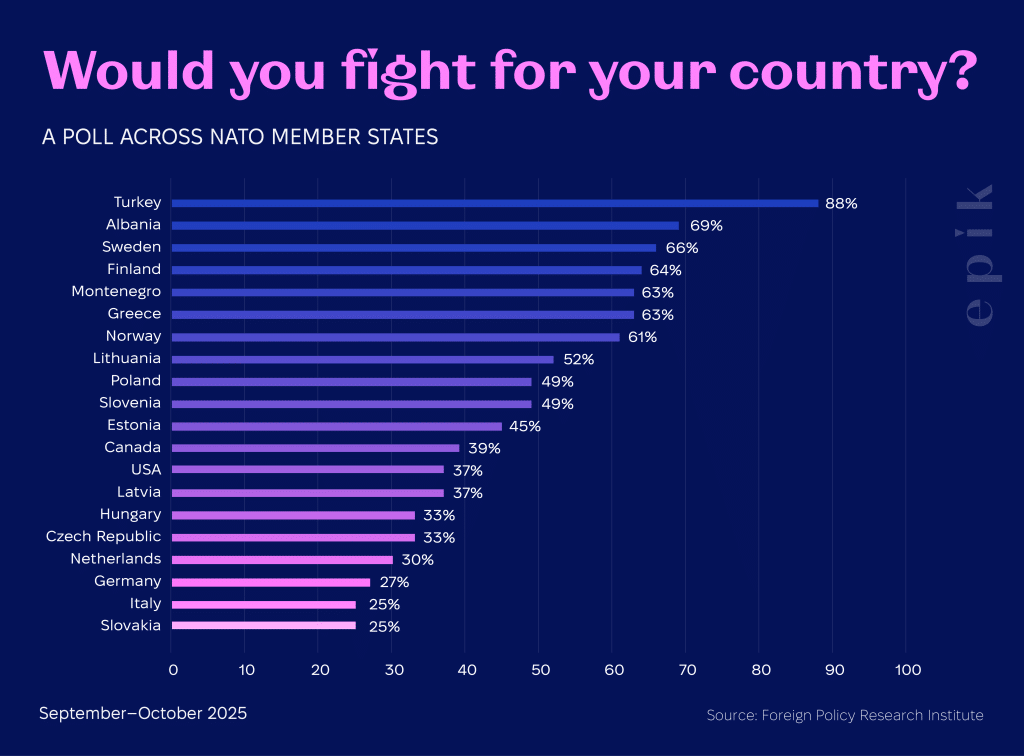
A poll carried out across all NATO member states in September–October 2025 shows striking differences in the willingness of citizens to fight for their country. The highest readiness is reported in Turkey (88 percent), Albania (69 percent), Sweden (66 percent), Finland (64 percent) and other Central and Eastern European states. While Lithuania scores 52 and thus ranks in the top ten, Estonia (45 percent) and Latvia (37 percent) have not seen a comparable surge in willingness despite Russia’s full‑scale invasion of Ukraine. By contrast, willingness is significantly lower in Italy (25 percent) and Germany (27 percent) – countries that do not perceive an immediate military threat and where memories and the stigma associated with the Second World War continue to dampen support for war fighting, revealing a serious political and societal gap within NATO on deterrence and defence.
Russia should not be feared but defeated. From the Livonian War (1558–1583), in which Muscovy fought Poland-Lithuania and Sweden for control of the eastern Baltic and ultimately renounced its claims to Livonia while returning captured Lithuanian territory, through the Crimean War (1853–1856), which concluded with the Treaty of Paris demilitarising the Black Sea and forcing Russia to cede Southern Bessarabia, to the Russo–Japanese War (1904–1905), where an Asian power defeated a European empire for the first time in modern history, Russia knows the taste of defeat.
In the First World War (1914–1917), Russia’s catastrophic casualties and losses on the Eastern Front culminated in revolution and the Brest‑Litovsk peace, under which it ceded vast territories to Germany. In Afghanistan (1979–1989), the Soviet Union withdrew without securing its political objectives after losing over 14,000 soldiers and tens of billions of dollars, becoming the decisive nail in the Soviet Union’s coffin; and in the First Chechen War (1994–1996), Moscow was forced into a ceasefire and de facto recognition of Chechnya’s autonomy after a campaign that killed tens of thousands of civilians and thousands of Russian troops.
Moscow has literally gone up in flames twice. In 1571, Crimean Khan Devlet I Giray burned most of the city while Russian forces were bogged down in the Livonian War, killing tens of thousands and taking many captive. In 1812, after Napoleon occupied a largely abandoned Moscow, fires destroyed much of the city as part of the scorched-earth logic that denied Napoleon a usable victory.
Thus, not only is Russia not invincible, it has lost several wars since becoming a nuclear state. Today, in the 13th year of its war against Ukraine, Russia cannot claim victory. Russia has suffered more than 1.2 million casualties. The current monthly death toll is around 35,000 personnel – a rate that exceeds new recruitment and reflects the growing impact of Ukrainian drones and precision strikes on Russian manpower and equipment. Moscow has not achieved regime change in Kyiv, has failed to force capitulation and remains bogged down in costly positional fighting in Donbas, while sanctions and war‑related disruption deepen its long‑term economic vulnerabilities.
Given the historical logic, the West should be prepared not just for regime change but for Russia’s dissolution in this century, especially given possible future Chinese interest in the return of historical territories in the Russian Far East. Hence, the idea of Russia-China decoupling will be best implemented not by US promises of huge business deals but by China itself, just like the Ukraine-Russia relationship.
During Prigozhin’s mutiny, there was genuine fear in the West that the outcome could be even worse, and that “the devil you know” was preferable to an unknown alternative. History does not recognise the subjunctive mood, and we can only speculate about how events might have unfolded had Prigozhin reached the Kremlin. Nonetheless, the idea that “it can only get worse” is ignores how dire things already are under Putin’s incessant nuclear threats.
While some point out that Lenin was followed by Stalin’s repression, it is worth remembering that Stalin was followed by Khrushchev’s Thaw, but then the Cuban Missile Crisis. In other words, even when the faces in the Kremlin change, Russia remains largely constant in its geopolitical ambition and hostility towards democratic ideas. This pattern will persist: brief thaws in relations with the West during periods of Russian economic weakness, used mainly to rebuild strength for the next round of destructive actions. Thus, fast and unconditional de-sanctioning of the Russian Federation as a downpayment for a reset of relationships would be another history lesson unlearned, which brings in yet another set of narratives.
Credit: Foreign Policy Research Institute
Another mirage of peace through pragmatism or idealism
In the coming years, power in the Kremlin is most likely to change not through a popular revolution, but through a palace coup or the (un)natural death of the leader. It is important to understand that Russia’s elites are direct accomplices to and enablers of the crimes of Putin’s regime. Moreover, the Russian opposition in the West has no real support inside the country, is tainted by imperial thinking and is often more interested in coming to power than in genuine transformation of the state.
Nonetheless, there will be a strong temptation to return to policy ideas that have benefited Europe in the short term in the past, but harmed it far more in the long run. These involve two opposing beliefs leading to the same result: that lasting peace with Russia can be achieved through a return to pragmatic engagement and reintegration into key international platforms; or that if Russians are reminded of the benefits of the democratic order and are informed about the current regime’s mistakes/atrocities, they could transform Russia into a democracy relatively rapidly, because no nation inherently leans towards authoritarianism.
Ideas such as “peace through trade is the way forward”, “dialogue with Russia and its reintegration into the western world is inevitable” or “a return to business as usual would be desirable” collectively construct a mirage of peace in which economic interdependence, diplomatic inclusion and normalisation are treated as sufficient safeguards against renewed aggression.
The experience of the 1990s shows that the West exerted little sustained pressure on Moscow over human rights or support for organisations promoting an honest reckoning with Soviet and imperial crimes, while political reforms such as genuine federalisation and decentralisation that might have redirected the attention of elites to domestic problems were largely absent. By 2014, Russia had been integrated into all the major Euro‑Atlantic economic and political frameworks short of full NATO and EU membership. It sat on the G8, the Council of Europe, the OSCE and the WTO, and maintained institutionalised formats such as the NATO–Russia Council.
On the eve of the annexation of Crimea, the EU was the Russian Federation’s largest trading partner, accounting for more than 40% of Russia’s foreign trade. Russian elites and their families were deeply embedded in western lifestyles, assets and education markets, but capitalist integration and material benefits did not prevent the illegal annexation of Crimea in March 2014 or the launch of a covert war in the Donbas.
Western sanctions imposed after 2014 were limited and sectorally narrow; they failed to compel Russia to reverse course and arguably helped convince the Kremlin that it could withstand and manage western economic pressure, thereby reducing the perceived cost of escalating to a full‑scale invasion in 2022. Had Russia succeeded in its initial plan to rapidly seize Kyiv and subjugate Ukraine’s statehood, there is little reason to doubt that it would have pushed its sphere of control as far as circumstances allowed, while many European capitals – faced with a fait accompli – would almost certainly have begun to explore a “reset” in relations with Moscow in order to stabilise energy supplies and restore trade, repeating the pattern established after 2014.
Those who still hope to reset relations with Russia avoid looking too far back in history. The recent attempt by the US administration to engineer a reset – starting with high‑level talks in Anchorage and followed by Kirill Dmitriev’s presentation of a multi‑billion‑dollar investment and cooperation plan – once again showed that, for the Kremlin, such economic gains matter less than geopolitical objectives, the grab for power and the leadership’s desire for a grand place in history, especially now that its key figures are already among the world’s wealthiest.
A sharp change of course should not be expected just because the leadership facade in Moscow changes at some point. Without deep internal work to dismantle Russia’s aggressive imperial and quasi‑barbaric identity, thinly veiled in a layer of “high culture”, there will be no real change and the evil will remain the familiar one.
Ukraine’s concessions as a path to peace
Russia promotes a dense ecosystem of myths designed to undermine NATO and harm Europe, often indirectly harming Ukraine. One of the most dangerous of these is the claim that “territorial concessions” by Kyiv – above all, surrendering currently held territory – are a necessary price for peace, while the Ukrainian President is the main obstacle.
Pressure on Kyiv from some western politicians and commentators, and “peace initiatives” to cede the heavily fortified parts of Donbas rest on the illusion that giving up land will end the war, when in reality it would provide Russia with “a full hand of cards” for further advancement.
Militarily, Ukraine’s defensive “fortress belt” not only shields the remainder of Ukrainian‑controlled territory, including the left bank of the Dnipro, but also acts as a forward barrier for Moldova and the NATO frontier, keeping Russian forces tied down instead of probing Article 5 through destabilisation or hybrid actions against NATO’s eastern flank.
Since the start of Moscow’s most recent “peace offensive” in 2024, Russian demands have consistently gone far beyond the status quo on the ground. Putin’s June 2024 proposal required Ukraine to withdraw its forces from and cede all of Donetsk, Luhansk, Zaporizhzhia and Kherson oblasts – not just the occupied areas – and to renounce NATO membership. In February 2025 and again in 2026, Russian diplomats and spokespersons repeated these maximalist terms, insisting on Ukrainian military demobilisation and legal recognition of Russia’s annexations before any ceasefire. Meanwhile, Russia’s current offensive in the Mala Tokmachka village in Zaporizhzhia oblast has already lasted longer – more than 1,500 days – than the legendary siege of Carthage.
These positions confirm that the war is not about “a few square kilometres”, but about crushing Ukraine militarily, economically, politically and demographically, and eliminating it as an independent strategic actor. Evidence from the occupied territories since 2014 – bans on the Ukrainian language and education, persecution and “filtration” of pro‑Ukrainian residents, forced passportisation, mass deportations and the systematic militarisation of youth – shows what a Russian “victory” would mean for the rest of the country. In less than a decade, a Ukraine destroyed in this way would leave Europe facing the largest battle‑hardened army on the continent, experienced in modern large‑scale war and unconstrained by meaningful internal opposition.
Back in 2014, Andrey Okara, a Russian political philosopher and director of the Center for Eastern European Studies, argued that Ukraine posed a fundamental challenge to the logic of Putin’s regime. He called Ukraine a “cognitive, semantic challenge” for Russia, stressing that its success would undermine not just Moscow’s geopolitical ambitions, but the entire ideological model of contemporary Putinist rule, going far beyond the earlier “Georgia challenge” of simply doing better where Russia has failed. According to Okara, the relationship between Russia and Ukraine is mutually transformative. Russia is splitting Ukraine but Ukraine is also splitting Russia. Ukrainian resistance has pushed Russia onto a path of total mobilisation. If Ukraine fulfills its goal to endure one day longer than Russia, it may catalyse the deeper transformation Russia needs: a shift from mobilisation to modernisation, from barbarism to civilizational breakthrough.
Against this backdrop, Western calls for Ukraine to trade territory for “peace” do not simply misunderstand the nature of the war; they risk advancing Russian strategic aims under the banner of de-escalation. By hurting Ukraine – territorially, demographically and politically – the West would ultimately be hurting itself, eroding deterrence and inviting a more dangerous confrontation with an unreformed, emboldened Russian state.
Instead, Ukraine – as an undeniable provider of European security – should be embedded in the new European and Trans-Atlantic security architecture. Interestingly enough, Ukraine’s power is now being recognised by Russian ‘talking heads’: “it is not shameful to lose to Ukrainians because Ukrainians are Russians – and Russians never surrender and are never truly defeated”. This is just another example of never-ending mental warfare.
Conclusions and recommendations
When thinking about humanising and de‑aggressing the Russian political mentality, one is reminded of a grim Soviet‑style joke: “At a former arms factory, the management decides to switch to making baby strollers. Soviet workers, as they often did because of chronical shortages, take the new parts home and try to put them together, but somehow, every single time, they still end up assembling a machine gun”.
This captures the core problem where every new narrative has to have its roots in old ones. Even when the declared goal is peaceful or civilian, ingrained habits, institutions and mental templates keep reproducing instruments of violence. Any strategy aimed at transforming Russian society therefore needs to work not only with formal narratives, but with these deeper patterns of perception and reaction that keep “reassembling” aggression out of almost any available material.
The first, extremely difficult, step for any westerner interested in counteracting Russia’s cognitive warfare is to step out of his or her own mentality and stop projecting it on another nation, primarily when it comes to the value of human life, which defines everything from the social contract to everyday individual interactions.
Russia is in a civilisational war with the West and the Kremlin is taking it seriously. So should the Kremlin’s targets, whose minds Russia is constantly attempting to rewire.
- The most important step is to break the mental frame of Russia’s invincibility and related fears.
In a 1977 conversation with his key foreign policy adviser, Richard V. Allen, future US President Ronald Reagan discussed his formula for success: “My idea of American policy toward the Soviet Union is simple, and some would say simplistic. It is this: We win and they lose”. While today’s White House administration struggles to revive the great Republican heritage, Europeans should reframe this idea for themselves. As Fredrik Löjdquist notes, Europe’s Zeitenwende on Russia remains incomplete and is still to be fully internalised and translated into concrete policy and practice.
One immediate step would be to finalise a joint European position that Europe, not the United States, should serve as the primary broker of any eventual peace settlement in a way that favours both Ukraine and Europe, rather than pre‑emptively pricing in Ukrainian concessions. This is particularly important given Ukraine’s growing medium‑ and long‑range strike capabilities and Washington’s increasingly volatile stance on the terms of a potential settlement.
- Such a reimagining could start with the clear image of the victory of Ukraine as a symbolic victory over current Russia’s self-identification.
Gustav Gressel argues that, for Europe, the security risks of a Russian victory would be severe, all the more so now that the United States has effectively stepped back as an ally. Instead of clinging to the illusion of a ceasefire, Europe must concentrate on the only realistic path to lasting security – a Ukrainian victory brought about by the eventual collapse of the current Russian regime. Such a vision of victory would also discipline European policy, aligning military assistance, sanctions and diplomacy with a clear strategic end-state rather than a vague and illusory promise of “stability”.
Ukrainian analyst Stanislav Boiko compares three models currently discussed around Ukraine. The “steel porcupine” model envisages strategic deterrence through the construction of a powerful, layered defence that makes any continuation of aggression prohibitively costly for the adversary. Andriy Zagorodnyuk’s concept of strategic neutralization, described as “functional defeat,” aims to render an adversary operationally ineffective without necessarily eliminating its formal military capabilities.
The “terminal defeat” model aims at the structural destruction of the Russian Federation’s capacity to wage war and the dismantling of its aggressive regime, achieved through a combination of a degradation vector – triggering irreversible degenerative processes within the adversary – and a deterrence vector that maintains a secure defensive perimeter.
- Review and reframe public communication about Russia as a strategic threat to Europe, moving away from narratives that range from “potential but not imminent” to “almost impossible”.
Existing messaging underestimates the fact that while geographic remoteness significantly mitigates the risk of invasion, there are no borders for kinetic sub-threshold and mental warfare.
Democracies can fall just like empires. Therefore, instead of reopening doors to Russia at major cultural and sporting events, such as biennales or the Olympic Games, Europe should launch a campaign that shows the true face of the current regime and Russia. At the same time, it will be crucial to maintain a careful balance: films that portray the banality of evil, such as the Oscar‑winning documentary Mr Nobody Against Putin, can sometimes trigger unintended feelings of sympathy or identification with ordinary perpetrators rather than resistance to the system as a whole.
The core task should be to expose the many ways in which the regime systematically breaks people, evoking a calibrated degree of fear that motivates citizens to act without paralysing them. For many Europeans, especially in societies once dominated or deeply influenced by the Soviet Union, historical memory of authoritarian rule is still relatively fresh; reminding them that this is not just “history” but a plausible future scenario if today’s decisions go wrong is a key part of preparing them to withstand external threats.
- Engage in an honest public conversation about sub-threshold warfare.
As of now, Russian sub-threshold operations remain significantly underreported and underestimated for primarily political reasons. A more structured and honest conversation with the public about these activities is essential, including their cognitive and societal impacts. This should go hand in hand with supporting initiatives, such as the Everywhere War Tracker, that help to document and visualise the continuous nature of this warfare; development of clear response protocols for the police, public institutions, business and civilians; and regular update of civil service training scenarios to reflect such incidents.
Governments and institutions should invest in realistic simulations of novel types of attack, and develop clear, rehearsed response protocols for the police, public institutions, business and civilians. This will help to calibrate threat perceptions as reflections of reality.
- Shift from a predominantly defensive posture in the cognitive domain to a proactive, offensive strategy.
The most obvious immediate steps would be, first, to finalise all preparations for the Special Tribunal on the crime of Russian aggression, including its mandate to prosecute Vladimir Putin and other senior decision makers. Recent decisions by the Council of Europe and the European Union to endorse and join an Enlarged Partial Agreement on the tribunal’s legal and organisational framework show that the project has now moved from a political declaration to the institutional phase. In parallel, the EU should introduce a comprehensive ban on entry to the Union for Russian special military operation combatants. While Kremlin rhetoric dismisses such initiatives as insignificant, they are a significant and problematic part of mental warfare.
The long-term strategy should focus on a reshaping of the Russian self‑imagining. Abandoning the norm of non‑interference in how other societies define themselves will be difficult for Europeans, but in this case it should be understood as a corrective measure targeted at a systemic, violent violator rather than an attempt at cultural engineering. It should be viewed as a helping hand for those living in an extensively regulated information environment. The goal is not to erase Russian identity, but to challenge those ideological constructs that lock Russia into a permanent circle of violence against other nations and its own people.
For decades, the Russian political system has generated mental traps that justify Russian exceptionalism, such as “Russia’s special path”, “state‑civilisation” or “managed democracy”. Russian sociologist Alexei Levinson describes the notion of Russia’s “special path” as a road about which nothing is really known and whose destination no one can define, but its main purpose is to keep Russia outside shared rules and experiences. From this it is only a short step to isolationism and xenophobia as primary tools for relating to other countries and peoples, and to the idea that the more hostile the world appears, the better, because this confirms the logic of a besieged fortress and explains “how to live”.
Unfortunately, the current geopolitical environment – marked by intensifying great power competition and contests over spheres of influence – tends to reinforce rather than undermine the siege mentality narrative described above. As global insecurity deepens, populations are increasingly likely to make political choices driven by threat perceptions and fear rather than by strategic calculation or aspiration.
Developing the narrative that exceptionalism is itself not exceptional could, over time, help Russian society move from a destructive collective sense of self towards something closer to a collective superego anchored in shared norms. Larisa Didkovska, a Ukrainian psychotherapist and rector of the Ukrainian Free University in Munich, has described contemporary Russia as “psychotic”.
The alternative could be to appeal to a cultural memory of a different developmental level – embodied by the Soviet intelligentsia – as a highly organised, neurotic subject searching for meaning rather than for domination. This historical experience of moving from destructive to creative energy suggests that – away from collective Raskolnikov – under the right conditions, Russian society could again be nudged towards a less destructive, more meaning‑oriented mode of existence. Ultimately, efforts to dismantle the imperialistic worldview should not be framed as Russia’s strategic defeat, but as Russia’s strategic opportunity (or even victory) to break out of a vicious circle that multiplies the human suffering of other nations and Russians themselves.
Thus, efforts are already being directed at an honest representation of Russian history, a final dismantling of the Stalin cult, which re-emerged in Russia, in preparation for de-Putinisation in the future. Putin should be framed not just as corrupt, which Russians tolerate, but as stealing Russia’s future as a developed and respected country.
Yegor Gaidar posed this as the paradox of “the Russian economic miracle” – a country extraordinarily rich in resources but chronically poor – and argued that escaping this trap meant adopting the institutional norms of a “normal First World country” rather than doubling down on statist control. Decoupling this vision from domestic repression and international aggression is as essential as it is difficult because the belief that a “strong hand” is a prerequisite for order and stable development is deeply entrenched – and not only in Russia. Moreover, on a personal level, the most rewarded strategy for survival and sometimes even success has not been collaboration, openness and tolerance, but either aggression or unquestioned compliance with the aggressive system.
Under Putin, regime change has been deliberately equated with the destruction of the Russian state. These two ideas need to be clearly separated. Interestingly enough, in the Russian collective subconsciousness, in contrast to the European, the concept of democracy is not tied up with the concepts of happiness, pleasure, dignity, security or prosperity, despite decades of envy of the western lifestyle. In the collective experience of the Russian people, a shift to democracy is associated with disorder, poverty, suffering and humiliation – both individual and collective.
For the average Russian, long‑term training in “coping with hardship” and “enduring deprivation” has become a psychological norm. Any strategy based on driving Russia towards economic exhaustion to stimulate a rethink of the consequences of the chosen path should take this into account, especially given the significant distance between the European hedonistic mentality.
Nonetheless, the democratic ideal could be rebranded in culturally resonant terms. Moreover, given the number of the oppressed nationalities on Russian territory, the cultural codes of each national minority should be studied and applied. All major Russian meta-narratives about themselves should be deconstructed and reframed. At the same time, there will be a need to nurture a discourse of collective political and moral responsibility for the crimes committed by Russia – not only against other nations, but also against its own soul. The Russian diaspora could be doing this now, if it were ready.
A similar reframing could draw on existing regional grievances. Narratives that “the regions have fed Moscow for too long” could be an entry point for advocating a genuine federalisation or even confederalisation of the post‑imperial space. To make this possible, western policy circles must overcome the deeply embedded “mind virus” that sees centralisation in Moscow as the only way to prevent chaos in Russia. The greatest challenge in this whole agenda is the need to repackage the concept of “strength”. In the current geopolitical context – and the wider shift from the “rule of law” to the “law of the strong”, co-constructed by some democracies – any attempt to deconstruct Russian imperialism is an even bigger challenge due to its embedded sense of superiority and assumed right to aggression. This is deeply rooted in experience, where the choice was between being an aggressor or becoming its victim, almost inevitably in case of opposing the system. Such an approach continues to produce “Gerasims” – after the obedient, brutalised protagonist in Turgenev’s Mumu.
Russia is not unique in its capacity for violence; the task is not to deny this aggression, but to bring it out of its ‘shadow’ and subject it to control. History suggests that Russia’s moments of genuine rethinking have almost always coincided with socio‑economic collapse: the decline of the Russian Empire and the dissolution of the Soviet Union. This pattern implies that the primary external instrument today should be to drive the current system towards economic exhaustion. When a new window of opportunity opens, the priority must not be to stabilise the economy in ways that preserve both the ruling elites and their worldview, but to use that opening to support precisely those forms of dissent and alternative thinking that today’s regime brands “extremist” or “treasonous.”
In conclusion, there are no ‘carrots’ that have not already been offered that could serve as a positive stimulus for change within Russia. Europe does not appear to Moscow as just another power centre competing for influence or resources; it embodies a fundamentally different vision of how societies can be organised and governed. In other words, it is an existential threat. In this context, trying to identify “positive incentives” one more time that might persuade the Kremlin to abandon its current confrontational stance misses the point. The regime sees no genuine upside in voluntarily altering a course that preserves its own survival. Only an unbearable cost-benefit ratio rebalancing might stimulate the liberation of Russia from its destructive delusions, providing a chance for constructive, human-centric development of the country and long-lasting peace in Europe.
Dr. Elena Davlikanova is Researcher, Senior Fellow with Sahaidachnyi Security Center (Kyiv) and Center for European Policy Analysis (DC)