


More in category

Russia’s escalation menu: conventional, nuclear and hybrid
As Ukraine’s deep strikes hit Russia’s economy and military rear, how will Moscow retaliate?
Russia’s battlefield strategy in Ukraine has plateaued and, if nothing radically changes, Russia cannot expect any significant progress on the battlefield in 2026.
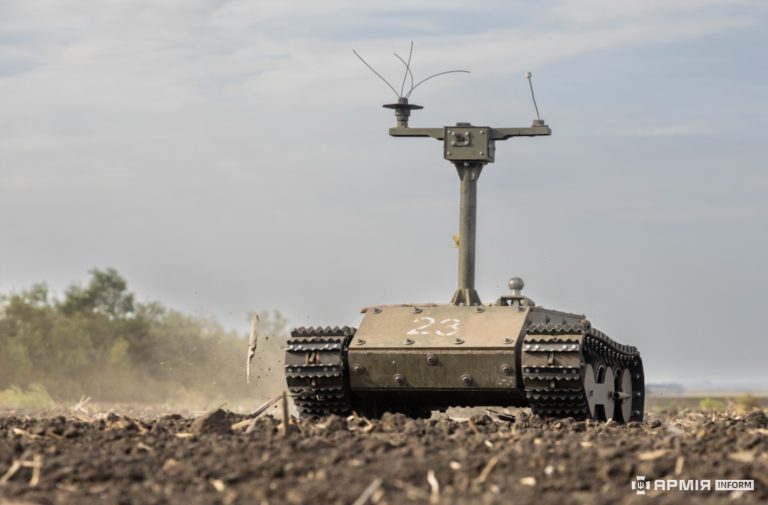
Ukraine has systematically removed humans from roles that don’t require human judgment, letting machines absorb the danger soldiers would otherwise face. What UGVs can and can’t do, and what lessons European institutions can draw from Ukraine’s experience.
A ceasefire is nowhere in sight. Putin sees no interest in ending his war. Even so, the EU should start preparing for the many post-war challenges Ukraine will face.
The primary aim of Russia’s expansionist war against Ukraine since 2014 – as well as of its use of armed forces in Moldova, Georgia, Armenia, Kazakhstan and Belarus – has been to recover control or influence over the territories and populations of the Tsarist and Soviet empires that Moscow lost when these states broke up in 1917 and 1991. As part of this wider strategy, an important goal of the Kremlin for the past 12 years has been the physical capture of Ukrainian citizens and their forceful integration, as far as possible, into Russian society and culture, its economy, state, education system and army. At least in Ukraine since 2022, Russian expansionism has been as much about demography as geography.
According to the United Nations Office of the High Commissioner for Human Rights (OHCHR) in 2025: “Russia’s full-scale invasion of Ukraine has been accompanied by systematic human rights violations against civilians in occupied territories, including arbitrary detention, torture, enforced disappearances and the denial of the right to a fair trial. UN mechanisms have documented numerous testimonies from civilian victims, demonstrating the scale and systematic nature of these abuses”. The primary topic of reporting and research on this aspect of Russia’s war on Ukraine since 2014 has been the abduction of unaccompanied Ukrainian children from the occupied territories in southern and eastern Ukraine. The capture, detention, displacement, deportation, re-education and Russification of these young children and teenagers, as well as their occasional return to Ukraine, have become the subject of numerous journalistic investigations, think tank reports, research papers, scholarly conferences, parliamentary hearings, government statements, international resolutions and diplomatic consultations. The repatriation of Ukrainian children from Russia to Ukraine has recently become a cause for US First Lady Melania Trump.
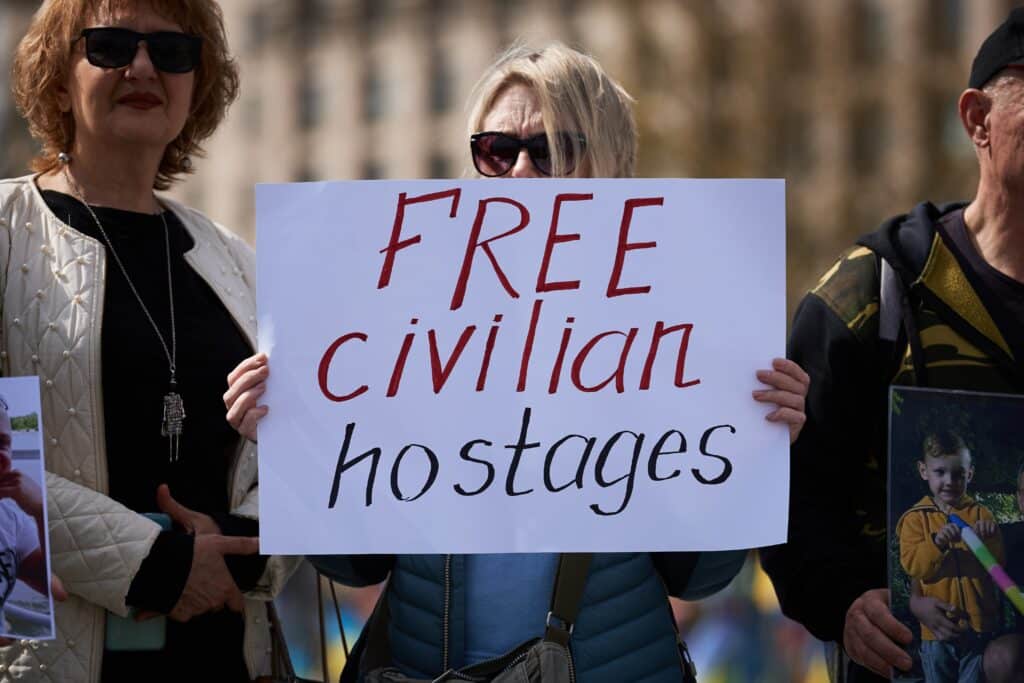
An arguably equally important but less well-investigated, reported, and publicised human rights issue concerning Russia’s treatment of Ukrainians detained since 2014 is the fate of adult civilians in the occupied territories. Thousands of Ukrainian civilians are currently incarcerated in various Russian detention facilities, from dungeons and garages to remand houses and regular prisons, in the occupied territories and Russia itself. Using previous reporting by journalists and human rights organisations, as well as interviews, this policy brief explains and assesses these human rights abuses as well as discusses the problem that there is no obvious method for freeing these political prisoners.
A minority of Ukrainian citizens in the temporarily occupied territories – especially among its ethnically Russian or highly Russified Ukrainian populations – did not oppose the region’s occupation and annexation by Russia or its integration or assimilation into the Russian nation. However, most of the Ukrainian citizens brought under Russian control since 2014, and especially since 2022, have been either unenthusiastic about or opposed to their uninvited participation in Moscow’s attempt to increase Russia’s territory and population at the expense of Ukraine.
One of the Kremlin’s major instruments for securing the submission and compliance of Ukrainians in the occupied territories has been the short- or long-term incarceration of thousands of ordinary citizens in order to suppress and deter dissent. The same goes for these Ukrainians’ more or less torturous treatment – see below – in Russia’s various remand homes, correctional facilities, prison colonies and filtration camps. Only a fraction of Russia’s imprisonment of Ukrainians can be explained by traditional criminal behaviour, but even these detentions are unlawful, as ordinary crimes by Ukrainians on Ukraine’s state territory should be dealt with by Ukrainian law enforcement agencies. Also, Ukrainian partisan activities against an armed occupation of Ukraine’s legitimate state territory do not constitute crimes under Ukrainian law.
Most of the Ukrainian civilian prisoners in Russia and the Russian-occupied territories are neither perpetrators of grave crimes nor irregular combatants in the Russo-Ukrainian War – at least, not according to Ukrainian legislation. Many of the detained Ukrainian civilians may have before – and in some cases even after – their arrest expressed disagreement with Russia’s war against and occupation of Ukraine. They have been arrested, imprisoned and convicted in connection with Russia’s “anti-extremist” legislation, which forbids criticism or even mention of Russia’s war, territorial expansion and genocide in Ukraine. Some of Ukraine’s civilian opponents of Russia’s takeover of their homes and towns have engaged in various forms of non-violent direct action.
However, an undefined proportion of the Ukrainian civilians in Russian prisons and camps are apparently randomly arrested people against whom charges have been trumped-up on the basis of false evidence, unreliable or absent testimony and extorted confessions. Many of the Ukrainian civilians in Russian detention have neither shown any active opposition to Russia’s annexation, nor voiced any public criticism of the Russian regime. A few of these prisoners were even expressly pro-Russian and pro-Putin, but for unknown reasons have still been detained under this or that pretext.
At first glance, the mass detention of Ukrainian civilians in the occupied territories appears paradoxical. Why would Russia’s occupying administration arrest, imprison, deport and torture civilians by the thousands? Why does the Russian occupation – despite amendments to the Russian Constitution in 2014 and 2022 that establish the Russia-occupied territories of Ukraine as full and equal parts of the Russian Federation – not apply Russia’s “anti-extremism” legislation there in a more moderate form?
The Kremlin’s strategy of temporary or long-term mass incarceration of Ukrainian civilians, among other human rights violations in the occupied territories, contradicts Moscow’s narrative that Russia’s expansion into Ukraine is to liberate and reunite the Russian territories and people that had been unjustly lost as a result of the break-up of the Soviet Union in 1991. The cruel treatment of thousands of Ukrainian civilian prisoners from the occupied territories seems to subvert Russian attempts to transform these areas into integral parts of Russia’s national territory, as it runs the risk to alienate so far loyal or neutral new Russian citizens in the occupied territories.
One explanation for the, at first glance, seemingly self-defeating behaviour of Moscow towards Ukrainian civilians lies in the results of opinion polls conducted in Ukraine’s occupied territories before they were captured by Russia. From Crimea in 2014 to the Zaporizhzhia region in 2022, the majority of respondents in these polls did not support a unification of Russia with Ukraine or the transfer of their region from Ukraine to Russia. Contrary to popular myths circulating in and outside Russia, only a minority of the local population approved of Russia’s takeover of these regions, in the first place. It is also likely that some who initially welcomed, or were indifferent to, Russian troops in their areas may have reconsidered their stance, especially after witnessing the harshness of the Russian attack on southern and eastern Ukraine as well as the ambivalent or even adverse socio-economic impact of the occupation on their regions.
The Russian takeover of the southern and eastern regions of Ukraine in 2014 and 2022 was more complicated than many observers in and outside Russia expected. Only in Crimea in 2014 did the Russian occupation and annexation largely go as planned, at least in its initial phase. One reason for this relative success was that both Tsarist and Soviet policy during more than 200 years of rule from St Petersburg and Moscow transformed the peninsula’s demography. Ethnic Russians went from a tiny minority to an absolute majority among Crimea’s inhabitants. The once predominant native Crimean Tatars were reduced to a minority of about 10 percent of the peninsula’s population. Nonetheless, even in Crimea, Russia is dealing with a local – largely Tatar – partisan movement fighting against its occupation. Since 2014, Crimean civilians – often from the Tatar minority – have been regularly detained by the Russian occupation administration.
In the other occupied and later annexed regions of mainland Ukraine, Russia’s military invasion was even less popular than in Crimea. Their capture had to be followed by a harsh state-led crackdown to dampen open expressions of ambivalence, critique, dissent or resistance regarding the foreign takeover. Moscow’s large-scale suppression and cleansing operation in the occupied parts of the Donetsk, Luhansk, Zaporizhzhia and Kherson regions continues today.
Against this background, the large-scale detention of Ukrainian civilians in the occupied territories fulfils three functions. First, the imprisonment of Ukrainian civilians is designed to displace, isolate, disable and, if necessary, kill those Ukrainians in the occupied territories that have either shown a readiness to resist Russia’s occupation or are suspected of being inclined to do so.
Second, the sometimes arbitrary arrest of Ukrainian civilians, along with documented cases of widespread torture, and occasional killing by Russian soldiers, police and prison guards, is intended to exert psychological pressure on the population of the occupied territories – whether ethnically Ukrainian or not. To a lesser degree, it is also a warning to Ukrainians who, for one reason or another, are living in Russia.
Third, not only incarcerated Ukrainian military personnel, but also Ukrainian civilian prisoners can be used in various forms of Russian bargaining with Ukraine and the international community. Most obviously, but not only, this involves ongoing and future prisoner exchanges between Russia and Ukraine.
The swaps of Ukrainians for Russian citizens initially only concerned prisoners of war but in the past two years have also included small numbers of Ukrainian civilian prisoners. For the Kremlin and its conduct of the war against Ukraine, Moscow’s ability to repatriate captured combatants and non-combatants in the service of the Russian state through prisoner exchanges – especially those who have committed crimes in Ukraine and elsewhere – is strategically important. The plausibility of the Kremlin’s promise to free any Russians captured by Ukraine is a crucial factor in securing the continued mobilisation, motivation and morale of Russia’s various armed and unarmed service personnel deployed abroad. Ukrainian civilians in the occupied territories constitute a large reservoir of potential exchange objects for the return of Russians who act as violent or non-violent governmental agents beyond Russia’s borders.
A large-scale monitoring report jointly published by Austausch, the Centre for Civil Liberties, the Sova Expert Group and partners too argues that the unlawful deprivation of liberty of Ukrainian civilians by Russian occupying forces is not incidental but a systematic state policy. Russia has created a network of detention facilities—both official and unofficial—where civilians can be held long-term without charge, often incommunicado, and subjected to physical as well as psychological torture, sensory deprivation and sexualized violence. Families of detainees receive no information. Surveys show that 75 per cent of families do not currently know where their relatives are and 60 per cent have received no official updates.
Official documents leaked from Russian institutions indicate close coordination between the Federal Security Service, Federal Penitentiary Service, Investigative Committee and military commanders on implementation of unlawful detentions. In one of many Russian violations of international humanitarian law vis-à-vis Ukraine, Russia does not distinguish between civilians and prisoners of war (POWs), classifying everyone as “opponents of the special military operation”.
Russia conceals the true number of its Ukrainian prisoners and locations of the detention of many of them. Moscow often denies access to lawyers and refuses to allow the International Committee of the Red Cross (ICRC) to visit prisoners, in violation of international humanitarian law.
There are various estimates of how many Ukrainian civilians have been detained and subsequently remain in Russian prisons or have since died. According to Artur Dobroserdov, the Ukrainian Internal Affairs Ministry’s Commissioner for Persons Missing under Special Circumstances, in the spring of 2025: “As of today, we have over 70,000 people on our missing persons list – these include military personnel, civilians, citizens of other states and stateless persons”.
At the same time, the Ukrainian Ombudsman, Dmytro Lubinets, reported that the Ukrainian authorities could confirm the ongoing detention of around 1,800 civilians for reasons related to the armed conflict, although Lubinets also stated that: “We have a separate list which, according to preliminary data, shows that there are more than 16,000 Ukrainian civilians in Russian prisons”. Concurrently, Deputy Head of the Office of the President Iryna Vereshchuk reported that around 2,500 civilian captives had been verified, while Ukraine’s Prosecutor General reported later that year, based on an analysis of criminal proceedings, that it had identified 15,250 civilians who were being held in custody by the Russian authorities between February 2022 and August 2025.
In March 2024, the non-governmental “Strategy for the Release of Civilians”, which contained proposals from the Centre for Civil Liberties on ways to exert pressure on the Russian Federation for the purpose of securing the release of Ukrainian civilians unlawfully detained by the Russian side in connection with the armed conflict, outlined the methodological challenge of coming up with a reliable number:
“The minimum number of civilians held by the Russian Federation as a result of the conflict is at least 7,000. In total, there may be up to 16,000 such people. Expert assessments, based on interviews with people who have returned from Russian captivity, allow only for an approximate estimate of the number of Ukrainian citizens and their breakdown into civilians and prisoners of war in places of forced detention in the Russian Federation and the occupied territories. Various sources have confirmed that around 1,900 civilians are being held in places of forced detention. The inaccuracy of the estimate of the number of detained civilians stems from the Russian Federation’s refusal to provide information on all these people or to grant access to them to representatives of the International Committee of the Red Cross or other international organisations.” Centre for Civil Liberties. (2024). Stratehiia zvilnennia tsyvilnykh [Strategy for the release of civilians].
Moreover, “Ukrainians already in detention may be released, transferred to criminal proceedings, exchanged or die, while Ukrainian civilians continue to be detained by the Russian Federation for reasons associated with the armed conflict. The number of civilians in detention by the Russian Federation therefore constantly evolves”. The only thing that is clear is that, “while the numbers of Ukrainian civilians arbitrarily deprived of their liberty by Russia was officially measured in the hundreds in the period between 2014 and 2022, since the full-scale invasion this is measured in the thousands”.
An authoritative 2025 study by the OSCE’s Office for Democratic Institutions and Human Rights (ODIHR), oddly prepared in accordance with the s0-called “Moscow Mechanism”, states that determining the scale and nature of Russia’s detentions of Ukrainian civilians is complicated by the diverse composition of the group. Among other classification issues, given the complex nature of the conflict, it is not always clear whether they are all really non-combatants.
Since 2022, according to the same ODIHR report, Russia may have, for one period or another, detained tens or even hundreds of thousands of Ukrainian civilians in the occupied territories. Many of these civilians were taken from their homes in regions such as Kyiv, Sumy, Chernihiv, Kharkiv and Kherson in the early months of the full-scale invasion. Some are still being held without charge, often on the basis of directives from military commandants or regional FSB officials. Their detention is often periodically extended, mostly without any legal justification.
Among them have been insufficiently submissive journalists or community leaders, and civilians suspected of having participated in Ukraine’s defence efforts, or of being associated with the Ukrainian anti-terrorist operation in Donbas after 2014. They also include Ukrainians whose digressions were minor even by Russian standards, such as those who did not possess all the necessary Russian documents in the annexed territory, or those who were unwilling to work for the Russian occupying power, such as employees of local administrations or critical infrastructure, prison staff and teachers, or others suspected of being disloyal to the occupying power.
The 2025 ODIHR report notes that the detained Ukrainian civilians even include:
“persons working for international organizations at the time of the full-scale invasion, including the three OSCE Special Monitoring Mission staff members, detained and subsequently charged with “treason” or “espionage” despite the OSCE making it plain that these personnel are being prosecuted for activities directly stemming from their work under the OSCE mandate.”
“Moreover, some 2000 Ukrainian sentenced persons in Ukrainian prisons were moved to Russia in 2022, some of whom were re-detained despite having served their sentences”. Many of those Ukrainian citizens who served sentences in Ukrainian prisons located in the territories occupied by Russia are, along with other Ukrainian detainees, often held in so-called Russian Centres for the Temporary Detention of Foreign Nationals. Internment in these Centres is supposed to last only a limited time, but a significant number have been detained without trial for several years.
Although the Geneva Convention relating to the Protection of Civilian Persons in Time of War permits internment of civilians only under strict conditions, with rights of appeal and due process, in most cases, few or none of these obligations are observed by Russia. Moreover, international humanitarian law stipulates that civilians must be released once the reasons for internment end, but many Ukrainian civilians currently detained are from areas that have long since been liberated from Russian occupation.
Ukrainian combatants and non-combatants are detained in either harsh or extremely harsh conditions. Both POWs and civilian prisoners are confined in locked cells, allowed little or no outdoor exercise, deprived of adequate food and medical care, cut off from contact with their relatives and subjected to abuse, ill-treatment and sensory deprivation. Surveys conducted by the Office of the United Nations High Commissioner for Human Rights reveal that most detainees are being tortured.
Over 92 per cent of the 216 released civilians interviewed by the OCHCR between 2023 and 2025 provided consistent and detailed accounts of ill-treatment while being held. Both men and women were affected (144 men, 1 boy and 54 women). In addition, 101 of those interviewed reported that they had witnessed the torture or ill-treatment of other detainees. Similarly, all the civilian detainees or their relatives interviewed by Amnesty International in a 2025 report reported treatment and conditions of imprisonment that amounted to torture, inhumane or degrading treatment, or punishment.
The Convention Against Torture, which Russia has signed, prohibits prolonged indefinite detention without charge. Lengthy imprisonment is a form of torture due to the severe mental suffering it causes. Moreover, the International Convention for the Protection of All Persons from Enforced Disappearance is being violated by Russia’s concealment of detainees’ whereabouts. Protocol I to the Geneva Conventions requires that any doubt about a person’s status has to be resolved in favour of civilian protection. However, Russia conflates civilians with POWs, citing Article 5 of the Third Geneva Convention without ever convening competent tribunals to determine prisoner status.
A relatively well-documented example of a Ukrainian long-term civilian prisoner is Kostiantyn Zinovkin, an engineer from the south-eastern Ukrainian city of Melitopol and former owner of a metal workshop there. When Russian troops occupied south-eastern Ukraine in 2022, Zinovkin was unable to flee as he was looking after his immobile grandmother who required care following a stroke.
In the early days of the occupation of Melitopol, Zinovkin took publicly a pro-Ukrainian stance and, along with thousands of other city residents, marched in peaceful protests during February-March 2022. He and others gathered in the city’s central squares waving Ukrainian flags, singing the Ukrainian national anthem and demanding that Russian troops leave the city. During the Maslenitsa (butter week) celebrations in the spring of 2022, Zinovkin and a friend organised a public event at which an effigy of Vladimir Putin was burned. Photographs of this event were widely shared on social media. The occupying authorities forcibly suppressed peaceful protests and carried out arrests and abductions of pro-Ukrainian activists, after which open protest ceased.
On 12 May 2023, Zinovkin was abducted by representatives of the Russian security forces. Subsequently, three unidentified armed men wearing balaclavas entered Zinovkin’s flat and took the family’s savings, documents and the keys to his car, workshop and summer cottage. Later, representatives of the Russian security forces returned to the flat several times using the keys they had seized.
For more than a month after his abduction, Zinovkin’s family had no information about his whereabouts or state of health. His mother repeatedly contacted the Russian military command, police and other occupation authorities in Melitopol, but was told that there was no information about him. At the same time, Zinovkin’s wife sent numerous appeals to the Russian state authorities, demanding to be informed of his fate.
It was only during another search of Zinovkin’s flat in June 2023, his mother was told that her son was being held in the town of Priazovske, about 17 kilometres from Melitopol. She was instructed, however, that she could not visit or contact him there.
On 1 June 2023, the occupation regime’s Melitopol District Court in the Zaporizhzhia Region imposed a pretrial detention order for a period of two months. On 26 July 2023, Zinovkin’s period of detention was extended until 29 October 2023, to be served at Pre-trial Detention Centre No. 2 in the Kherson Region. In August 2023, the family received a first official response from the Prosecutor General’s Office of the Russian Federation. It stated that “the Investigative Department of the FSB of Russia for the Zaporizhzhia Region is investigating a criminal case initiated on 30 May 2023 on the grounds of an offence under Part 3 of Article 30 and sub-paragraph ‘ka’ of Part 2 of Article 205 of the Criminal Code of the Russian Federation”.
The investigation into Zinovkin had begun on 30 May 2023 – 18 days after his abduction. In Russia’s official records for Zinovkin, the period 12–30 May 2023 is unaccounted for. His family still does not know where Zinovkin was during this time, under what conditions he was held or what happened to him during these 18 days.
Until March 2024, Zinovkin was held in the village of Chongar in the Kherson region. At that time, this settlement effectively functioned as a secret detention centre for Ukrainian civilians, the existence of which Russia refused to acknowledge. In March 2024, he was transferred to a remand centre in occupied Mariupol, where he remained until December 2024. He was subsequently held for about a month in a Donetsk remand centre. In January 2025, he was unlawfully deported to the Rostov Oblast in the Russian Federation. There, Zinovkin was initially held in Remand Centre No. 1, and later transferred to Remand Centre No. 3, where he is still being held.
In October 2023, Zinovkin appeared on the Sunday prime-time television show, “Vesti” (Messages), one of the Russian state broadcaster’s main weekly news round-up programmes. The 12-minute report focused on Melitopol and featured detained Ukrainian journalists, administrators of Telegram channels and other civilians from the city. Zinovkin was shown last in the report. He was presented as a “Ukrainian zombie” in so far as Zinovkin claimed that Ukraine is independent and Russia a terrorist state. Watching this report, his family saw Zinovkin for the first time since his abduction. Despite the report’s propagandistic nature, it provided visual confirmation that Zinovkin was alive and being held in Russia.
During the pretrial investigation, Zinovkin was brought before the occupation court in Melitopol about once every two months to consider an extension of his pretrial detention. At this stage, a state-appointed lawyer represented his interests. In the family’s view, this lawyer did not provide an effective defence and did not protect Zinovkin’s interests.
On 2 November 2024, the criminal case was referred to the Southern District Military Court in Rostov-on-Don. The criminal case is being heard by a single judge, Sergei Mikhailovich Gorev. Alongside Zinovkin, three other Ukrainian civilians are involved in the case — two brothers, Oleksiy and Hryhoriy Semykopenko, and Vladyslav Vidlatskyi, who was only 17 at the time of his arrest. Prior to his abduction, Zinovkin was not acquainted with any of them. Despite this, the investigation alleges that they acted as an organised terrorist group. The court later removed the names of the accused from its official website.
Zinovkin faced charges under seven articles of the Criminal Code of the Russian Federation, including a terrorist act, high treason against Russia (even though Zinovkin remains a citizen of Ukraine) and the unlawful manufacture and possession of weapons. Following the opening of the criminal case, he was added to the Russian federal list of individuals involved in extremist activities or terrorism maintained by the state agency RosFinMonitoring.
Court hearings were held in camera on the grounds that the case files contain information that constitutes a state secret. Members of the public, journalists and independent observers were not permitted to attend the hearings. Although the trial had been ongoing for more than a year and a half, hearings were regularly adjourned or rescheduled for reasons not explained to the defence or the family.
For over a year, Zinovkin was held in solitary confinement and completely deprived of any opportunity for outside exercise. His only opportunity to see daylight was during transport to and from court hearings. Correspondence with his family was irregular and depended on where he was held. According to accounts from the families of other Ukrainian civilians and released prisoners of war, such conditions are not isolated cases.
On 22 September 2026, the Southern District Military Court in Rostov-on-Don handed down its verdict in the case of Zinovkin. He was sentenced to 28 years’ imprisonment. He is to spend the first seven years in prison, and the remainder of his sentence in a strict-regime correctional colony. In addition, the court imposed a fine of 600,000 roubles on him.
The verdict marked the end of a trial that had been ongoing since November 2024 and was held behind closed doors. Throughout this period, members of the public, journalists and independent observers were denied access to the court hearings. Despite the harsh sentence, Zinovkin’s family never received full information about the factual circumstances on which the charges against him were based.
The story of Kostiantyn Zinovkin illustrates the mechanisms employed by the Russian Federation against Ukrainian civilians abducted in the temporarily occupied territories of Ukraine. Following their enforced disappearance, they find themselves in isolation and subsequently become defendants in criminal cases of alleged terrorism, sabotage, treason and other particularly serious crimes. Criminal proceedings are used to present the unlawful deprivation of liberty as an ordinary criminal prosecution.
In Zinovkin’s case, unlike in numerous other cases, in response to its continued requests, his family received several official confirmations of his detention from Russian state bodies, such as the Prosecutor General’s Office, Ministry of Defence and Federal Security Service. Furthermore, Russian state television showed Zinovkin in a report. At the same time, as with many other Ukrainian civilians who are on trial or have already been convicted on trumped-up criminal charges, his status has still not been confirmed through the mechanisms of the ICRC.
Zinovkin’s example highlights one of the key issues with this category of prisoners: Moscow attempts to portray abducted civilians not as victims of enforced disappearances and unlawful deprivation of liberty, but as ordinary criminals or terrorists. Russian war crimes and violations of international humanitarian law are disguised as criminal proceedings by Russia’s law enforcement agencies and regular court system, as well as their branches in the occupied territories.
Under traditional conditions of warfare, the care and release of civilian prisoners, as well as their return to the jurisdiction of their homeland, would be, in military terms, a secondary issue, and thus easily resolvable, as well as a routine operation for the ICRC. However, Russia treats the Ukrainians in its detention facilities as treacherous Russian citizens in so far as it respects, as indicated above, neither the existence of a self-sufficient Ukrainian nation nor the authority of the independent Ukrainian state. Instead, Moscow uses Ukrainian civilian prisoners as instruments of war and its terror rule over the occupied territories, as well as hostages vis-à-vis Kyiv and its partners. As a result, the Ukrainian state and ICRC are severely limited in their sphere of action, and civilian prisoners are freed only seldom and in small numbers.
For instance, by December 2025, 1,782 Ukrainian civilians had been identified by Ukraine by name as prisoners in the Russian Federation and temporarily occupied territories, but the detention of only 867 could be confirmed by the ICRC. In the period March 2022 to May 2025, only 173 Ukrainian civilians were returned as part of various prisoner exchanges.
Among the 120 civilians Russia handed over to Ukraine in the largest return to date on 23 May 2025, there was only one political prisoner. A further 15 of the civilian prisoners returned were former convicts from Ukraine who had committed crimes and been sentenced in Ukraine prior to 2022. All the other civilians exchanged were Ukrainians who had served sentences in Russian prisons for criminal offences committed in the Russian Federation. Most of the returnees were not among the primary people of concern to the Ukrainian state.
The Ukrainian government has tried some unusual methods to facilitate the exchange of civilian prisoners. On 25 July 2024, Ukraine’s Coordination Headquarters for the Treatment of Prisoners of War, together with the Main Intelligence Directorate of the Ministry of Defence of Ukraine (HURMOU), the Security Service of Ukraine (SBU) and the Secretariat of the Ukrainian Parliament Commissioner for Human Rights, launched “I Want to Be with My People”, a project that publishes information about convicted Russian agents and collaborators who have cooperated with or assisted the Russian occupying forces in the war against Ukraine on the website hochuksvoim.com. These are Ukrainian citizens who have been charged with treason and gave their consent to be exchanged for Ukrainian citizens held in Russia. However, this project to repatriate Ukrainian civilians has been criticised for potentially contravening international law and ultimately leading to even greater human rights violations in territories occupied by Russian forces.
Members of the Bundestag and German regional parliaments, and German Members of the European Parliament are campaigning for the release of political prisoners, including Ukrainian civilians, through political sponsorships. For instance, a sponsorship programme by the Germany-based International Society for Human Rights (IGFM) tries to protect and free political prisoners from various countries and aims to draw attention to the plight of political prisoners and increase pressure on governments. The programme was launched by the IGFM in 2011 and matches prisoners from various countries, including Ukraine, with German parliamentarians who, through political sponsorship, campaign for their release.
A growing number of governmental and non-governmental investigations paint a grim picture of unlawful deprivation of Ukrainians’ liberty as a weapon of war and control in the Russian occupied territories. Not only combatants, but also civilians are held in pre-trial detention centres, penal colonies and improvised sites such as cellars and garages, often for months or years without charge.
Psychological pressure, isolation from family members and various forms of torture are widespread. The whereabouts, legal status, and physical and psychological condition of many detainees are unknown. Sometimes even the question of whether the detained person is still alive cannot be answered. The absence of protective powers by the ICRC, and its inability to overcome Russia’s obstruction of access, leave detainees without international protection. The sheer scale of detentions – thousands of civilians across hundreds of sites – underscores the urgent need for a systematic response.
The clumsiness of the above-mentioned Ukrainian and international attempts to liberate Ukrainian civilians from Russian detention illustrates the enormous complication of the challenge: there is no clear roadmap for addressing the issue. This is in stark contrast to the fate of and prospects for Ukrainian prisoners of war, most of whom have also suffered or are suffering from Russian torture, and many of whom are often held by Russia together with Ukrainian civilians. Unlike civilian prisoners, POWs can be and have, however, been returned to Ukraine in large numbers via prisoner exchanges, in which so far very few civilians were included.
For another related group, the thousands of unaccompanied Ukrainian children displaced or deported by the Russian occupation forces in Ukraine, and already adopted by Russian parents, there is also no regulated mechanism for return. However, the mass capture and transfer of Ukrainian children by Russia has been the topic of numerous media reports, several resolutions by national parliaments and international assemblies, and growing international civil society activity. The high level of attention on and considerable efforts regarding Ukraine’s “stolen children” have, to be sure, also had only limited practical success and led to relatively few repatriations. Nevertheless, the increasing global focus on this emotive issue makes it likely that at least a partial solution could emerge.
This is in contrast to the situation of the around 16,000 adult Ukrainian civilian prisoners for whom there is little prospect of a return to their motherland or avoiding further Russian detention, which is often accompanied by torture. While there has recently been a surge in think tank and NGO reports on the topic, political, journalistic, diplomatic, civic and general public attention to this specific theme remains relatively low. Even Western and non-Western politicians, activists, reporters, researchers and diplomats with an interest in Ukraine’s fate are partly unaware of the specific challenges of the issue, and, in particular, of the absence of any established mechanism for affecting the release of Ukrainian civilian prisoners.
Various expert discussions inside and outside Ukraine have identified sustained monitoring, coordinated advocacy, effective sanctions and holding Russian state organs publicly accountable for their violations as pathways for action. More specifically, Ukrainian human rights NGOs, such as the Centre for Civil Liberties and the Human Rights Centre “Zmina” have recommended that Ukraine and its partners:
In addition to these recommendations, four additional areas of action by governmental and non-governmental Ukrainian and non-Ukrainian actors with an interest in the issue should be considered:
Acknowledgements
This policy brief benefited greatly from, among other things, interviews with and help from Mykhailo Savva and Natalia Yashchuk at the Centre for Civil Liberties in Kyiv, Liusiena Zinovkina from the NGO “Civilni Vilni” in Berlin, and two officers of Ukraine’s Coordination Headquarters for the Treatment of Prisoners of War in Kyiv. None of these experts, however, can be held responsible for any inaccuracies that this brief might still contain.
As Ukraine’s deep strikes hit Russia’s economy and military rear, how will Moscow retaliate?

You will now receive EPIK’s latest analysis, publications, event invitations, and other updates directly in your inbox.
You will now receive EPIK’s latest analysis, publications, event invitations, and other updates directly in your inbox.
Go Home Page
The form has been successfully submitted. We value your time, so please expect a call or email from our manager shortly.
Go Home Page
You will now receive EPIK’s latest analysis, publications, event invitations, and other updates directly in your inbox.
You will now receive EPIK’s latest analysis, publications, event invitations, and other updates directly in your inbox.
You will now receive EPIK’s latest analysis, publications, and event updates directly in your email.
Go Home Page
You will now receive EPIK’s latest analysis, publications, event invitations, and other updates directly in your inbox.
You will now receive EPIK’s latest analysis, publications, event invitations, and other updates directly in your inbox.
Go Home Page
The form has been successfully submitted. We value your time, so please expect a call or email from our manager shortly.
Go Home Page
You will now receive EPIK’s latest analysis, publications, event invitations, and other updates directly in your inbox.
You will now receive EPIK’s latest analysis, publications, event invitations, and other updates directly in your inbox.
You will now receive EPIK’s latest analysis, publications, and event updates directly in your email.
Go Home Page