Argument in brief
Ukraine’s accession to the EU needs a stronger working relationship between the European Parliament and the Verkhovna Rada. Much of the accession work will involve the European Commission and the Ukrainian Government. However, Ukraine’s parliament must pass the laws needed to meet EU commitments, oversee their implementation and hold the government accountable. Existing parliamentary procedures do not consistently enable Ukrainian committees to monitor EU legislation while it is still being drafted and debated, or to provide European lawmakers with evidence of the practical difficulties Ukraine faces in applying EU rules.
A small Verkhovna Rada office in Brussels could help committees in Kyiv follow relevant EU proposals and share their experience with European lawmakers before legislation is finalised. At the same time, a pilot scheme could allow a limited number of Ukrainian parliamentarians to participate in selected European Parliament activities. These steps could start now without altering the responsibilities of the institutions managing accession. If this approach works, the European Parliament could introduce a new “Rule 13a” to set clear, lasting rules on participation in its work by candidate country parliaments. It could adopt this provision by amending its own Rules of Procedure, without requiring Council approval.
Important note: This paper concerns participation before membership. It would confer none of the rights reserved to Members of the European Parliament and does not prejudge Ukraine’s future seat allocation.
1. Core problem
Accession could fail between the negotiating table and the parliamentary vote
Complications begin with how accession is organised. The European Commission reviews alignment with EU law, known as the acquis, and assesses readiness to advance. The national government negotiates and reports on implementation, while the Council of the European Union decides when negotiations move forward. In Ukraine, the Verkhovna Rada must turn commitments into law and hold ministers to account for delivering them. However, it often only becomes involved after the government has agreed its approach. If parliamentarians and committee staff learn the reasoning behind an EU requirement too late, parliamentary scrutiny risks becoming a formality or triggering a last-minute political confrontation.
Ukraine lacks a reliable and practical way to explain to parliament what accession commitments require of Ukrainian legislation while its members of parliament (MPs) are still able to influence critical decisions. Accession negotiations concern Ukraine’s adoption of the acquis, although transitional arrangements can be negotiated. This weakness runs in both directions. A Ukrainian committee might discover the political cost of an EU commitment too late, while Members of the European Parliament (MEPs) might receive the Ukrainian government’s assessment of a reform without knowing whether it has sufficient parliamentary support or funding, or a workable implementation plan in Kyiv.
Of course, the Brussels office would not be able to dictate a parliamentary outcome or prevent a political crisis like the one that arose in July 2025 over the independence of the National Anti-Corruption Bureau and the Specialised Anti-Corruption Prosecutor’s Office. However, it could put the EU implications and the related evidence before the responsible committee while the text is moving through the legislative process. It could also explain the responsible Verkhovna Rada committee’s view to MEPs regarding whether a reform has parliamentary support, what might prevent its implementation and where the committee’s assessment differs from the government’s position.
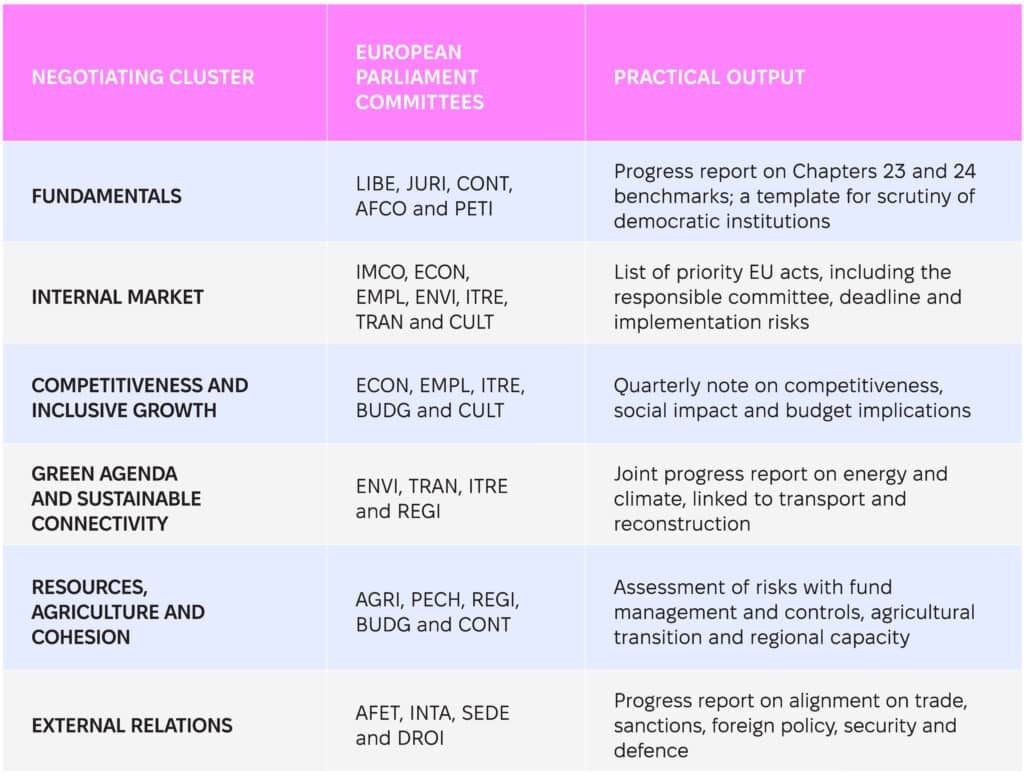
The EU has made this broader weakness part of the formal accession agenda. In its common position on opening Cluster 1 (Fundamentals), the Council notes that the Verkhovna Rada’s oversight of the executive is limited and calls for greater transparency and effectiveness in law-making. Cluster 1 opened on 15 June 2026 and Cluster 6 (External Relations) followed on 14 July. Legislative alignment is already advancing while the political route to open the remaining four clusters is unclear.
2. What already exists
Existing cooperation does not yet support day-to-day legislative work
The European Parliament and the Verkhovna Rada are not starting from scratch. The EU-Ukraine Parliamentary Association Committee (PAC) is a political forum established under the Association Agreement. The 2023 Memorandum of Understanding discusses committee exchanges and support for parliamentary democracy through staff development and annual action plans. The European Parliament opened a permanent presence in Kyiv in September 2025.
The PAC has adapted to accession. A permanent Subcommittee on Accession was established at the sixteenth meeting, held in Kyiv on 7 March 2025. At the eighteenth meeting, held in Kyiv in June 2026, co-chaired by Vadym Halaichuk and Pekka Toveri, the delegations agreed early involvement of candidate country parliaments, closer committee links and stronger research capacity.
These mechanisms are important, but they mainly operate around periodic political meetings and programmes rather than the daily legislative workflow. They do not yet comprise a standing team of serving MPs and parliamentary staff who could track the legislation under discussion in the European Parliament, explain its implications to committees in Kyiv and provide evidence of implementation to Brussels. This practical link would connect high-level dialogue and technical assistance with day-to-day parliamentary work.
Consider a hypothetical proposal to reform the electricity market. The European Parliament’s Committee on Industry, Research and Energy (ITRE) considers a deadline for national regulators to introduce a new system for managing electricity reserves. The Brussels office links the proposal to accession Chapter 15 on Energy and asks the Verkhovna Rada Energy Committee and its Research Service whether Ukraine could meet the new requirement. Analysis shows that the deadline would be difficult to meet while power plants and grids remain under attack, with risks for energy resilience and future compliance. The office sends the findings, identifying the committee responsible, to the rapporteur leading the European Parliament’s work and the shadow rapporteurs following it for other political groups before the committee vote. These MEPs decide whether to propose changes, such as a narrowly defined provision for countries facing armed aggression or another systemic emergency. If the difficulty concerns Ukraine’s accession terms, they can flag the need to consider a transitional arrangement in the negotiations. Kyiv would thus learn about evolving EU rules early, while MEPs would gain evidence about the conditions in which a future member must apply them.
This exchange would give the proposed representation a practical role in accession, connecting EU law-making with parliamentary work in Ukraine. A political opening already exists: on 3 August 2026, Verkhovna Rada Chair Ruslan Stefanchuk announced that parliament intended to open a representation at the European Parliament “in the very near future”. However, no public mandate, staffing plan or administrative arrangement with the European Parliament accompanied the announcement. Defining this role now would help to ensure that the office could support legislation and oversight as well as visits and official meetings.
3. The European Parliament's case
Give the European Parliament a practical role it can develop itself
The European Parliament occupies an ambiguous position in enlargement. It co-legislates much of the acquis Ukraine must adopt, shares budgetary authority and must consent to accession, but it has no real seat at the negotiating table. It is the Commission that leads screening and monitoring, while the Council controls formal advances. The European Parliament debates enlargement throughout but when it is asked for binding consent, the evidence and the major political compromises have largely been shaped elsewhere.
Institutional frustration surfaced in October 2025 when the European Parliament called for the early and close involvement of candidate countries in EU institutions, including observer status, and for a stronger role for candidate country parliaments. The vote, with 310 in favour, 277 against and 53 abstentions, demonstrated substantial support but considerable division. A broad coalition had supported the principle, but a resolution alone cannot change either committee access or the flow of evidence. A practical procedure is needed to turn political support into regular cooperation.
A practical answer would be a form of enhanced cooperation between the candidate country parliament and the European Parliament committees responsible for adopting the required legislation. Designated parliamentarians and staff would follow relevant public committee work, explain the implications to committees in Kyiv and send the European Parliament clearly sourced findings on feasibility, political support and implementation risks. Committees could test these exchanges using targeted invitations. If this proves useful, the European Parliament could later adopt rules setting the same eligibility conditions and terms of participation for all candidate parliaments.
This matters because Article 232 of the Treaty on the Functioning of the European Union (TFEU) allows the European Parliament to amend its rules by a majority of all its members, without requiring Council consent. Parliament can therefore use its own powers to strengthen its contribution to enlargement. This would give MEPs direct access to the views of Ukrainian parliamentary committees before they exercise their budgetary and consent powers, while leaving the formal negotiating responsibilities unchanged.
Both parliaments therefore have an interest in this arrangement. The European Parliament would decide the terms of participation while the Verkhovna Rada would need to provide timely, useful analysis.
4. The operating centre
Build the Brussels representation around work in Kyiv
The proposed Verkhovna Rada office in Brussels should focus on legislative analysis and avoid duplicating the protocol work of the Mission of Ukraine to the EU, the Verkhovna Rada’s international directorate and the PAC secretariat. The representation will need a narrower mandate: to explain developments in the European Parliament to Ukrainian committees, convey verified findings from Kyiv to the relevant European Parliament bodies and follow up on their responses.
Its permanent core should be lean, with four to six officials. One parliamentary representative should lead the office, supported by two policy officers working on legislative tracking and committee relations. A programme officer could organise staff placements and keep records of submissions and follow-up under agreed security rules. Specialists on the EU negotiation clusters could be based in Kyiv and visit Brussels when specific legislative work requires.
Norway’s Storting offers a useful example of how to organise such an office, although it is not a legal precedent for participation. A Brussels representative links European Parliament work to a home-based EU/EEA team and standing committees.
The European Parliament’s Kyiv office would serve as the representation’s daily counterpart. A simple administrative arrangement could cover workspace and accreditation, with separate provisions for staff welfare and safety. The 2023 Memorandum provides a political basis for committee and staff cooperation. It does not confer access rights, which would require a separate decision.
5. Political participation
Start with two serving MPs and expand as negotiations advance
An office staffed only by officials can exchange information but would need parliamentarians to act on its findings. A large number of MPs from the outset would be premature while only two clusters are open, as wartime parliamentary capacity is scarce and a large number of travelling MPs might appear disproportionate to the immediate workload.
The political pilot should therefore start with two serving MPs: one for Fundamentals and one for External Relations. One would come from the governing majority and one from a non-majority faction. They would be Kyiv-based and travel only when a European Parliament committee agenda item or hearing creates a specific need.
The political pilot may expand from two to six MPs once all six clusters are open, provided that the EU assessment at each stage records progress against the Chapter 23 and 24 interim benchmarks. These interim benchmarks are the rule-of-law requirements that must be met before negotiations on Cluster 1 can move towards closure. Opening all the clusters will create work for six MPs, one for each cluster. Requiring progress on Fundamentals provides a democratic safeguard as Cluster 1 is the first opened, the last closed and the pace-setter for negotiations.
Appointments would be renewed when the next Verkhovna Rada first sits after a parliamentary election. All political appointments should lapse at the end of the parliamentary term. The civil service office and its activities would continue while the new chamber selects its representatives. This would prevent a wartime allocation from becoming an inherited entitlement.
6. Clear and transparent parliamentary input
A parliamentary voice is useful only when its authority and limits are visible
Where serving MPs are involved, every contribution must make clear whose view it represents: the position of a parliamentary representation will sometimes differ from that of the Government Office for European and Euro-Atlantic Integration, the Mission to the EU or the chief negotiator. A reform may meet a negotiating commitment but lack either a parliamentary majority or the resources and administrative capacity required for implementation. MEPs need to know the difference.
Coordination is essential. On 23 July 2026, Vice Prime Minister Vsevolod Chentsov met MPs and committee leads to discuss the accession process and the Cluster 1 interim benchmarks. This is the correct working relationship: regular contact without a presumption that the executive settles parliament’s view.
Every note sent through the Brussels office should state whether it represents a committee position, a cross-party position or staff analysis. None should carry the label “Ukraine’s negotiating position”. The Government Office and the Mission should be sent a draft for a brief check before publication or sharing. They should be allowed to correct data and append the government’s view, but not to veto a parliamentary conclusion. Where views differ, the record should reflect both positions.
Committee submissions on EU proposals under discussion need additional safeguards. European Parliament rules already require members to publish scheduled meetings with representatives of third country public authorities, while rapporteurs must disclose whose input contributed to a report or opinion. Public authorities generally fall outside the registration requirements for interest representatives under the Transparency Register but the relevant meeting disclosure rules still apply.
Any rules governing participation under the European Parliament’s Rules of Procedure should apply the same eligibility conditions to all candidate parliaments. The membership perspective under Article 49 of the Treaty on European Union (TEU), together with the obligation to adopt the acquis through the accession process, explains the focus on candidate countries.
7. From practice to status
Test participation with invitations before establishing a formal status
The pilot should be a time-limited test of access, not a new status. European Parliament committees can use their existing powers to invite political participants to selected public meetings and hearings. Political groups can decide separately whether to admit them to their own meetings. This would be a test of cooperation before Ukraine reaches the stage of signing an accession treaty.
Observer status for candidate country MPs under existing Rule 13 becomes available only after an accession treaty has been signed. It allows the parliament of an acceding state to appoint the same number of observers as its future seats. Observers may speak in committees and groups but cannot vote or hold office. Before that point, the consolidated July 2025 Rules provide a narrower route: under Rule 222(2), a committee may, by decision, invite any other person to attend and take the floor.
The pilot would ask three practical questions:
- Are the most relevant EU proposals being followed?
- Does Ukrainian evidence help the host committee?
- Does participation improve legislative scrutiny in Kyiv?
Reliance on invitations has its limits. Access can be withdrawn and practice will vary between committees. In addition, informal success could persuade MEPs and European Parliament officials that no formal instrument is needed.
If the invitation pilot demonstrates its value, the European Parliament could establish rules for participation through a new provision immediately after Rule 13. This paper therefore proposes a “Rule 13a” that would set the same eligibility conditions and terms of participation for all candidate country parliaments. It would allow their members to participate before an accession treaty is signed, with fewer rights than the observer status available to acceding states.
Rule 243 sets out the procedure for amending the European Parliament’s Rules of Procedure. Article 232 TFEU allows Parliament to adopt such changes without Council approval, but requires a majority of all its members: 361 in a Parliament of 720 MEPs. The October 2025 resolution received 310 votes in favour. Reaching the threshold for a rules amendment would therefore require at least 51 more affirmative votes than supported that resolution.
The next steps would be to seek a rapporteur in the Committee on Constitutional Affairs (AFCO), an opinion from the Committee on Foreign Affairs (AFET) and support from the European People’s Party (EPP), the Socialists and Democrats (S&D), Renew Europe and Greens/EFA groups before a vote.
Under the proposed “Rule 13a”, eligibility would require all negotiation clusters to be open and documented progress against the Chapter 23 and 24 interim benchmarks. Meeting these conditions would not automatically guarantee participation because AFET would need to provide a final political assessment. The Conference of Presidents, comprising the European Parliament President and political group chairs, would decide whether to grant participation. The Bureau and Secretary-General would then settle the administrative arrangements.
The proposed rule could cap participation at, for example, six parliamentarians for each eligible candidate parliament, regardless of its future seat allocation, while leaving attendance and speaking rights under the control of the host committee or group. The status should exclude:
- voting, holding European Parliament office or acting as a rapporteur;
- tabling amendments or gaining access to confidential material;
- claiming any entitlement to future seats.
Participation would be reviewed every six months and could be suspended in case of democratic backsliding. Once an accession treaty is signed, the observer arrangements under existing Rule 13 would replace this pre-accession status.
Once Ukraine meets the proposed eligibility conditions, the Conference of Presidents would be able to record one of three outcomes: (i) grant participation under the rule if it has been adopted; (ii) authorise a temporary extension with a stated justification while AFCO completes the amendment; or (iii) end the pilot.
8. Staff cooperation and political links
Staff continuity and links between political parties support the model
Under both the invitation pilot and the proposed formal arrangement, MPs would travel irregularly, so staff would ensure continuity. A small placement programme would place Verkhovna Rada committee staff and analysts from the Verkhovna Rada Research Service with relevant European Parliament services on defined assignments.
Links between Ukrainian political parties and European political families would provide a separate, voluntary form of cooperation. European Solidarity and Batkivshchyna have EPP relationships. Servant of the People and Holos are linked to the Renew family through ALDE. The Party of European Socialists (PES) register has no Ukrainian member, associate or observer party. The S&D Group, however, works with the Ukrainian NGO SD Platform through its Ukraine outreach activities, although SD Platform is a civil society organisation, not a PES member party. The representation would identify relevant contacts, while European Parliament political groups and European political parties would choose their partners and finance their own programmes.
9. Governance and results
Two decisions required to launch the model
The proposal is dependent on two decisions. In Kyiv, the Speaker will need to submit a Verkhovna Rada resolution defining the office and setting up the two-person political pilot using the cross-party procedure described above. The resolution would set out reporting duties and procedures for the renewal of appointments following elections. In Brussels, the Conference of Presidents must ask AFCO and the Secretary-General to prepare options for the proposed “Rule 13a” while committees commence a coordinated invitation pilot.
Funding should follow responsibility. The Verkhovna Rada or an existing technical assistance project would cover the costs of the office and salaries. Subject to its rules, the European Parliament could provide workspace, accreditation and eligible services. The budget would be agreed once responsibilities and costs are clear. A provisional ceiling up to €1 million a year for the initial phase would cover four to six Brussels posts, premises, travel, IT and security. This is an indicative ceiling to test against actual costs, not a spending target. European Parliament support provided in kind should be assessed and recorded in quarterly reports.
Three measures would demonstrate whether the office has proved useful.
- Coverage: relevant EU acts are given a dated note and a named responsible Verkhovna Rada committee.
- Speed: the office records how long it takes to alert the responsible Verkhovna Rada committee to a relevant EU proposal or development in the European Parliament.
- Effect: a committee record identifies the Ukrainian bill or scrutiny action changed by the analysis. Reporting the total number of priority EU files alongside those covered would make clear both the achievements and any gaps.
Decision sought
The Verkhovna Rada should mandate the establishment of a lean Brussels representation as an accession office to support parliamentary committees and launch a cross-party pilot involving two serving MPs. The European Parliament should run a time-limited invitation-only pilot and open formal work on the proposed “Rule 13a”, with the same eligibility conditions for all candidate parliaments. The performance of the office, parliamentary participants and staff placements should be judged by improvements in legislative scrutiny and the quality of legislation, rather than by the number of meetings held.
EPIK UA-EU Institutional Integration Series examines practical options for integrating Ukraine and other candidate countries into the work of EU institutions before a Treaty of Accession is signed. It explores how structured participation, observer arrangements, staff-level cooperation and political links can move candidate countries beyond conventional third-country engagement, strengthen mutual preparedness and build institutional familiarity without prejudging the rights that come only with full EU membership. Each paper proposes legally sound, politically feasible and operationally practical pathways for deeper integration with the main EU institutions during the accession process.