Russia’s occupation strategy: reinforcing maximalism
The sham voting in Ukraine’s occupied territories last month is further proof, if any were needed, that Russia still has no intention of good faith negotiations, much less backing down.
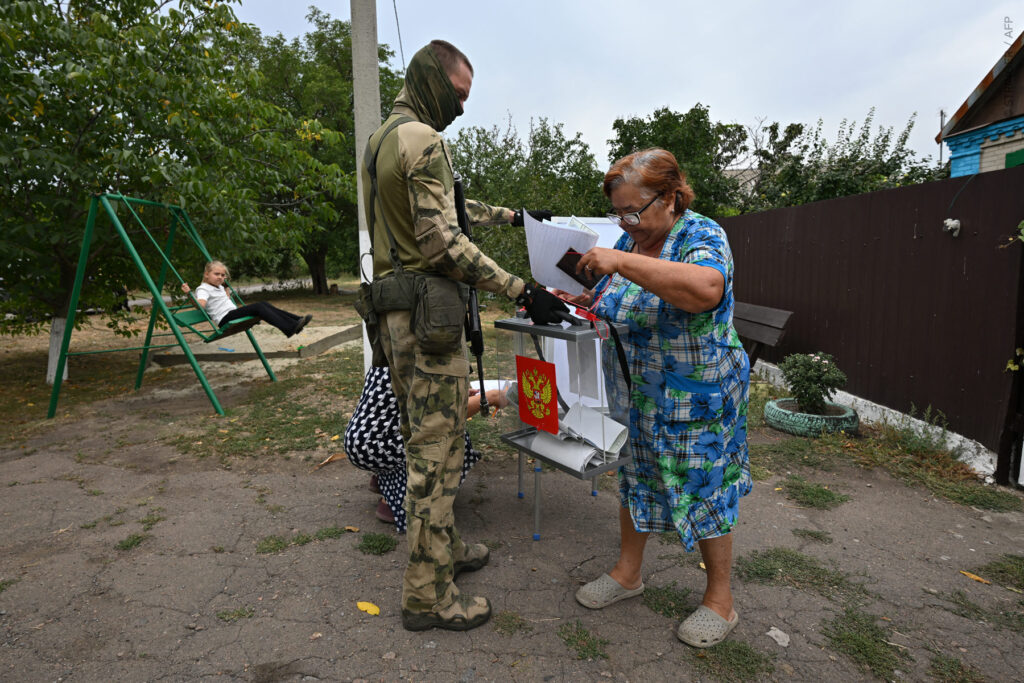
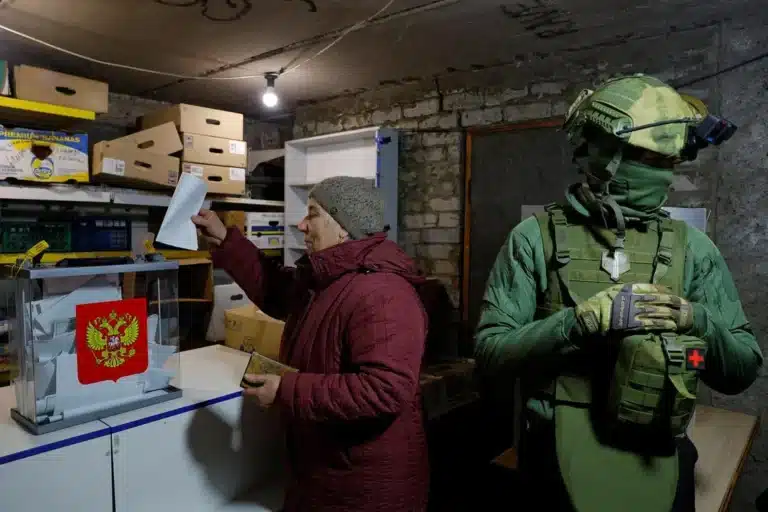
The orchestrated voting exercise in Ukraine’s occupied territories in September surpassed even previous violations. Mobile voting took place under the supervision of Russian military personnel, effectively at gunpoint. Imaginary voters were added to electoral rolls directly at polling stations, journalists’ access was restricted, and ‘early voting’ allowed more time to manipulate the process.
A new feature of 2026, ahead of the vote in the occupied territories of Ukraine, was that Russia established single-member electoral districts in Donetsk Region. These included both occupied and free territories of Ukraine, namely the so-called ‘Kramatorsk Urban District’, the ‘Sloviansk Municipal District’, and ‘Kostiantynivka Municipal District’. The vote should be understood primarily as an attempt to formalise the annexation it declared in its own Constitution after 2022 – that is to say, absorbing the Donetsk Region of Ukraine.
This reflects Russia’s maximalist demands. Genuine popular expression is impossible when electoral districts include unoccupied territories whose residents have no connection to the voting process. To establish new districts in occupied Ukraine while preserving the number of parliamentary seats, Russia redrew constituencies within its internationally recognised borders. This exemplifies Moscow’s broader policy since the invasion: disregarding its own citizens’ interests while annexing territories and imposing Russian citizenship on de facto hostage Ukrainians. In effect, this amounts to formalising a consensus established within Russia: the rights of citizens living in Russia’s internationally recognised territory are violated to accommodate the occupation of new territories.
Russia arranged for so-called DPR ‘Prime Minister’ Aleksandr Borodai, a close ally of Vladislav Surkov (the Kremlin’s curator of the occupation from 2014 to 2020), to be a winner of one of the votes held in the occupied territories. Another pre-selected winner was Channel One war correspondent Irina Kuksenkova. War-related loyalty is again rewarded with paths to professional advancement. Furthermore, the Russian authorities are attempting to ride the wave of criticism from the right – that is, to inject an even stronger pro-war stance into the ruling party’s narratives by bringing such figures on board. This clearly rules out a settlement in the near future.
The occupation of parts of eastern Ukraine and Crimea has lasted for more than 12 years. During this time, an entire generation has grown up knowing no other governing reality than the imposed one described above. When Ukraine regains these territories, these people will need appropriate conditions for holding elections and time to implement educational and informational programmes explaining how the electoral process should function and what constitutes a violation. All of this will require years of groundwork. Any discussion of holding elections immediately after de-occupation amounts to populism and speculation.
For Ukraine to heal, it will be impossible for the reintegration process to include Russian citizens who turned up in the occupied territories as a result of Russia’s policy of replacing the local population. Reintegration will be an enormous challenge as it is, but it remains distant, because after liberation they will require security. Discussions of international missions and their possible mandates do not yet provide assurance of sustainable peace in these territories. Monitoring and/or peacekeeping missions can only begin their activities when the necessary security conditions have been established. Otherwise, Ukraine risks being forced to repeat its experience of the first eight years of the war.
Authors
Maria Kucherenko
Executive Director & Co-Founder, Strategic Intelligence Institute