Categories
Trending Searches


The plateauing of Russia’s military strategy in Ukraine
Russia’s battlefield strategy in Ukraine has plateaued and, if nothing radically changes, Russia cannot expect any significant progress on the battlefield in 2026.

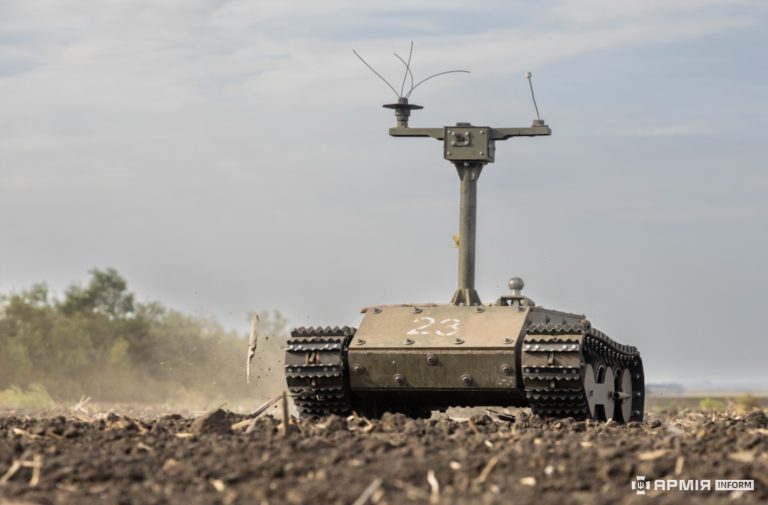
Robots take the risk: Ukraine’s UGV ecosystem and what Europe should learn from it
Ukraine has systematically removed humans from roles that don’t require human judgment, letting machines absorb the danger soldiers would otherwise face. What UGVs can and can’t do, and what lessons European institutions can draw from Ukraine’s experience.

The day after: Six post-war challenges for Ukraine
A ceasefire is nowhere in sight. Putin sees no interest in ending his war. Even so, the EU should start preparing for the many post-war challenges Ukraine will face.




Team members



No Results Found
Derisking and incentives: EU single market access to Ukraine
17 June 2026
20 min read
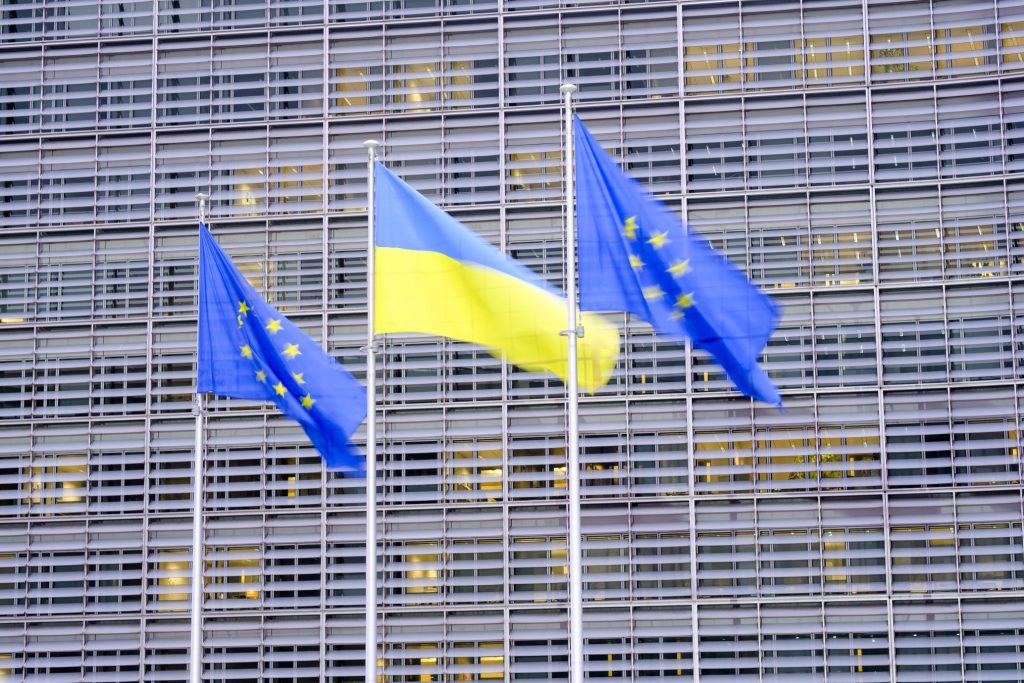
Credit: Getty Images
Text size:
Context
The Franco-German non-paper, A New Momentum for Enlargement (June 2026), focused on the Western Balkans and Moldova, and Chancellor Merz’s letter of 21 May 2026, focused on Ukraine, have reopened the question of how candidate countries can derive tangible benefits from integration ahead of full membership.
The core proposal in the Franco-German paper is “full participation in the Single Market based on a European Economic Area+ model”. It promises merit-based access to the Single Market for the Western Balkans and Moldova. “European Economic Area+” points to the full access to the Single Market recently negotiated with Andorra and San Marino, rather than membership of the existing EEA.
According to a non-paper by Austria, the Czech Republic, Italy, Slovakia and Slovenia, “merit-based access – if necessary, step by step – to the European single market represents such an incentive, speeding up economic integration and regulatory convergence, while safeguarding the long-term prospect of full EU membership.”
These proposals overlap. Austria, the Czech Republic, France, Germany, Italy, Slovakia and Slovenia should then all be able to agree and push for the European Council to include a reference like this in its conclusions:
“Merit-based access to the European single market on the European Economic Area+ model represents an important incentive for all accession candidates, speeding up economic integration and regulatory convergence, while safeguarding the long-term prospect of full EU membership.”
The single most valuable benefit the EU can extend to an advanced candidate before accession is genuine, level-playing-field access to the internal market and the four freedoms at the heart of European integration. This non-paper sets out how this principle could be operationalised for Ukraine in a way that accelerates the accession trajectory and brings closer the prospect of full membership.
The Merz paper suggests an “associate membership” formula for Ukraine. This formula has received a mixed response, mostly linked to the risk that interim formats could become a substitute for, rather than a step towards, membership.
1. This is a significant offer for Ukraine
Some have argued that offering Single Market access would be a modest prize for Ukraine, given that the EU-Ukraine Deep and Comprehensive Tree Trade Area (DCFTA) already provides reciprocal liberalisation and the EU accounts for roughly half of Ukraine’s total trade in goods. This, however, conflates two distinct aspects. Tariff elimination removes border duties; it deals mainly with goods (and much less with services); it does not confer the four freedoms of the internal market.
Enjoying a level playing field in the Single Market means fully automatic mutual recognition of conformity, equivalence of standards and supervision, and the removal of all non-tariff barriers – technical, sanitary and regulatory – that continue to constrain Ukrainian operators even with zero tariffs. It also includes services, the motor of so much growth in 21st century advanced economies.
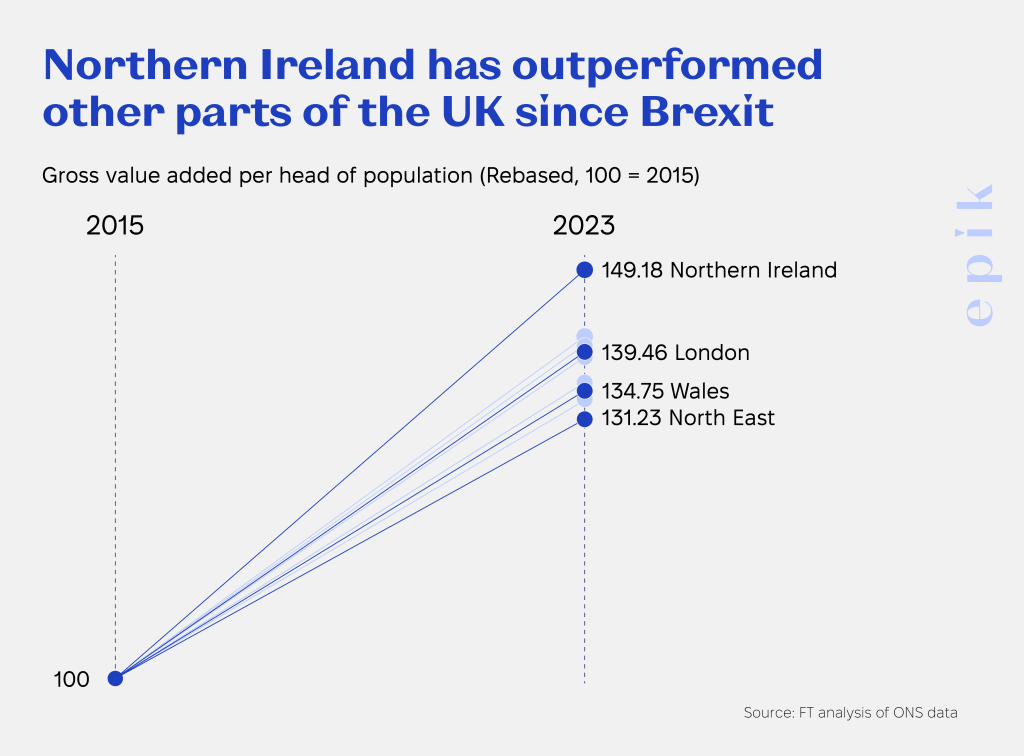
A recent article in the Financial Times noted that Northern Ireland (which has remained in the EU Single market for goods) has outperformed all other parts of the United Kingdom, even London, since 2015. The impact of enjoying all four freedoms would be even stronger.
The benefits of being fully in the Single market are not symbolic; it is the highest-yield instrument available short of full membership. It is so attractive that eight successful European democracies have negotiated their full access to the four freedoms and the Single Market in the past: Austria, Finland, Sweden, Norway, Iceland, Liechtenstein, Andorra and San Marino.
For an economy where the EU is the principal market and where reconstruction depends on embedding Ukrainian producers in EU supply chains, every element of genuine market integration translates directly into higher GDP, more investment and a faster industrial recovery.
Ministry of Economy of Ukraine, bulletin on EU–Ukraine trade relations: the EU accounted for 50.3% of Ukraine’s total goods trade in January–August 2025 (54.0% in the same period in 2024).
2. Concerns – and how to answer them
Another standard objection is this: if Ukraine reaches the requisite level of approximation, why settle for market access rather than membership itself?
The answer lies in sequencing risk. Even on an optimistic timetable, the conclusion of negotiations and – critically – the ratification of an Accession Treaty by all member states are unlikely to happen before 2028–2030. They are also exposed to political contingencies beyond Ukraine’s control. Such a period of political uncertainty is itself a strategic vulnerability.
Delivering level-playing-field access to the Single Market as soon as possible secures the economic dividend of integration immediately. In addition, demonstrating that Ukrainian participation in the internal market functions smoothly and is of mutual benefit will erode the political reservations that currently shape the membership question in some important EU member states. Early single Market access is not an alternative to membership but a de-risking mechanism for it.
3. Single Market access as a reform engine
A second rationale for this approach concerns incentives. The model proposed here can be made an even more effective motor for dramatic reforms (which Ukrainians undertake under historically unprecedented conditions of a full-scale military aggression) by tying access to performance and financing.
The next Multiannual Financial Framework (2028–2034) is expected to carry forward EU support to Ukraine. The Commission has proposed a dedicated Ukraine Facility II or “Ukraine Reserve” in the order of €100 billion, potentially complemented by resources derived from frozen Russian assets, the scale of and modalities for which remain under negotiation.
Like the current Facility, the disbursement of this support under a “Ukraine Reserve Plan II” will be conditional on the fulfilment of agreed indicators. The strategic opportunity is to synchronise and prioritise the new “Ukraine Reserve Plan II” performance indicators with the closing benchmarks of the accession clusters most relevant to the internal market: free movement of goods, services and capital, company law, competition, state aid, and consumer and health protection. This would signal that the EU treats enlargement as a serious, resourced commitment rather than a rhetorical one, and would channel both financial support and reform effort towards the precise approximation needed to unlock access.
The European Commission’s proposal for the 2028–2034 MFF foresees a dedicated Ukraine reserve of c. €100 billion; resources from frozen Russian assets are a separate, still-unresolved track (the €90 billion package for 2026–2027 was agreed via joint EU borrowing in December 2025).
4. The legal vehicle: annexes to the Association Agreement
There is a tested legal template for granting level-playing-field access to the internal market short of membership. The EU’s Association Agreement with Andorra and San Marino delivers participation in a “homogeneous extended internal market” through a structure of framework provisions plus 25 technical annexes to each Associated State Protocol, which transpose the relevant internal market acquis with tailored adaptations and transitional periods. Ukraine has a different prospective weight, but the approximation requirement and the relevant acquis are the same for all, and the legal architecture is portable.
Level-playing field inclusion in the Single Market for Ukraine could be structured as a set of new annexes to the existing EU–Ukraine Association Agreement, taking effect on signature and ratification by the European Parliament. This would keep the instrument anchored in the Association Agreement already in force, avoid reopening the agreement’s foundations and allow access to be switched on sector by sector as readiness is confirmed. As in the case of San Marino and Andorra, these annexes would be amended as the acquis changes, and the European Commission and the European Court of Justice would have a direct role to play in enforcing respect for Single Market rules – providing the perfect opportunity for Ukraine to demonstrate a track record of effective implementation of EU law.
Association Agreement between the EU and the Principality of Andorra and the Republic of San Marino – framework agreement, seven framework protocols, two Associated State Protocols and 25 technical annexes to each (COM(2024) 189/191); in ratification, EP interim report A10-0003/2026.
5. Self-paced dynamics, safeguards and the assessment trigger
The architecture should put setting the pace firmly in Ukraine’s hands. “Ukraine Reserve Plan II” indicators are front-loaded towards the internal market clusters and structured to be deliverable by 2030 –the remainder at the very latest by 2034. The EU has demonstrated that it is financially and technically ready to support accession: the pace is for Ukraine to choose. Crucially, the framework should reward over-performance, where Ukraine moves faster than the indicative schedule, particularly in the internal market clusters. The EU should commit to respond to this dynamic, assessing progress actively and disbursing the corresponding support ahead of schedule rather than according to a fixed calendar. The ball would then rest with Kyiv.
To address the principal objection to interim formats, access granted through the annexes should be conditional and reversible. In alignment with the merit-based and reversible logic of the Franco-German proposal, suspension would apply only in cases of serious regression on the relevant acquis or on rule-of-law fundamentals, under transparent and predefined criteria. This would protect the integrity of the internal market without converting a step towards membership into a permanent alternative to it.
The Commission already possesses an instrument to operationalise this. The annual Enlargement Package grades preparedness on a defined scale and chapters rated “good level of preparation” are, in essence, candidates for level-playing-field treatment. The Commission could therefore track approximation chapter by chapter and identify the precise moment at which Ukraine is ready to sign successive annexes to the Association Agreement and switch on access in that sector. Ukraine’s demonstrable dynamism could be reflected as early as the 2026 Enlargement Package Report.
Association Agreement between the EU and the Principality of Andorra and the Republic of San Marino – framework agreement, seven framework protocols, two Associated State Protocols and 25 technical annexes to each (COM(2024) 189/191); in ratification, EP interim report A10-0003/2026.
Summary and recommendations
- The European Council to include a commitment, based on both the Franco-German and the Austrian-Czech-Italian-Slovenian-Slovak non-papers, to “Merit-based access to the European single market on the European Economic Area+ model represents an important incentive for all accession candidates, speeding up economic integration and regulatory convergence, while safeguarding the long-term prospect of full EU membership.”
- This treats level-playing-field Single market integration as the principal pre-accession benefit for Ukraine, recognising its direct impact on investment, GDP growth and reconstruction.
- Frame this explicitly as a de-risking step towards membership; as something that is inherently hugely beneficial that has been embraced in the past by countries such as Finland, Sweden and Norway; and not as a substitute, but as addressing the political uncertainty gap before ratification.
- Synchronise “Ukraine Reserve Plan II” indicators (MFF 2028–2034) with the closing benchmarks of the internal market clusters.
- Use new annexes to the existing Association Agreement, modelled on the EU–Andorra/San Marino template, effective on signature and European Parliament consent.
- Let Ukraine set the pace; have the EU commit to respond dynamically to over-performance, using the annual assessment (“good level of preparation”) as the sector-by-sector trigger, with first effects visible in the 2026 Enlargement Package.
- To safeguard the internal market and prevent any interim format from displacing the membership goal, keep access merit-based and reversible using transparent criteria.
Authors

Gerald Knaus
Visiting Policy Fellow

Ivan Nagornyak
Policy Fellow

Thank you!
You will now receive EPIK’s latest analysis, publications, event invitations, and other updates directly in your inbox.
Thank you!
You will now receive EPIK’s latest analysis, publications, event invitations, and other updates directly in your inbox.
Go Home Page
Thank you!
The form has been successfully submitted. We value your time, so please expect a call or email from our manager shortly.
Go Home Page
Thank you!
You will now receive EPIK’s latest analysis, publications, event invitations, and other updates directly in your inbox.
Thank you!
You will now receive EPIK’s latest analysis, publications, event invitations, and other updates directly in your inbox.
Thank you for subscribing
You will now receive EPIK’s latest analysis, publications, and event updates directly in your email.
Go Home Page