Executive summary
- Ukraine’s economy has been highly “dronised.” Between 2022 and 2025, first-person- view drone production expanded roughly one thousandfold, far outpacing Russia on a per capita basis. Low-cost drones now perform functions once dominated by artillery, enabling deep strikes against logistics and supporting layered air defence, thereby reducing reliance on expensive missile systems.
- This expansion has been driven by a decentralised industrial ecosystem and strong state demand, sometimes described as “drone Keynesianism”, which has proved more adaptable than traditional platform-centric mobilisation models. However, Ukraine’s drone economy faces structural risks, such as volatile demand, reactive procurement, dependence on Chinese components, talent shortages and possible postwar overcapacity.
- For Europe, the main takeaway is about decentralised production, rapid procurement cycles and mindful technological independence along with diversified supply chains. Ukraine’s air-defence capabilities should be gradually included in Europe’s air-defence system, which would enable NATO and EU member states to gain from Ukraine’s practical experience. In a first step, the Baltic states could act as a route for EU-Ukraine cooperation through joint training, shared testing facilities and buying proven Ukrainian systems.
Introduction
In nominal terms, Ukraine’s economy is much smaller than Russia’s. In 2025, Ukraine’s gross domestic product (GDP) was about $209 billion, while Russia’s was $2.54 trillion. For four years, Ukraine has been engaged in intense combat against a much stronger opponent. It has maintained this fight thanks to western military support and a rapid internal shift to a wartime economy. Since 2024, new military technologies, especially unmanned systems, have become an essential part of Ukraine’s economic mobilisation and battlefield strength.
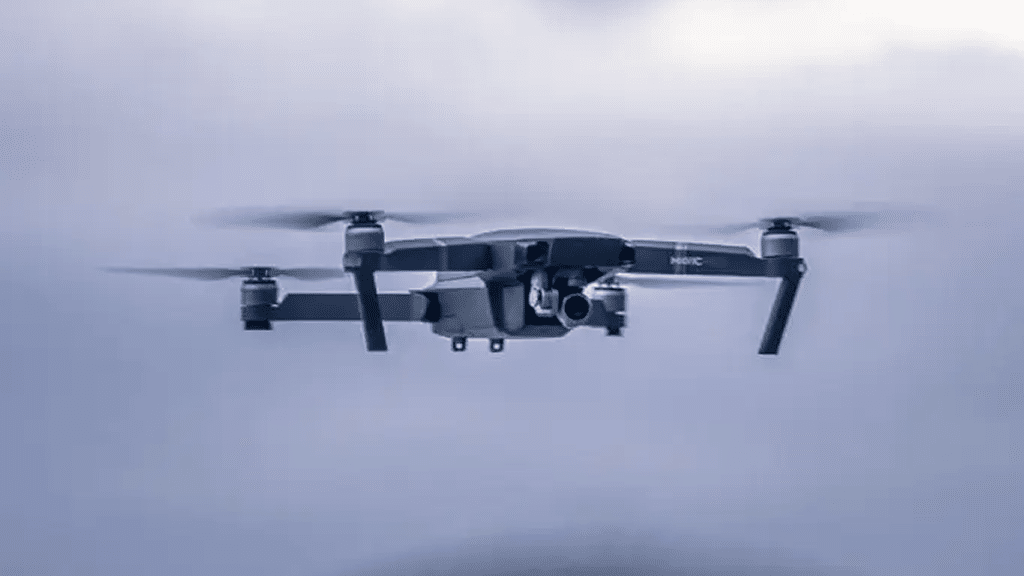
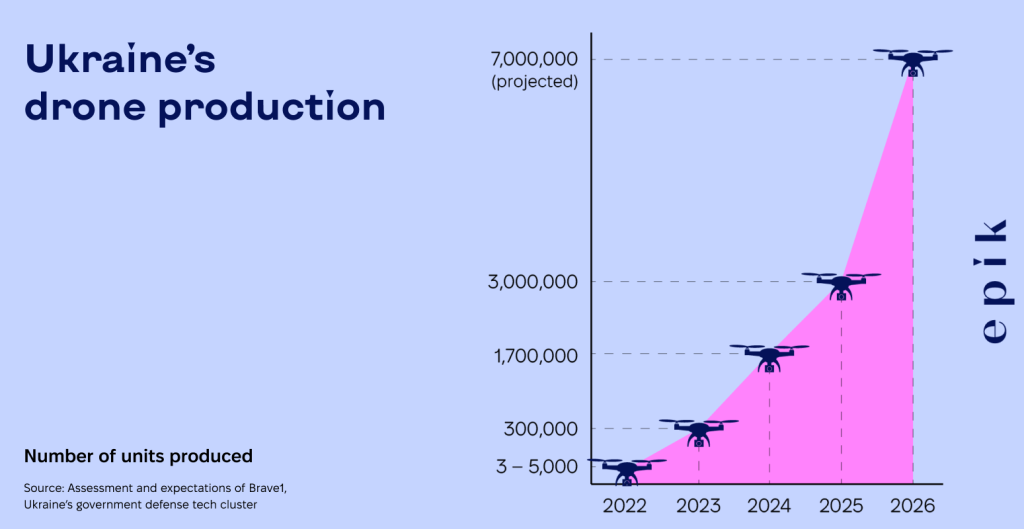
First-person-view (FPV) drones became ubiquitous on the battlefield in 2023. The use of drones was prompted by a serious shortages of artillery ammunition. What started as a temporary solution, however, quickly became an important combat tool. Ukraine’s FPV production increased from an estimated 3000–5000 units in 2022 to around 300,000 units in 2023. It reached about 1.7 million units in 2024 and expanded further to roughly 3 million drones in 2025. Much of this capacity comes from civilian engineering and manufacturing skills adjusted for military needs, which could be shifted back to peaceful applications after the war.
How economies adapt to war: A general overview of Ukraine vs Russia
Throughout the 20th century, during large-scale wars or prolonged arms races, great powers relied on highly centralised economic mobilisation. In World War II, the United States directed production through the top-down allocation of materials, quotas and price controls. The Soviet Union institutionalised even stricter control through five-year plans and state-dominated heavy industry. Both systems depended on massive state spending concentrated on large contractors and prioritised military output over civilian needs. Against this backdrop, this section focuses on how Ukraine and Russia have adapted their economies to high-intensity warfare.
Facing limited financial resources and the decline of the industrial capacity left over from the Soviet system, Kyiv could not depend solely on traditional forms of centralised mobilisation. Russia’s defence spending in 2025 reached roughly $160 billion, compared with Ukraine’s $44 billion, highlighting the structural resource imbalance that pushed Kyiv towards more decentralised and cost-efficient forms of military production. Ukraine has created a hybrid model of military-industrial mobilisation. This model blends state-funded procurement and subsidies with decentralised approaches, involving various private sector initiatives, both domestic and foreign, large volunteer networks and fast-moving informal feedback channels from the battlefield to commercial companies and NGOs.
This form of mobilisation emerged when the nature of the war changed to what is now known as a “war of drones and robotic systems”. Consequently, drone production has become a key component of the structure of Ukrainian industrial demand, labour allocation and procurement logic that serves not only as a military capability, but also as a new economic sector within the wider war economy.
The state still plays an important role in driving demand through defence procurement, subsidies and fast-track contracting. However, it does not completely dominate production. In areas like drones, electronic warfare systems and tactical software, hundreds of small and medium-sized companies compete more on speed, adaptability, resilience in electronic warfare and ease of use for operators than on size.
Ukraine managed to increase drone production not through a single national champion but through parallel production facilities that specialise in components, assembly, software and battlefield integration. This decentralised system somewhat resembles earlier forms of wartime Keynesianism, in which government spending increases demand and production, and this helps to increase output and create jobs during a crisis. At the same time, relatively free market competition and decentralised production structures maintain adaptability. Feedback loops connect frontline troops and unit commanders with engineers in the rear, civil society groups and international support networks. These mechanisms tend to drive innovation faster than traditional defence timelines.
Ukraine’s wartime economy is not universally decentralised. Legacy sectors, such as construction, fuel supply and certain traditional defence procurement areas, still exhibit monopolistic tendencies and rent-seeking behaviour, as recent anti-corruption investigations have revealed. The drone sector stands out not because it is free of corruption risks, but because its structure makes inefficiency expensive and strongly rewards rapid adaptation and substantive results. As a result, some parts of Ukraine’s wartime economy are highly dynamic and responsive, while others remain slower and resistant to change. Key corruption risks in drone procurement involve unclear policies that lead to manipulation, overlapping state roles that allow abuse, favouritism, flawed pricing that allows overpricing and kickbacks, and lax write-off rules that permit embezzlement.
Since its full-scale invasion of Ukraine, Russia too has reshaped its entire economic system around sustained military production. More often than not, however, this change still encompasses strict top-down planning, guaranteed state contracts and significant fiscal expansion. The military-industrial complex remains largely controlled by large state-owned or state-aligned companies like Rostec, Almaz-Antey, the United Shipbuilding Corporation and the Kalashnikov Combine. These companies receive long-term, non-competitive contracts, favourable financing from state banks and regulatory protections. The strength of this centralised system lies in its ability to endure and scale. Russia has demonstrated its capacity to mass produce a limited range of systems for extended periods, even under western sanctions.
Russia’s defence-industrial complex is also structurally large. Russia’s defence sector employs more than 4.5 million people. It is deeply embedded in the national economy. Taking into account family members, roughly 10% of Russia’s population is economically connected to the defence sector. Ukraine’s defence ecosystem is far smaller, around 300,000 workers, and operates with greater flexibility and faster innovation cycles. This difference in scale highlights the opposing logics of the two models. Russia’s large, socially integrated structure provides endurance through sheer size, while Ukraine’s leaner ecosystem prioritises adaptability and rapid change.
Russia’s centralisation also strengthens political control. Access to defence contracts and subsidised loans connect oligarchs, defence-industry leaders and regional elites closely to the Kremlin. Loyalty brings rewards, while disloyalty can lead to income losses, asset seizures or even prosecution. Sanctions have significantly impacted Russia’s war economy. The evasion of sanctions through state-supported intermediaries and other channels has become a crucial part of Russia’s war economy. This further centralises control and strengthens opaque, rent-based distribution systems.
Western sanctions have pushed Russia towards autarkic adaptation and authoritarian replacement. Trade and technology transfer have shifted to a small group of non-western partners, especially China and Iran. These relationships provide essential inputs such as electronics, machine tools, unmanned aerial vehicle (UAV) designs and ammunition components. Another key supplier, North Korea, mainly provides ready-made, low-cost military products, notably artillery shells, missiles and artillery systems. However, these lead to unequal dependence and limited innovation. Russia has been forced to smuggle or repurpose restricted technologies; for instance, secretly obtaining Starlink satellite connectivity terminals through grey-market channels or intermediaries from other countries.
In contrast, Ukraine’s hybrid model is shaped by concurrent integration with a range of western partners, the introduction of NATO interoperability standards, use of EU funding, direct technology transfers and access to global commercial supply chains. Western tools such as Starlink, commercial AI frameworks from US companies and open-source software have enabled rapid adjustments and improvements at the tactical level. This environment has sparked competition among a range of small and medium-sized companies, volunteer groups and emerging defence tech start-ups.
Even though there have been efforts to substitute western parts, Moscow still often relies on foreign-made high-tech components for weapon production. To maintain its defence industry output under the sanctions regime, it has turned to parallel import channels and third-country intermediaries. Western export controls target semiconductors, drone engines and other sensitive technologies, and try to limit Russia’s access to advanced dual-use goods, but there are still gaps in sanctions enforcement. Ukraine, on the other hand, enjoys links to European and US supply chains and dual-use commercial markets. However, this access is limited and restricted by regulatory requirements. This provides a steady supply of advanced sensors, encrypted communications, AI tools and navigation modules that work even under GNSS denial. Oddly, both Russia and Ukraine obtain many basic drone components, such as motors, batteries and chips, from the same Chinese suppliers. Nearly 89% of Ukrainian Unmanned Aerial Systems producers identify China as their primary source of imported parts. Ukraine reports that around 80% of the critical electronics used in Russian drones originate from China, which also supplies machine tools, gunpowder and other materials to at least 20 major Russian military factories. Reliance on imported parts presents challenges for both countries, but access differs. Russian firms often secure larger quantities of production equipment directly or through evasion networks, while Ukrainian companies depend on commercial off-the-shelf imports obtained through intermediaries. Russia’s centralised governance structure allows concentrated resource allocation and long-term contract stability within its defence-industrial base. In contrast, Ukraine’s decentralisation gives power to volunteers, grassroots innovators and frontline workers to test and improve rapidly.
The battlefield performance of Ukraine’s armed forces suggests that the decentralised mobilisation model has generated faster tactical adaptation, even though Russia retains advantages in scaling and sustaining selected production lines. In simple terms, Ukraine tends to outpace Russia in the speed of innovation and adapting to the battlefield. Russia is usually slower at developing new solutions but more effective at putting selected innovations into practice and scaling them for mass production.
From industrial scale to battlefield effect
Since 2022, Ukraine has evolved from an importer and battlefield user of drones into one of the world’s largest and most active producers and operators of unmanned systems. In 2025, Ukraine’s armed forces were supplied with approximately 3 million FPV drones, nearly 2.5 times more than in the previous year. By comparison, the entire British armed forces ordered around 3,500 FPV drones for testing and evaluation in the same year. This contrast illustrates that in Ukraine, drones are not an experimental capability but a core industrial and operational category.
At the tactical level, drones have fundamentally reshaped frontline combat. They are relatively inexpensive and generate battlefield effects that would have previously required significantly higher financial and logistical inputs. FPV systems priced at $300–400 per unit have become an alternative to artillery shells costing $800–9000 per unit. This allows the armed forces in Ukraine to compensate for the shortage of traditional weapons and inflict disproportionately high losses on the enemy. In high-intensity sectors, drones are estimated to account for the majority of confirmed Russian personnel and equipment losses. Some Ukrainian assessments attribute 70–80% of casualties to drone-enabled strikes. Engagement cycles have shortened from hours to minutes, and reliance on massed fire has decreased. Continuous aerial reconnaissance enables near-real-time detection and targeting.
The same cost logic applies to air defence. Interceptor drones provide a low-cost supplement to surface-to-air missiles, the unit costs of which can reach hundreds of thousands or even millions of dollars. By 2025, Ukraine had built the capacity to produce up to 1000 interceptor drones per day. These are effective against low-flying, slow-moving targets that evade or saturate conventional air defence systems. Affordable counter-UAV systems, most built by volunteer-run start-ups and small manufacturers, add to this layer of defence.
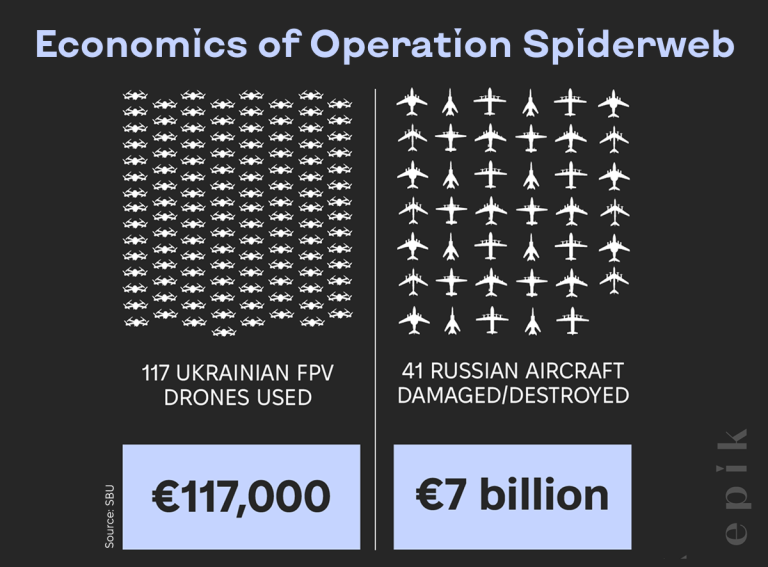
Drone warfare has also redefined strategic depth. Operations such as the June 2025 “Spiderweb” strike illustrate this asymmetry, when 117 FPV drones costing up to $1000 each ($117,000 total) reportedly damaged or destroyed more than 40 Russian aircraft, causing multi-billion-dollar losses. This demonstrates how modest quantities of low-cost systems can impose disproportionate costs on high-value military assets.
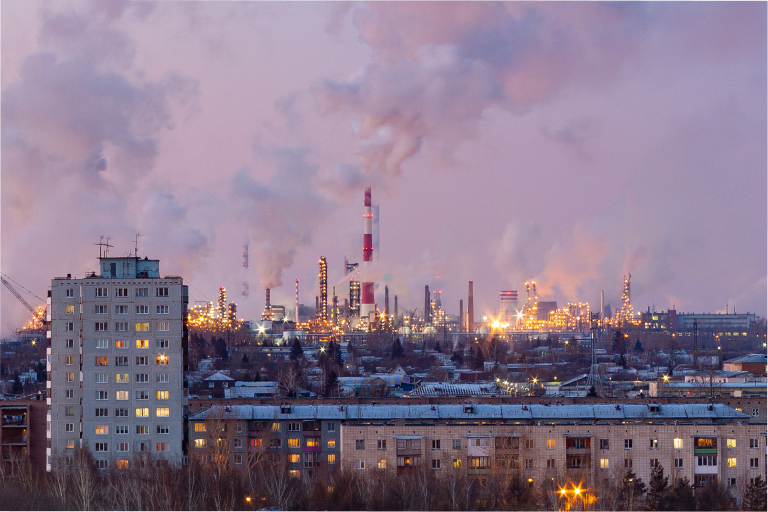
Beyond airbases, long-range drone strikes have targeted oil extraction, refining and fuel infrastructure hundreds of kilometres from the frontline, periodically forcing shutdowns. These actions do not merely destroy assets; they impose systemic economic pressure and compel resource reallocation. In several cases, drones have forced Russia to move air-defence systems, disperse concentrated aircraft, strengthen infrastructure and redirect resources from the front to the rear.
Crucially, home-produced unmanned systems allow Ukraine to strike deep targets while reducing geopolitical risks. In contrast to western-supplied missiles such as ATACMS or Storm Shadow, which cost over $1 million per unit and may be subject to political restrictions, Ukrainian drones cost between $500 and $20,000. This enables repeated deep strikes at a fraction of the price and creates powerful cost asymmetry. Relatively cheap systems can damage aircraft, refineries or logistics hubs worth tens or hundreds of millions of dollars. Western missiles remain necessary for heavily fortified targets, but sovereign drone capabilities have become a more scalable and politically flexible instrument for sustained economic and logistical disruption.
However, battlefield adaptation is not one-sided. Russian forces now increasingly use drones as instruments of operational disruption, targeting logistics, isolating sectors and contesting rear areas. This reflects a broader transformation. Drone warfare rewards those who disable systems rather than merely destroy frontline units. Initiatives such as Russia’s Rubikon programme (a highly specialised, elite military drone unit) use medium-range drones for electronic warfare and battlefield isolation in an adaptation of classic interdiction concepts to a drone-saturated environment.
For Ukraine, the main lesson is that large-scale industry needs to lead to battlefield advantage. While drones have produced tactical successes, maintaining a strategic advantage requires skilled personnel and integration across different zones. The value of Ukraine’s drone economy comes not just from how much it produces, but also from its ability to respond faster than Russia in the ongoing electronic warfare contest.
Electronic warfare is shaping drone effectiveness on both sides. Russian systems frequently jam or spoof satellite navigation and radio links, forcing Ukrainian operators and engineers to constantly adapt by adjusting communication frequencies, navigation methods and control software. Russia’s growing deployment of wideband jammers and drone-hunting units is degrading Ukrainian FPV effectiveness in some areas. This dynamic has transformed the drone sector into a rapid innovation cycle, forcing constant reinvention and increasing the burden on engineers and operators.
This adaptability comes from the civilian origins of Ukraine’s drone ecosystem. Much of the sector draws on civilian engineering, such as open-source software, 3D printing communities, university laboratories and even electronic musical instruments and other commercial electronics rather than a traditional defence-industrial base. This civilian foundation allows producers to redirect capabilities to military needs while preserving the sector’s dual-use character.
The structural constraints and risks of Ukraine’s drone economy
Even under extreme pressure, Ukraine’s drone ecosystem has demonstrated impressive levels of innovation and production, leading to successes on the battlefield. However, its effectiveness lies on thus far fragile economic and institutional foundations. The weaknesses of Ukraine’s drone economy are most apparent where production outcomes meet frontline needs. Drones reach units through various channels: state procurement, brigade budgets, direct partnerships with manufacturers and volunteer support. This mixed approach has increased flexibility since 2022, but also resulted in uneven distribution in terms of quality and quantity, and increased coordination problems among military units.
Despite the decentralisation mentioned above, the main focus is on more or less centrally supported production and delivery chains. Only the state can buy drones in large enough quantities to keep production going over time. Brigade and volunteer purchases help fill gaps and match weaponry with battlefield needs, but these methods are somewhat irregular and cannot support long-term investment. As a result, manufacturers sometimes boost capacity during high-demand periods without knowing exactly how many of their products will be bought, or even if they will sell at all.
Short term, reactive procurement is mainly responsible for this pathology. Without predictable and ideally multi-year prospects for demand volumes, companies struggle to plan production, retain skilled workers and invest in innovation. Price competition in decentralised procurement often forces manufacturers to cut costs which, among other things, means that frontline units take on the burden of testing, modifying and repairing the UAVs. They sometimes need to rework a large proportion of the delivered drones before they can be used. Companies experience constant financial stress and frequently face idle production lines.
While western financial support for Ukrainian drone production has been crucial, much of it is conditioned by procurement algorithms focused on fulfilling compliance and accountability standards rather than on securing delivery speed and industrial stability. Aid usually arrives in large, irregular amounts, aimed at satisfying immediate battlefield needs instead of building steady domestic production capacity.
The well-known Danish model of military support – direct purchases by Ukraine’s partner states of drones made by Ukrainian companies, and their rapid delivery to frontline units – has been an important step forward. This method shortens bureaucratic decision chains, speeds up deployment, supports domestic production and, if repeatedly applied, matches battlefield needs with industrial planning. However, these arrangements are still rare and not systemic. Worse, their effect is limited by certification requirements, a separation between aid policies and industrial strategies, and donor preferences.
Despite its impressive production scale and battlefield effectiveness, Ukraine’s drone ecosystem relies on a rather weak economic and institutional base. The same factors that allow for quick growth during wartime, such as decentralised production, reactive purchasing, dependence on global supply chains and emergency-driven expansion, also create deep vulnerabilities.
The key vulnerability in Ukraine’s drone ecosystem is its dependence on supply chains. Ukraine’s ability to manufacture drones in large numbers still relies on access to Chinese commodity components, which means that technological leverage remains external. Although the industry has diversified its ways to supply the front since 2022, numerous key components (motors, batteries, electronic speed controllers, frames and basic sensors) are still mostly produced in China. Beijing has tightened control over drone technology, rare earth materials and processing equipment since 2023, which has already led to shortages and price swings. Russia uses the same global supply chains, increasing prices and competition for components.
A particularly paradoxical constraint is that current Ukrainian production capacity far exceeds what the state can reliably purchase from the producers and can deliver to and use at the front. Nonetheless, units may wait for weeks or months for the delivery of ordered armaments. The state often buys in bulk, initially for storage. By the time even cutting-edge drones reach the end-user, they can already be outdated and must be sent back from the frontline for rework.
A related bottleneck involves the supply of explosives and warheads for drones. While Ukraine has quickly increased the production of drone platforms, the manufacturing of explosive payloads, such as shaped charges, fragmentation munitions and adapted artillery ammunition, has not kept pace. Much of the explosive material and many key components came from Soviet-era stockpiles or imported precursors, which are limited and hard to replace during wartime. As a result, the growth of drone production has not always been matched by a similar increase in munitions manufacturing. The Ukrainian authorities and private sector manufacturers have started to boost dedicated production lines for drone warheads, but the sector still struggles with shortages. This gap highlights a wider structural issue: increasing drone output requires a parallel expansion of the entire supply chain, including explosives and safety-certified production infrastructure.
Quality inconsistencies can make the situation worse. Brigades sometimes receive drones of different standards, with cheaper cameras, transmitters or other components that have not been tested in real electronic warfare conditions. This prompts many ad hoc field modifications. In some brigades, up to 50% of incoming drones need to be reworked before they can be deployed.
Export restrictions have been a major political and economic barrier for Ukraine’s drone industry under martial law. These focus on supplying the front line and preventing technology leaks. While this makes sense strategically, it limits the ability of manufacturers to create stable revenue, attract investment and plan for long-term growth. In 2025, Kyiv started to ease these restrictions and President Zelenskyy announced a plan for “controlled exports”, which includes setting up ten export offices in the EU, with Germany set to be among the first. Production of Ukrainian drones in Germany was expected to begin in mid-February 2026. Ukraine has liberalised and accelerated the issuance of export permits. However, export activity is still held back by administrative challenges and slow processes. International certification, testing and procurement can take up to 12 months. As a result, while export facilitation improves the prospects for industrial sustainability, it cannot fully resolve the conflict between immediate wartime needs and long-term market growth.
In addition, Ukraine’s drone ecosystem needs a better-skilled workforce. Since 2022, more than 120,000 IT and engineering professionals have moved abroad. Some continue to work remotely for Ukrainian companies, but the overall loss of talent within the country has been significant. In late 2025, private sector drone manufacturers reported a critical lack of young professionals able to design and implement advanced solutions. For example, one large defence company in Kyiv has over 700 unfilled technical vacancies, and the labour market cannot meet the demand for essential skills. Manufacturers increasingly depend on students from technical universities to fill these gaps. Obviously, this approach cannot completely remedy the talent drain and capacity problem.
Future labour distortions under conditions of a stable ceasefire or peace represent a further risk. As discussed above, Ukraine’s defence-industrial base already employs hundreds of thousands of workers, including more than 60,000 people directly involved in drone production. In a post-war scenario, these specialists might enter civilian job markets that lack the capacity to absorb them at similar skill or wage levels. A clear economic transition plan will be crucial to avoid mass unemployment and a loss of expertise. The EU and Ukraine should work together to create a reintegration plan for these specialists.
A ceasefire or peace scenario would eventually entail a risk of military-industrial overcapacity. In 2025, production was set to reach 3 million FPV drones, and the target for 2026 is 7 million. If there is a rapid move to peace, demand could fall sharply. This would leave factories idle and waste billions that has been invested in the sector during wartime. These “post-conflict surplus” issues are similar to events after the Cold War. To mitigate these risks, Ukraine has commenced integration with the European market, launching joint EU-Ukraine drone production projects. These early actions suggest a way to use excess capacity by co-producing and exporting tested systems to NATO members and partners.
Why Ukraine’s drone war matters for Europe
Ukraine’s wartime experience is obviously not fully transferable. Future possible military conflicts in Europe or elsewhere would only partly mirror Ukraine’s current conditions, if at all. Nonetheless, Ukraine’s drone-driven war economy provides several valuable lessons for European defence policies concerning the institutional structures, procurement practices and organisation of military-industrial capacity.
Lesson 1. Decentralised industrial ecosystems are more resilient than platform-centric mobilisation
Unlike traditional models of wartime mobilisation, Ukraine is not dependent on a few large, state-backed defence companies. Instead, it has built a decentralised production ecosystem made up of private sector firms, volunteer engineering groups, university laboratories and frontline workshops.
In contrast, European defence procurement is still focused on a limited number of prime national and transnational contractors, such as Airbus, Rheinmetall, Thales, Leonardo and BAE Systems. These operate on long-term contracts, fixed technical specifications and multi-year development cycles in an approach that emphasises efficiency, predictability and compliance during peacetime.
However, the current structure of the military-industrial complex in Europe is likely to lead to grave institutional weaknesses and material vulnerabilities during wartime. Delays or disruptions affecting one prime contractor could impact the entire system. In Ukraine, dozens of small and medium-sized producers create core drone components, allowing for rapid substitution when traditional suppliers fail to deliver or certain technologies become obsolete.
Lesson 2. Speed of adaptation matters more than technical perfection
Ukrainian drone systems are rapidly deployed, tested in combat, modified based on feedback from the front line and then redeployed within weeks. Initial and even continued failure is seen as a normal part of the improvement and learning process. A decentralised industrial structure can foster different procurement cultures. In the EU, defence procurement involves long certification and qualification procedures intended to reduce technical and political risk. Major projects funded by the European Defence Fund often require five to ten years before operational deployment, even for already fairly mature technologies.
While these procedures work for large and long-lasting platforms, they do not fit smaller and rapidly changing systems such as drones. According to EDF guidance, once a project is selected, it can take 12 months or more from the application to funding agreement, before technical development even starts. When combined with multi-year development phases, this leads to very slow EU defence project initiation and implementation compared to battlefield-driven procurement models.
Moreover, Ukrainian engineers and programmers, whether from within or outside the military-industrial complex, work directly with combat units, get real-time feedback and sustain this loop, allowing for adjustments. In the EU, such direct and constant interaction between civilian developers and frontline users is uncommon and limited by various legal and security obstacles.
Lesson 3. Strategic autonomy requires selective sovereignty, not full localisation
Despite an increase in European production capacity, many key parts, such as motors, batteries, electronic speed controllers, basic frames and low-end chips, are still sourced from China. Geopolitical tensions or sudden policy changes in Beijing could create serious supply problems. At the same time, Russia is reliant on the same global supply chains, which increases competition for parts. Any attempt to suddenly and fully localise the entire drone value chain, in the case of new military escalation in Europe, Asia or elsewhere, would significantly increase unit costs and slow production. As a result, Europe might obtain fewer systems at a time when quantity is crucial.
Lesson 4. European drone defence system without Ukraine will remain reactive
For the Baltic and other eastern flank states, drone defence is not a future capability but a short-term requirement. The EU’s eastern flank defence initiatives can add capacity, but they will only become adaptive if Ukrainian operational know-how is built into them from the start.
Russian drone incursions into EU and NATO airspace show that Europe is already facing a steady, low-cost aerial threat and does not have sufficient low-cost countermeasures. Ukraine is currently the only European actor that is systematically detecting, intercepting and destroying Russian drones at scale. Ukraine’s drones target launch sites, logistics hubs and production facilities in Russia – actions that EU and NATO member states cannot carry out directly without risking escalation. For these and other reasons, investment in Ukraine’s drone and counter-drone capabilities functions as forward defence, reducing the number and intensity of threats to the EU before the drones reach its airspace.
In addition, Ukraine has served as Europe’s main learning hub in drone warfare. Ukrainian forces have faced all major versions of Russian aerial tactics – from decoy waves to saturation strikes, altitude changes, GPS-denied navigation, electronic warfare and mixed drone-missile attacks – under combat conditions that no NATO member has experienced.
Conclusion
Ukraine’s drone economy shows that small and medium-sized states do not need to build a complete defence industry to improve deterrence. Modern drone and counter-drone systems are complex and require coordination with air defence, electronic warfare and command structures. However, smaller EU member states can strategically focus on specific parts of this system. By prioritising certain niches, such as interceptor drones or electronic warfare components, and aligning public procurement to support these, Baltic and eastern flank countries can develop effective local capabilities. Targeted specialisation, along with integration into broader EU and NATO systems, provides a realistic way to achieve stronger and faster deterrence.
Europe faces a post-war challenge of a potential “drone dividend” versus a “drone overhang”. If the war ends, Ukraine will still have the largest operational drone design and manufacturing ecosystem outside the United States and China. The EU should integrate this capability through co-production and joint certification. Early steps towards coordination are already visible. Ukraine has opened dedicated drone export and cooperation offices, signalling an intent to channel surplus capacity and expertise into European markets. To turn this into a lasting benefit, the EU should formalise such efforts through an EU-Ukraine Drone Transition Compact. This would connect reconstruction funding to controlled export plans and pathways for specialists to reintegrate.
Ukraine’s war also highlights talent velocity as the new deterrence benchmark. What is really important is how fast a society can turn civilian engineers and coders into defence specialists. The time it takes to go from idea to prototype to deployment, the speed of iterations and the proportion of civilian talent entering defence sectors may become more important than having large stockpiles. Europe should invest in rapid training and dual-use career pathways to develop its own regenerative capacity.
The normalisation of cheap, long-range drones carries a threat of horizontal escalation without crossing traditional “red lines”. In Europe, similar capabilities in the hands of proxies or non-state actors could target important infrastructure. This requires an EU-level doctrine on drone attribution, aimed at preventing and deterring drone-enabled terrorism.
The Ukrainian case also has a gender aspect. Women, who are less affected by mobilisation pressures, are taking on more roles in assembly, firmware development and drone operations. Europe could expand drone-tech training programmes to increase female participation, thereby turning social inclusion into a strategic benefit.
Finally, Ukraine’s drone economy does not have to lead to permanent militarisation. Targeted state demand, funnelled into a decentralised base of small and medium-sized enterprises, can create jobs, speed up dual-use innovation and develop exportable skills without trapping the economy in continuous defence spending. “Dronisation” refers to the resilience of a society, not its militarisation. It is the ability to rapidly shift civilian engineering skills into effective defence results and then return them to civilian use after the war. Europe can take this approach proactively. It should use focused industrial demand during peacetime without waiting for a crisis to prompt expensive militarisation.
Recommendations
- Ukraine’s air-defence capabilities should be integrated into Europe’s air-defence architecture. Ukrainian forces already operate one of the most active air-defence systems on the continent, regularly countering large-scale missile and drone attacks and confronting the full spectrum of Russian aerial tactics. Sharing operational data and counter-drone experience would significantly strengthen early warning and defensive coordination across NATO’s eastern flank. As a practical starting point, the Baltic states could serve as the first corridor for EU-Ukraine air-defence cooperation through joint training detachments, shared testing facilities and procurement of combat-proven Ukrainian systems.
- To support this integration, European governments should take a three-track approach. First, EU member states should increase direct purchases of Ukrainian systems using mechanisms like the Danish model. They should prioritise equipment that has already proved effective in combat. Fast-track qualification procedures within EU procurement frameworks would help these systems enter European service much faster than through regular acquisition cycles.
- Second, the EU should increase co-production with Ukrainian firms on European soil. This approach would combine Ukraine’s combat-tested designs with European industrial capacity and financing. Such partnerships would speed up production while strengthening Europe’s own industrial base and ensuring secure supply chains.
- Third, the EU should adjust its procurement model to fit the Ukrainian innovation ecosystem. This would involve distinguishing long-life platforms from rapidly changing technologies such as drones, electronic warfare tools and software-defined capabilities. The European Commission should create a dedicated fast-iteration procurement track within the European Defence Fund and related instruments. This track would feature shorter contracting timelines and simpler qualification procedures.
- EU defence funding should focus on resilient innovation ecosystems instead of a small group of platform-centric main contractors. Encouraging competition at the component level and opening entry points for small and medium-sized enterprises, university laboratories and dual-use start-ups would allow Europe to tap into the same decentralised innovation dynamics that have driven Ukraine’s rapid adaptation during wartime.
- Finally, Europe should aim for selective technological sovereignty. Control should centre on crucial technologies that affect combat effectiveness. More widely available components can still be sourced through diverse global supply chains. Friend-shoring with partners such as Japan, South Korea, Taiwan, Turkey and Ukraine itself offers a sensible balance between security, resilience and cost efficiency.